Red Hat Advanced Cluster Management 5 makes the multicluster observability add-on (MCOA) delivery model and Perses dashboards generally available for namespace and OpenShift Virtualization right-sizing recommendations. The release replaces the earlier policy-based delivery path with MCOA distributing PrometheusRule resources via ManifestWork and Perses providing the primary integrated right-sizing experience in the console. It also adds configurable percentile profiles for more precise CPU and memory recommendations. Upgrades from version 2.16 or 2.17 require no migration action, and the platform automatically removes legacy resources. The new architecture aligns right-sizing with the rest of the observability stack, which already used MCOA for metrics, logging, and tracing.
Context
For platform engineering and FinOps teams, right-sizing a fleet is a balancing act. Requests that remain well above actual use lock capacity away from other workloads and increase infrastructure cost. Requests that remain below demand can cause throttling, degraded performance, and unstable applications. The challenge grows when the same analysis must cover many clusters, namespaces, and virtual machines.
Approach / What changed
Red Hat Advanced Cluster Management 5 makes the multicluster observability add-on (MCOA) delivery model and Perses dashboards generally available for namespace and OpenShift Virtualization right-sizing recommendations. The release replaces the earlier policy-based delivery path with MCOA distributing PrometheusRule resources via ManifestWork and Perses providing the primary integrated right-sizing experience in the console. It also adds configurable percentile profiles for more precise CPU and memory recommendations. Upgrades from version 2.16 or 2.17 require no migration action, and the platform automatically removes legacy resources. The new architecture aligns right-sizing with the rest of the observability stack, which already used MCOA for metrics, logging, and tracing.
Takeaways
1
Right-sizing recommendations in Red Hat Advanced Cluster Management 5 are delivered via MCOA and ManifestWork, replacing the earlier policy-based delivery model.
2
Perses dashboards provide the primary integrated right-sizing experience in the console, replacing Grafana as the default visualization.
3
Configurable percentile profiles give administrators independent control over how CPU and memory recommendations account for workload peaks.
FAQ
Do I need to manually migrate right-sizing configuration when upgrading?
No. Upgrades from Red Hat Advanced Cluster Management 2.16 or 2.17 require no migration action. Existing rs-namespace-config and rs-virt-config customizations are preserved, and the platform removes legacy Policy, Placement, and PlacementBinding resources automatically.
How long after enabling right-sizing do recommendations appear?
It can take approximately 30 minutes for recommendations to appear after right-sizing is enabled because metrics must be collected and aggregated through Thanos. Historical right-sizing data is not backfilled, so longer aggregation periods become useful only after enough new data has accumulated.
What are the limitations of namespace and label filters?
The namespaceFilterCriteria accepts inclusion or exclusion criteria, but not both at the same time. The labelFilterCriteria acts only on an entry whose labelName is label_env, and the Red Hat Advanced Cluster Management 5 rule builder ignores other label names.
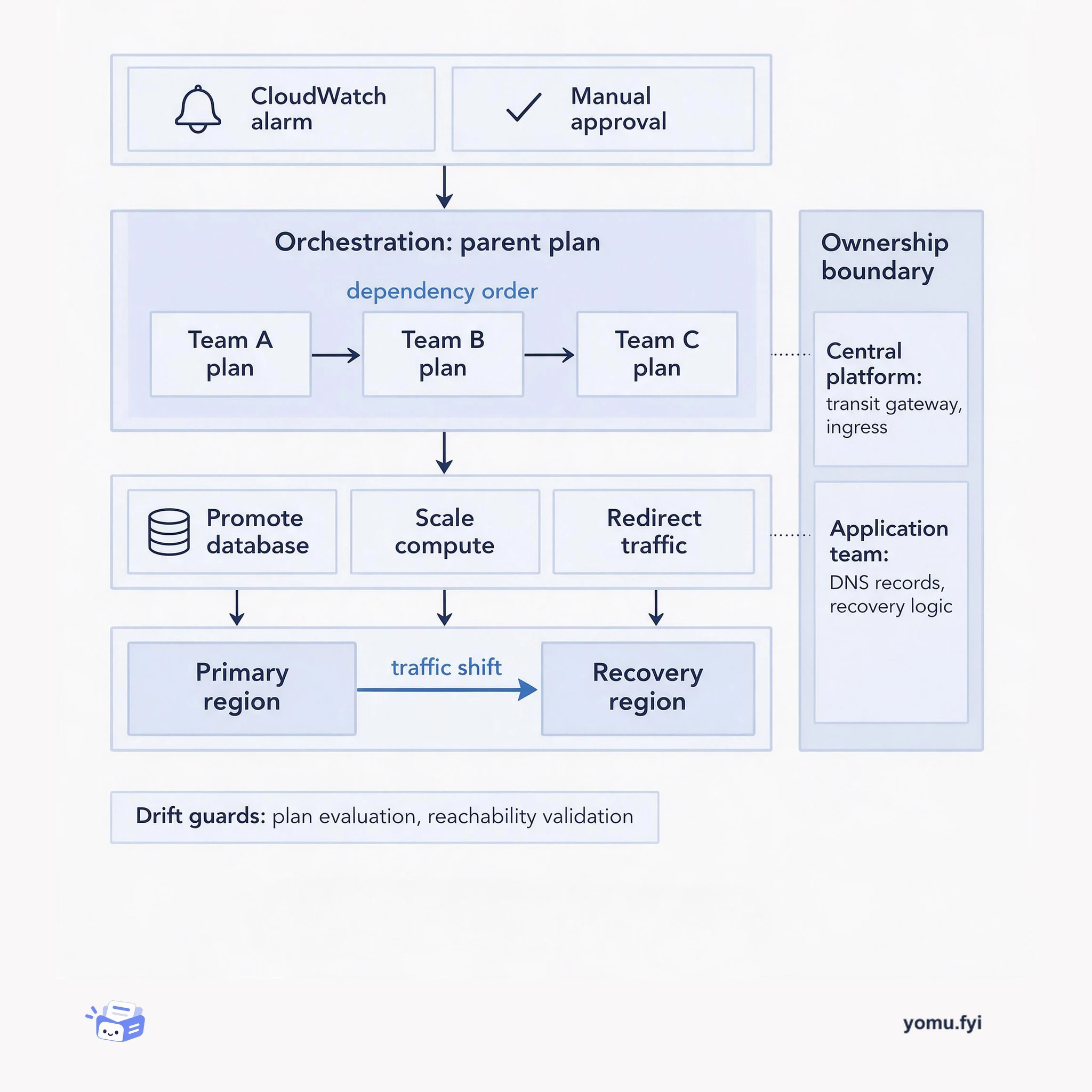
ARC Region Switch is a managed failover orchestrator that runs team-owned plans in dependency order. This diagram maps its trigger, orchestration, execution, and region layers and the ownership boundary.
Keep reading
Related reading
The Good Stuff
Paid picks we use ourselves. Links carry a referral code — a subscription through one earns us a commission at no extra cost to you.