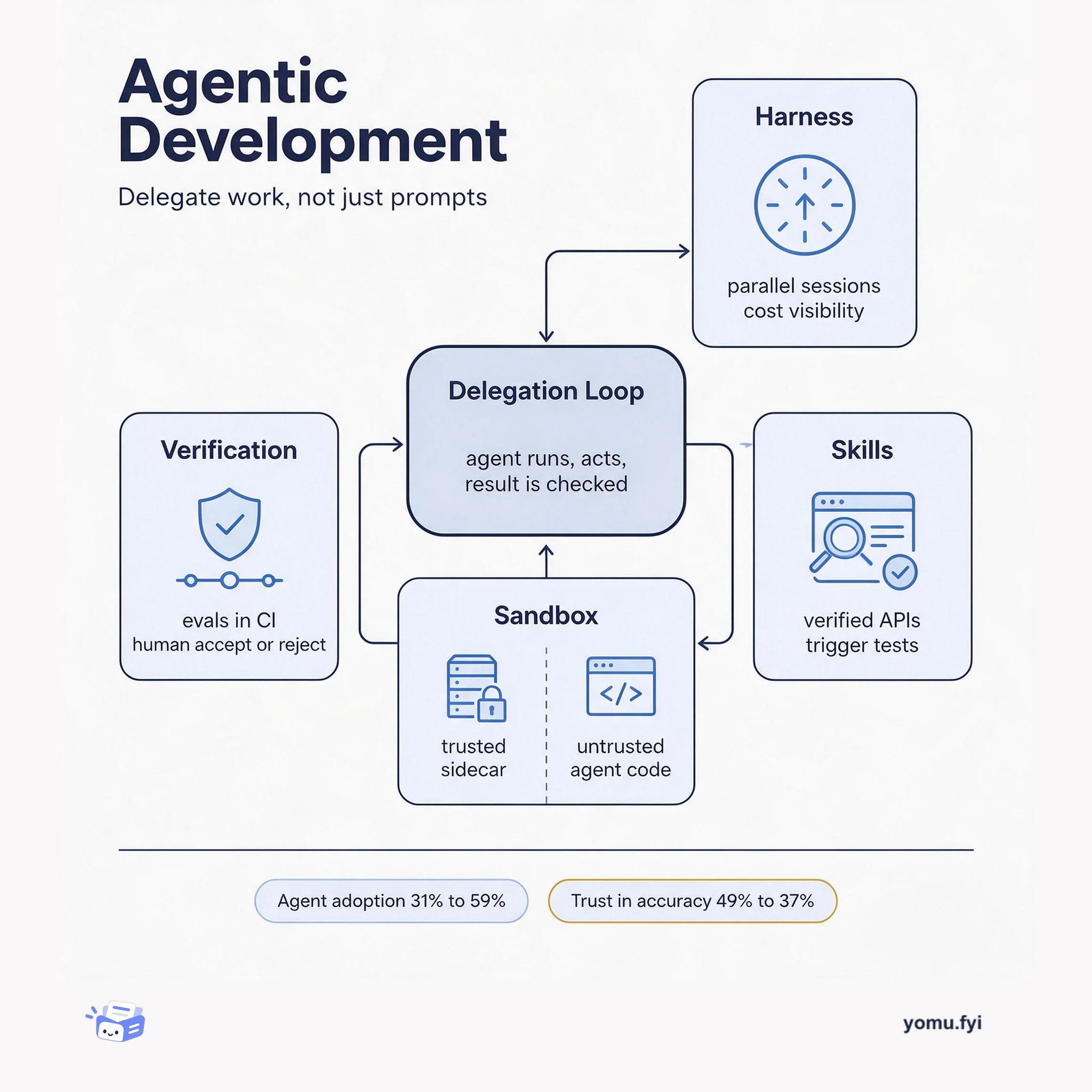
Agentic Development: The Four Parts of a Delegation Loop
Agentic development turns AI assistance into delegated work: a harness runs the agents, skills supply domain knowledge, a sandbox bounds execution, and evals verify the result.
 AppleProblem & solution
Recent autonomous machine learning engineering agents increasingly rely on elaborate machinery such as multi-agent orchestrators and dedicated retrieval subagents, motivated by progress stagnation over long-horizon cycles and limited Large Language Model primitives. This paper finds that under an equal time budget and the same frontier LLM backbone, open-source state-of-the-art harnesses provide no advantages over a single session of a minimal-harness coding agent baseline that uses direct read, write, and bash primitives. The authors argue via large-scale systematic ablation studies that the machinery layers become redundant in the coding agent setting. The backbone, not the harness complexity, is the primary driver for performance. Consequently, the effort spent elaborating hand-crafted harnesses around strong models yields poor returns for current MLE benchmarks.
Research on autonomous machine learning engineering agents, comparing elaborate harnesses (multi-agent orchestrators, retrieval subagents) with minimal-harness coding agents using direct read/write/bash primitives.
Large-scale systematic ablation studies comparing open-source state-of-the-art harnesses to a minimal-harness coding agent baseline under equal time budget and same frontier LLM backbone.
Under equal time budget and same frontier LLM backbone, open-source state-of-the-art harnesses provide no advantages over a minimal-harness coding agent baseline.
The machinery layers such as multi-agent orchestrators and retrieval subagents become redundant in the coding agent setting.
Effort spent on hand-crafted harnesses around strong models yields poor returns for current MLE benchmarks.
A minimal-harness coding agent is one where the LLM has direct access to the execution environment through read, write, and bash primitives, without multi-agent orchestrators or retrieval subagents.
Yes, under equal time budget and same LLM backbone, open-source state-of-the-art harnesses provide no advantages over a minimal-harness baseline; the authors conclude that the machinery layers become redundant.
The backbone, not the harness complexity, is the primary driver for performance in current MLE benchmarks.
Summaries are generated from the original by a language model. Check the original before relying on it.
See the idea
Agentic development turns AI assistance into delegated work: a harness runs the agents, skills supply domain knowledge, a sandbox bounds execution, and evals verify the result.
Keep reading
The Good Stuff
Paid picks we use ourselves. Links carry a referral code — a subscription through one earns us a commission at no extra cost to you.
One useful email. Unsubscribe anytime.
