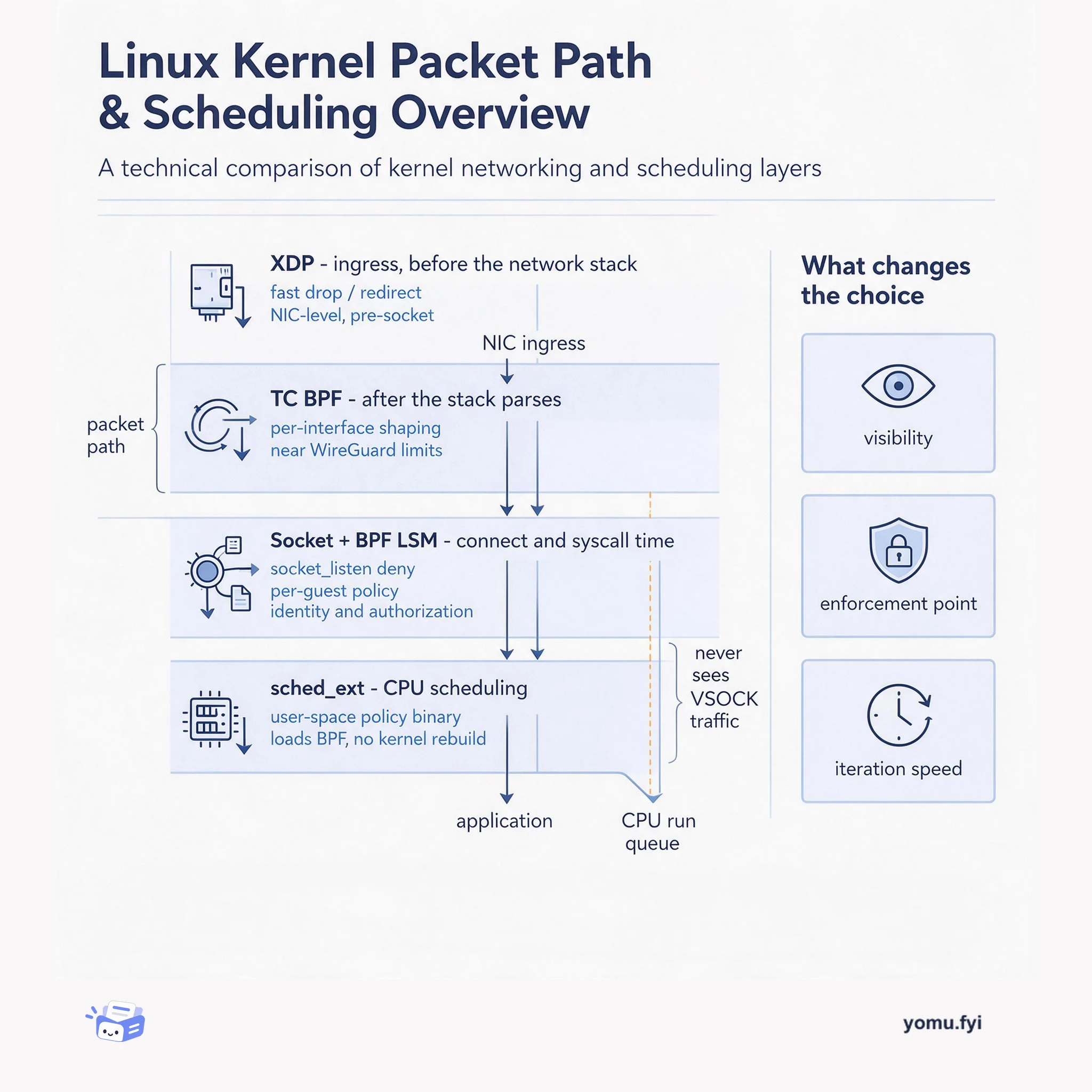
KubeVirt, VSOCK, and eBPF address different layers, so none replaces the others. KubeVirt adds virtual-machine lifecycle management to Kubernetes, running QEMU in a launcher Pod while KVM uses hardware virtualization features to execute guest code; it does not replace either component. VSOCK provides host–guest communication through a CID-and-port socket address, independently of guest IP networking, but attaching virtio-vsock does not define permitted applications or provide authentication and authorization. For host-enforced control, BPF LSM can use the socket_listen hook to deny unapproved host-side VSOCK listeners before creation, whereas ordinary XDP and TC filters on VM network interfaces do not see VSOCK traffic; this still leaves existing listeners, per-guest permissions, kernel attack surface, policy lifetime, and other virtual devices to address.
Context
The post distinguishes VM management, host–guest transport, and host-kernel policy enforcement. It focuses on a VM management channel whose guest user may have administrator access, and explains why controls must apply to the communication path they are intended to protect.
Approach / What changed
Use KubeVirt to manage the VM through Kubernetes, attach VSOCK when host–guest communication should not depend on guest IP networking, and enforce selected host-side restrictions with BPF LSM. In the example, a socket_listen policy denies unapproved host-side VSOCK listeners before creation; application authentication and authorization remain separate requirements.
Takeaways
1
KubeVirt manages VM lifecycle through Kubernetes but still relies on QEMU for the device model and KVM for hardware-assisted execution.
2
VSOCK uses a context ID and port, allowing host–guest communication without the guest's Ethernet interface; attaching it does not define application permissions.
3
BPF LSM can restrict supported host-side operations such as creating VSOCK listeners, while XDP and TC filters on VM network interfaces do not inspect VSOCK traffic.
FAQ
Does removing a VM's network card prevent host–guest communication?
No. It removes the network path, but a guest can still communicate over VSOCK if that device is attached. An IP firewall does not automatically control the separate VSOCK transport.
Why use socket_listen instead of socket_accept for VSOCK control?
socket_listen can reject an unapproved listener before it is created. By socket_accept, the virtio-vsock receive path has already queued the connection and sent its handshake response, so the initial work has occurred.
Does VSOCK authenticate the guest or authorize operations?
No. A CID is a transport address, not a complete application identity, and VSOCK itself does not provide TLS authentication or authorization. Application protocols must handle endpoint authentication and operation permissions separately.
BPF is not one hook but a set of attachment points, and each one sees different traffic. This diagram maps XDP, TC, socket-level BPF LSM, and sched_ext so you can pick the layer that can actually enforce your rule.
Keep reading
Related reading
The Good Stuff
Paid picks we use ourselves. Links carry a referral code — a subscription through one earns us a commission at no extra cost to you.