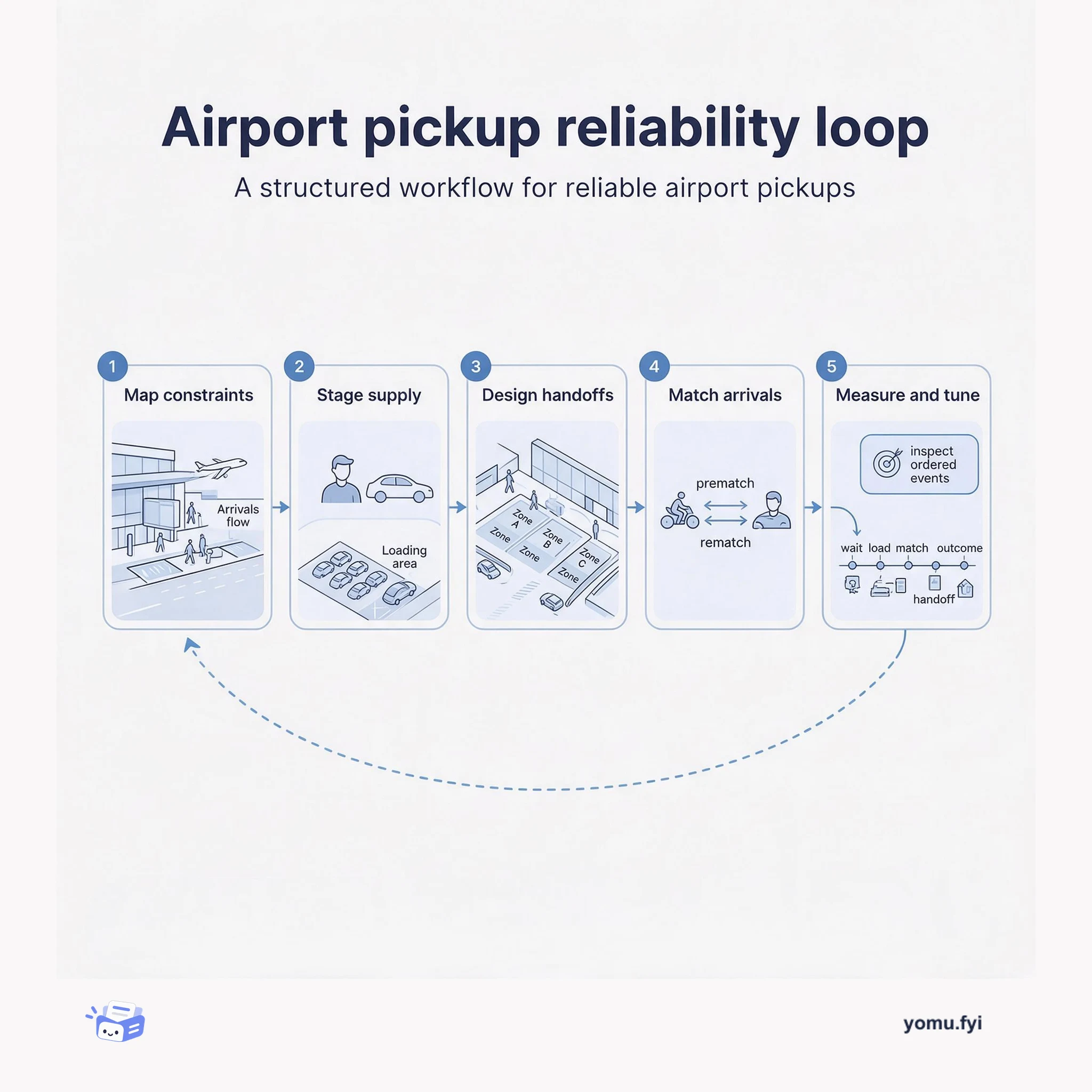
How to Turn Airport Pickup Into a Reliability Loop
A practical checklist for designing reliable airport pickups: map curb constraints, stage drivers, simplify matching, and measure each handoff so improvements target the real bottleneck.
 UberAnnouncement
Uber’s 2025 Airport Awards recognize airports in San Antonio, San Diego, Dallas, and Pittsburgh for improving rideshare reliability, infrastructure, and rider experience. San Antonio International Airport won Quickest Pickup, reporting an average on-demand pickup time of just over four minutes after implementing a nearby staging lot, advanced dispatch technology including ExpressMatch, defined pickup zones, and efficient loading practices. San Diego International Airport and Dallas Love Field received Experience Obsessed recognition for redesigned pickup arrangements, while San Diego added a pedestrian-island setup and secondary staging lot and Dallas replaced a difficult garage location with a terminal-adjacent area. Pittsburgh International Airport won Smartest Space for pull-through loading bays, coordinated signage, Rematch and Prematch technology, and a larger driver waiting lot designed to improve matching, reliability, and pickup speed.
The awards recognize airport partners in the US and Canada that improved rideshare operations through reliability, design, infrastructure, and rider-focused changes. The 2025 categories named in the source are Quickest Pickup, Experience Obsessed, and Smartest Space.
The recognized airports used operational coordination and physical redesigns to improve pickups. Measures included staging and waiting lots, advanced dispatch and matching technologies, designated pickup zones, pedestrian-island access, terminal-adjacent areas, pull-through loading bays, signage plans, and more efficient loading practices.
San Antonio International Airport achieved the fastest average on-demand Uber pickup time in the US and Canada at just over four minutes, supported by staging, ExpressMatch, defined pickup zones, and efficient loading.
San Diego International Airport improved curbside operations around its new Terminal 1 with a pedestrian island, designed pickup zones, and a secondary driver staging lot.
Pittsburgh International Airport combined pull-through loading bays, coordinated signage, Rematch, Prematch, and a larger driver waiting lot to improve matching and pickup reliability.
SAT implemented a nearby staging lot and advanced dispatch technology, including Uber’s ExpressMatch feature. Defined pickup zones and efficient loading practices also helped reduce rider wait times.
PIT developed pull-through loading bays and a signage plan as part of its new terminal project. It also adopted Rematch and Prematch and built a larger driver waiting lot to support faster, more reliable pickups.
San Diego added a pedestrian-island pickup setup outside baggage claim, a secondary staging lot, and improvements to pickup zones and signage. Dallas replaced a challenging garage location with a terminal-adjacent pickup area and a staging area that kept drivers closer to riders.
Summaries are generated from the original by a language model. Check the original before relying on it.
See the idea
A practical checklist for designing reliable airport pickups: map curb constraints, stage drivers, simplify matching, and measure each handoff so improvements target the real bottleneck.
Keep reading
The Good Stuff
Paid picks we use ourselves. Links carry a referral code — a subscription through one earns us a commission at no extra cost to you.
One useful email. Unsubscribe anytime.
