Wide-area networks (WANs) require segmentation to isolate resources, but modern network size makes exhaustive packet-based mapping impractical, so organizations historically relied on incomplete sampling. AWS’s Tiros automated-reasoning tool, previously used for reachability analysis in services like Amazon Inspector and VPC Reachability Analyzer, now offers a static alternative that examines network topology without dynamic packet traffic. Tiros collects a customer’s Cloud WAN configuration from route tables, attachments, and policy documents, then converts those configurations into logical propositions. The system queries Tiros for satisfying assignments corresponding to paths and checks that no path exists between segments the policy declares should be isolated. If actual reachability matches expected segmentation the validation succeeds; otherwise it alerts an operator, and analyses can run as frequently as every hour.
Context
Wide-area networks (WANs) require segmentation to isolate computational resources, but modern network size and complexity make exhaustive packet-based mapping impractical. Organizations historically relied on sampling, which rarely validates segmentation completely. AWS’s Tiros automated-reasoning tool, previously used for reachability analysis in services like Amazon Inspector and VPC Reachability Analyzer, now offers a static alternative that examines network topology without dynamic packet traffic.
Approach / What changed
Tiros collects a customer’s Cloud WAN configuration from route tables, attachments, and policy documents, converts those configurations into logical propositions, and then queries Tiros for satisfying assignments that correspond to network paths. The system checks that no path exists between segments that the policy declares should be isolated, and if actual reachability matches expected segmentation the validation succeeds; otherwise it alerts an operator.
Takeaways
1
Tiros validates network segmentation by converting Cloud WAN configurations into logical propositions and checking that no path exists between segments that should be isolated.
2
Automated segmentation validation is a static process that examines network topology without relying on dynamic packet traffic, enabling exhaustive analysis rather than sampling.
3
Tiros can analyze a deployed network’s topology as frequently as every hour, providing a mathematical demonstration that the topological description aligns with isolation specifications.
FAQ
How does Tiros validate network segmentation?
Tiros collects the customer's Cloud WAN configuration from route tables, attachments, and policy documents. Specialized software converts these configurations into logical propositions that describe network behavior, and then Tiros generates satisfying assignments corresponding to paths, checking that no path exists between segments that should be isolated.
How does Tiros identify missing paths?
The key insight is that if Tiros can determine the reachable paths in a network, it can also identify the absence of paths between particular resources. This allows the system to check that no path exists between segments that the policy declares should be off limits from each other.
How often can Tiros analyze a network?
Tiros can analyze the topology of a deployed network as frequently as every hour. These analyses provide a mathematical demonstration that the topological description aligns with the isolation specifications.
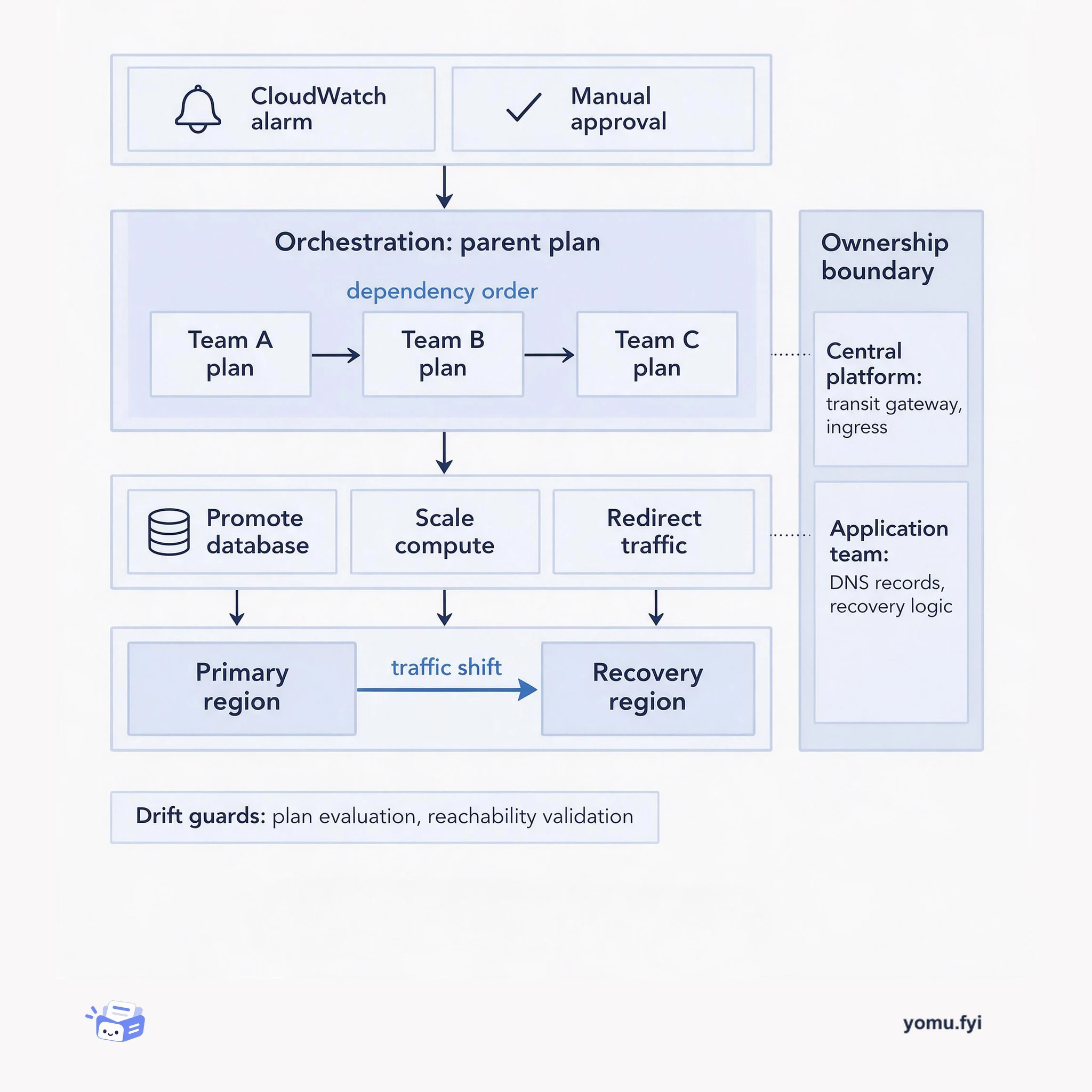
ARC Region Switch is a managed failover orchestrator that runs team-owned plans in dependency order. This diagram maps its trigger, orchestration, execution, and region layers and the ownership boundary.
Keep reading
Related reading
The Good Stuff
Paid picks we use ourselves. Links carry a referral code — a subscription through one earns us a commission at no extra cost to you.