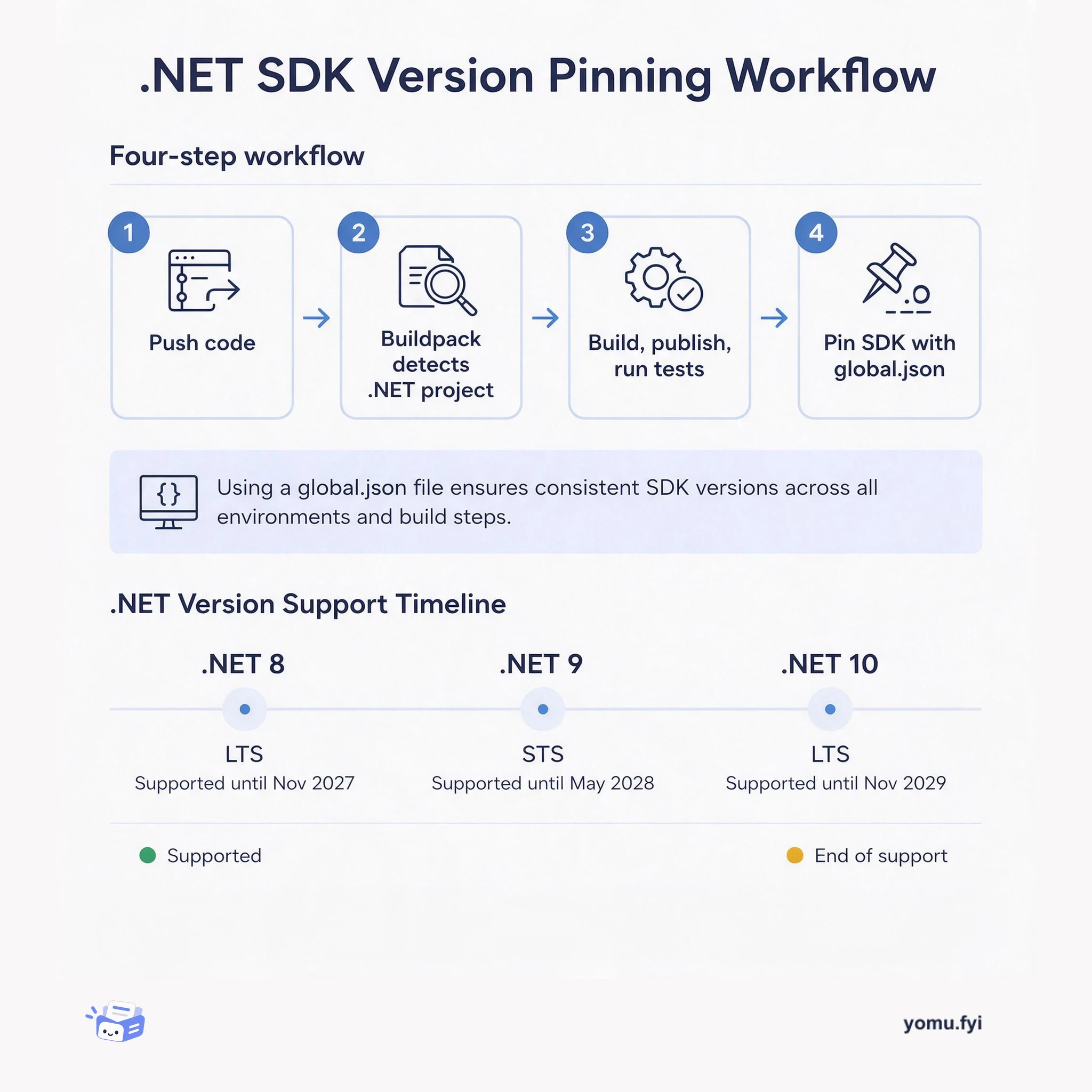
Deploying .NET 10 on Heroku: A Practical How-To
Learn the step-by-step process for deploying .NET 10 applications to Heroku, from buildpack detection to SDK pinning, and understand the lifecycle of .NET LTS releases.
 AWSFrenil RanderiaTutorial
Athenahealth’s single-Region Terraform Enterprise deployment became inaccessible to developers during an October 2025 AWS regional service event, exposing missing regional failover capabilities. The post describes a customer-operated active-passive design spanning us-east-1 and us-west-2, using Aurora PostgreSQL-Compatible global databases, bidirectional S3 cross-Region replication, Route 53 health checks, and compute scaled to zero in the DR Region. AWS Fault Injection Service experiments validate three phases of recovery, including failover, failback, and disruptions that can reveal dependencies such as state-file lookups or S3 connectivity. The resulting architecture achieved a validated 12–14 minute RTO and less than one minute RPO, while costing approximately 30–40% more than the single-Region deployment. The design is presented as an option for critical workloads rather than a supported multi-Region TFE product configuration.
An AWS regional service event made Athenahealth’s single-Region Terraform Enterprise deployment inaccessible, preventing developers from deploying, modifying, or recovering infrastructure. The deployment had Availability Zone resilience but no cross-Region database replication, secondary compute capacity, external Terraform state backup, or regional DNS failover. Athenahealth determined that losing deployment capabilities during regional events was unacceptable for its critical healthcare workloads.
The customer implemented and tested an active-passive Terraform Enterprise disaster recovery pattern across us-east-1 and us-west-2. Aurora PostgreSQL-Compatible global databases replicate application state, S3 cross-Region replication handles workspace state files, Route 53 directs traffic, and the DR Auto Scaling group remains at zero during normal operations. AWS Fault Injection Service experiments validate recovery phases, expose hidden dependencies, and test both failover and failback.
Aurora PostgreSQL-Compatible global databases provide sub-second replication lag, while bidirectional S3 replication supports failback without data resynchronization.
The TFE encryption password must be replicated and referenced in the DR launch configuration; a different value can prevent instances from starting or decrypting existing data.
Subnet-level AWS FIS connectivity disruption can simulate regional S3 connectivity loss and expose circular dependencies involving Terraform state files.
Summaries are generated from the original by a language model. Check the original before relying on it.
See the idea
Learn the step-by-step process for deploying .NET 10 applications to Heroku, from buildpack detection to SDK pinning, and understand the lifecycle of .NET LTS releases.
Keep reading
The Good Stuff
Paid picks we use ourselves. Links carry a referral code — a subscription through one earns us a commission at no extra cost to you.
One useful email. Unsubscribe anytime.
