CostBench streamed 113.2 billion stock-market quotes into both systems while four aggregate queries ran every ten minutes and two drill-down queries ran every hour. ClickHouse asynchronous inserts order raw data and build pre-aggregations during ingestion, while Redshift relies on separate background sorting and materialized view refreshes. ClickHouse Cloud led in preparation cost ($28.69 versus 522.03), normalized query cost ( 0.05 versus $24.97), and accumulated query runtime (58.12 seconds versus 1.69 hours). The combined score shows ClickHouse Cloud delivered 1,996× better end-to-end performance per dollar in this continuous-ingestion comparison. The difference originates in the preparation path: ClickHouse makes data query-ready during inserts, whereas Redshift’s streaming, sorting, and refresh steps advance independently.
Context
The blog post compares ClickHouse Cloud and Redshift Serverless for real-time analytics under continuous ingestion, using the CostBench framework. Both systems ingested 113.2 billion stock-market quotes while serving mixed query workloads. The authors present detailed cost and runtime measurements to explain why ClickHouse Cloud achieved a 1,996× better end-to-end performance-per-dollar score.
Approach / What changed
ClickHouse Cloud uses asynchronous inserts to order raw quotes and build current summaries during insert time, while Redshift Serverless relies on streaming ingestion from Amazon MSK, background sorting, and incremental materialized views that advance separately. The comparison employs CostBench, which streams 113.2 billion stock-market quotes at a target of 1 million rows per second, runs four interactive aggregate queries every ten minutes and two drill-down queries every hour, and calculates an end-to-end performance-per-dollar score from preparation cost, normalized query cost, and accumulated query runtime.
Takeaways
1
ClickHouse Cloud delivered 1,996× better end-to-end performance per dollar than Redshift Serverless in a continuous-ingestion benchmark of 113.2 billion stock-market quotes.
2
ClickHouse inserts order raw data and build current summaries during ingestion, whereas Redshift’s streaming, background sorting, and materialized view refreshes advance separately, increasing preparation cost.
3
Accumulated query runtime was 104.8× lower on ClickHouse Cloud (58.12 seconds) compared to Redshift Serverless (1.69 hours) under the same workload and query schedule.
FAQ
What is included in the preparation cost calculation?
The preparation cost covers the complete fresh-data path, including ClickHouse's two-node HA ingest service or Redshift's writer plus MSK broker and storage costs. For Redshift, the accepted scenario models 32 active RPUs over the producer window.
How was accumulated query runtime measured?
Accumulated query runtime sums the durations of all accepted queries. ClickHouse Cloud had 58.12 seconds of accumulated runtime, while Redshift Serverless had 1.69 hours, a 104.8× difference.
Why did Redshift Serverless have higher preparation cost?
ClickHouse uses insert-time sorting and summary building, making data immediately query-ready. Redshift uses separate streaming ingestion, background sorting, and materialized view refreshes, creating additional latency and cost before data can be queried efficiently.
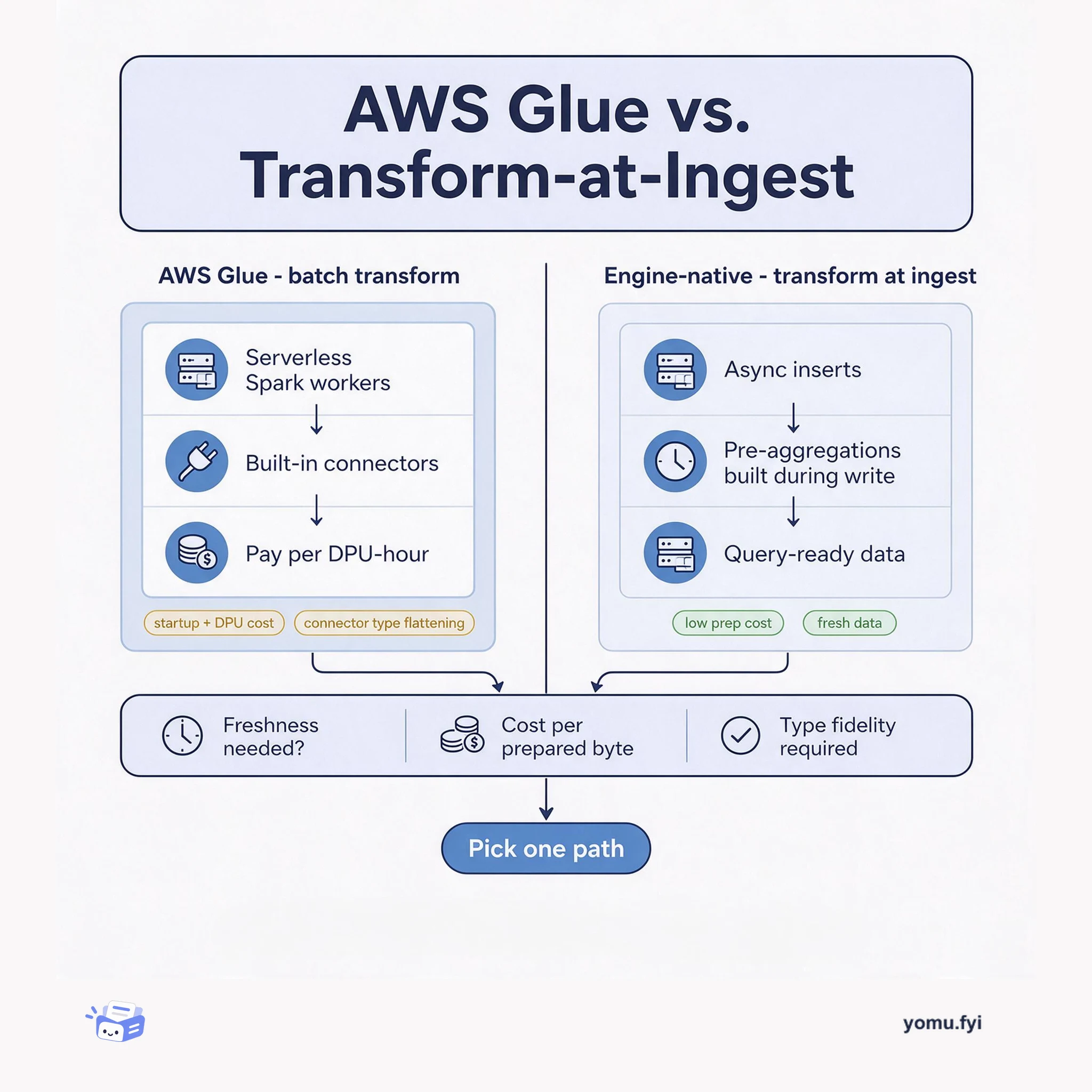
AWS Glue runs serverless Spark jobs that transform data in batches; engine-native pipelines transform during ingestion. This comparison shows how to pick between them by freshness, cost, and data fidelity.
Keep reading
Related reading
The Good Stuff
Paid picks we use ourselves. Links carry a referral code — a subscription through one earns us a commission at no extra cost to you.