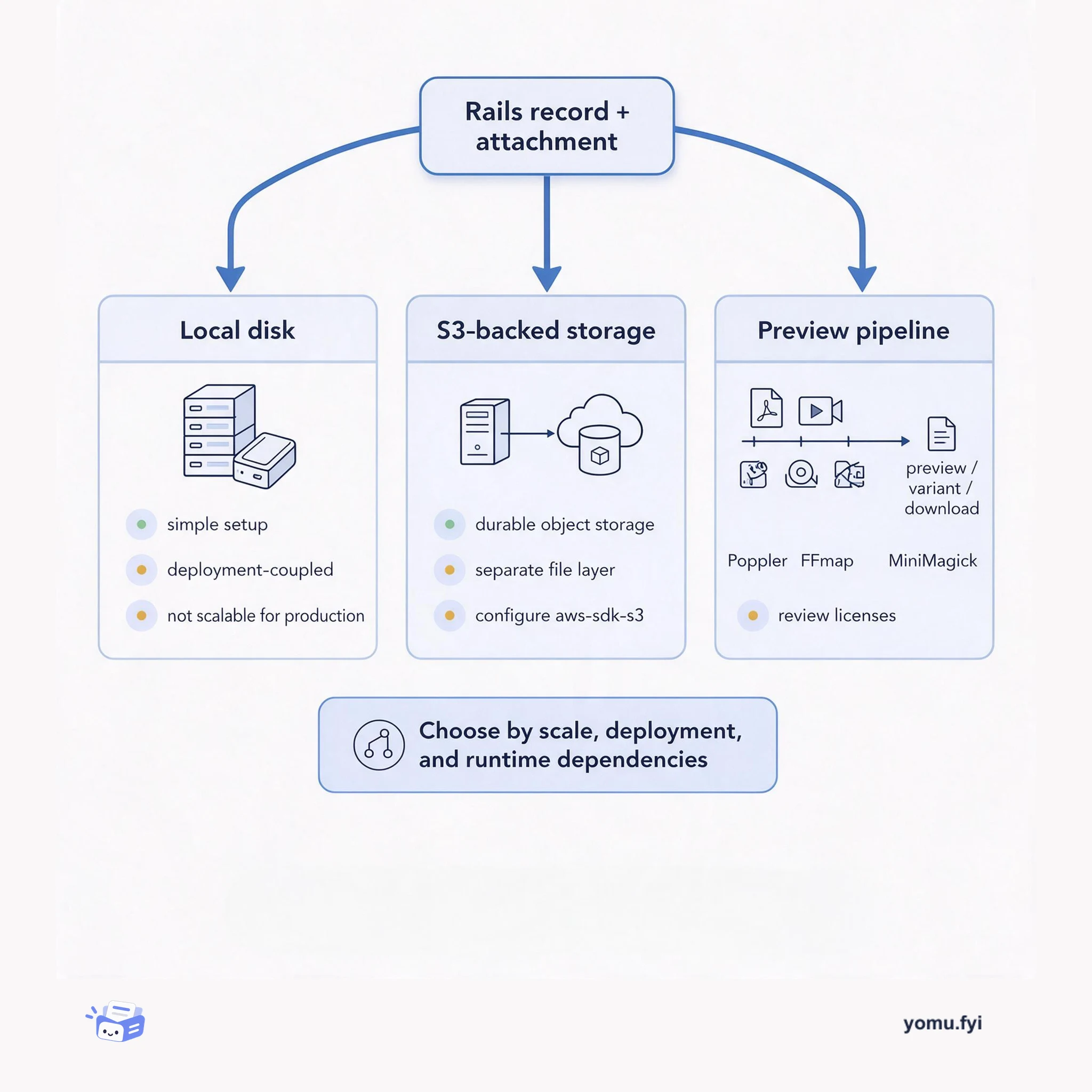
Active Storage Is a Boundary Decision
See how Active Storage balances local simplicity, durable object storage, and preview-processing dependencies so you can choose the right boundary for a Rails file workflow.
 ClickhouseAnnouncement
ClickHouse Cloud’s On-Demand Compute is announced in private preview as a way to run eligible queries on a shared pool of workers outside a service’s primary cluster, avoiding production contention and reactive autoscaling delays. It uses ClickHouse’s multistage distributed query execution and cost-based optimizer to distribute complex workloads, with queries requesting worker counts through settings including make_distributed_plan and distributed_plan_workers_num. Workers are leased for at least 60 seconds, reused during the lease, and released when it expires; concurrent queries share the pool, which grows to the largest request. In a stated benchmark, On-Demand Compute was faster for the tested workload and at 25 concurrent queries delivered similar performance while using 50% less compute, though results vary by query shape.
Metric-based autoscaling reacts to observed demand, so compute-intensive queries may wait for capacity. The post describes overprovisioning, waiting for autoscaling, and allowing heavy queries to compete with critical workloads as imperfect alternatives, motivating query-level scaling.
Eligible queries request additional workers from a ClickHouse-managed pool using settings such as make_distributed_plan and distributed_plan_workers_num. The capability uses multistage distributed query execution and a cost-based optimizer; workers are leased, reused during active leases, shared among concurrent queries, and released after lease expiry.
On-Demand Compute supports SharedMergeTree, Apache Iceberg, and Delta Lake workloads, including ad hoc queries, selected read offloading, and eligible data lake queries.
Workers have a minimum 60-second lease that renews for longer-running queries; subsequent queries can reuse active workers without a cold start or discovery delay.
In the benchmark, 25 concurrent queries using 15 workers achieved performance similar to the stateful cluster’s single-node execution while using 50% less compute; results vary by workload.
Summaries are generated from the original by a language model. Check the original before relying on it.
See the idea
See how Active Storage balances local simplicity, durable object storage, and preview-processing dependencies so you can choose the right boundary for a Rails file workflow.
Keep reading
The Good Stuff
Paid picks we use ourselves. Links carry a referral code — a subscription through one earns us a commission at no extra cost to you.
One useful email. Unsubscribe anytime.
