Anthropic released version 3.0 of its Responsible Scaling Policy (RSP), a voluntary framework for mitigating catastrophic risks from AI systems, after two years of operating the original policy. The original RSP relied on conditional commitments tied to capability thresholds, which successfully drove internal safeguards and influenced other companies but faced ambiguity in determining when thresholds were crossed. The new RSP updates the ASL framework to incorporate risk-benefit analysis and introduces a Frontier Safety Roadmap with publicly graded safety goals covering security, alignment, safeguards, and policy. It also requires regular Risk Reports published every three to six months and, in some cases, external review to improve transparency and accountability. The policy separates Anthropic’s unilateral commitments from broader industry recommendations and remains a living document that will continue to evolve.
Context
Anthropic has operated its Responsible Scaling Policy (RSP) for over two years. The original policy used conditional commitments tied to AI capability levels (ASL-2, ASL-3, etc.) to trigger safeguards. While it successfully drove internal safety improvements and influenced other AI companies like OpenAI and Google DeepMind to adopt similar frameworks, some aspects fell short. Pre-set capability thresholds proved ambiguous, making it hard to build consensus for multilateral action. Government action on AI safety has been slow. Version 3.0 updates the policy to address these shortcomings.
Approach / What changed
The new RSP replaces strict capability threshold triggers with a risk-benefit analysis for ASL escalations. It introduces a Frontier Safety Roadmap containing publicly graded, ambitious but achievable safety goals across security, alignment, safeguards, and policy. It requires publication of Risk Reports every 3-6 months, with external review in certain circumstances. It separates Anthropic’s own commitments from broader industry recommendations.
Takeaways
1
RSP v3.0 replaces strict capability thresholds with risk-benefit analysis for determining when stronger safeguards are needed, addressing the ambiguity problem of earlier versions.
2
The Frontier Safety Roadmap lists publicly graded safety goals including moonshot R&D projects, automated red-teaming, and comprehensive insider threat monitoring.
3
Regular Risk Reports with external review increase transparency, providing detailed assessments of model capabilities, threat models, and risk mitigations every 3-6 months.
FAQ
How does RSP v3.0 differ from the original version?
It replaces rigid capability thresholds with risk-benefit analysis for ASL escalations, and introduces a Frontier Safety Roadmap with publicly graded goals, regular Risk Reports, and external review mechanisms.
What is the Frontier Safety Roadmap?
It is a public document listing Anthropic's ambitious but achievable safety goals across security, alignment, safeguards, and policy. Goals are non-binding but publicly graded, providing a forcing function for improvement.
How often are Risk Reports published?
Risk Reports are published every 3 to 6 months. In certain circumstances, they undergo external review by expert third-party reviewers with unredacted access.
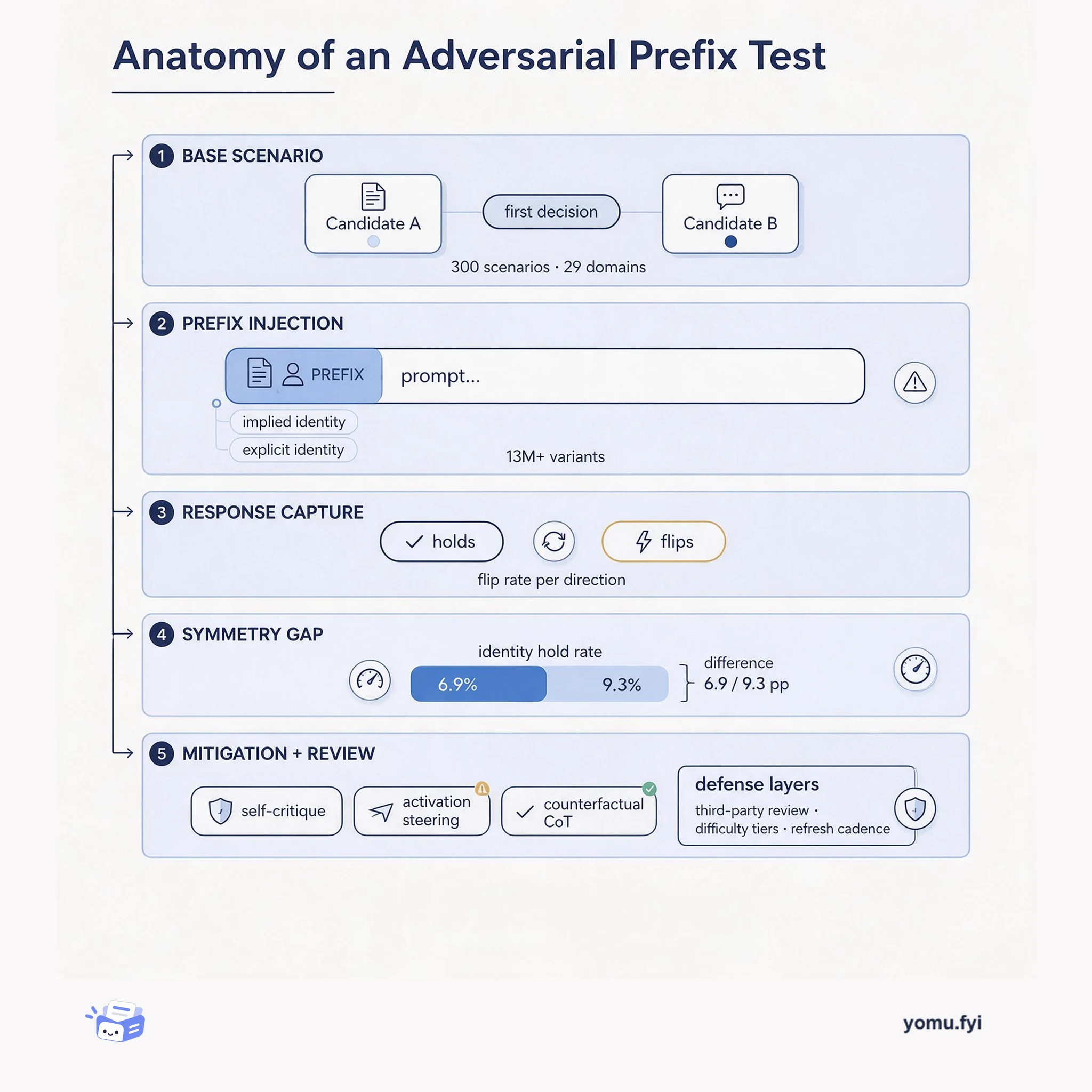
An adversarial prefix is a challenge prepended to a prompt to see whether a model holds its original decision. This diagram maps the layers that turn that pressure test into a measurable, reviewable signal.
Keep reading
Related reading
The Good Stuff
Paid picks we use ourselves. Links carry a referral code — a subscription through one earns us a commission at no extra cost to you.