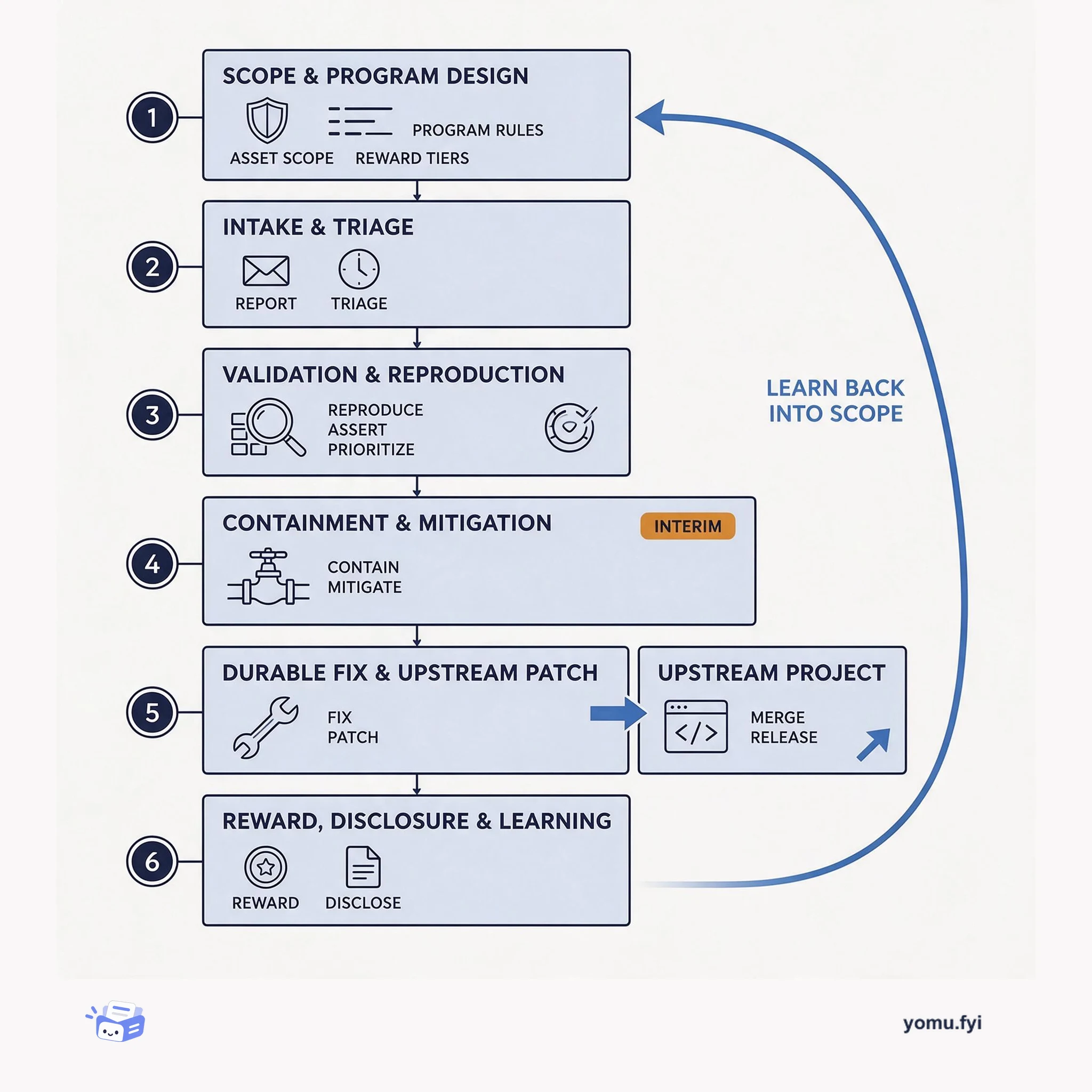
Anatomy of a Bug Bounty Pipeline: From First Report to Upstream Patch
An architecture view of a bug bounty program: scope, triage, validation, containment, durable fix, and payout, plus the loop that turns each report into stronger defaults.
 HerokuWadeExplainer
Heroku frames security as an engineering discipline that must challenge happy-path assumptions, test continuously, and prepare for low-predictability, high-consequence “black swan” events. Its threat-modeling guidance focuses on challenging defaults, recognizing that attackers have resources and organizational support, and planning for unexpected failures such as a zero-day exploit. A control-plane instrument for Heroku Postgres detected privilege escalation to a superuser role, and the Data team isolated the instance within 17 minutes while investigating the activity. The event was traced to researcher Andrew Krasichkov (“buglloc”), whose testing exposed a vulnerability in the dblink and postgres_fdw extensions. Through the Bugcrowd bug bounty program, Heroku worked with him to understand the issue, reward the finding, and defend against the previously unknown flaw before a patch was available.
Software security can rely on unsafe assumptions about isolation, role segregation, authentication, encryption, and other controls. The brief argues that mature security programs must account for low-predictability, high-consequence events, including vulnerabilities known first to an attacker or researcher.
Heroku combines threat modeling, automated misconfiguration testing, external security testing, control-plane instrumentation, rapid incident response, and collaboration with bug bounty researchers. In the described case, the Data team detected privilege escalation, isolated the instance within 17 minutes, and worked with Andrew Krasichkov through Bugcrowd before a patch was available.
Heroku Postgres instrumentation detected privilege escalation to a superuser role, enabling the Data team to isolate the instance within 17 minutes.
Andrew Krasichkov’s research identified a Postgres vulnerability in the dblink and postgres_fdw extensions.
The Bugcrowd relationship let Heroku understand and mitigate the previously unknown flaw before a patch was released.
Summaries are generated from the original by a language model. Check the original before relying on it.
See the idea
An architecture view of a bug bounty program: scope, triage, validation, containment, durable fix, and payout, plus the loop that turns each report into stronger defaults.
Keep reading
The Good Stuff
Paid picks we use ourselves. Links carry a referral code — a subscription through one earns us a commission at no extra cost to you.
One useful email. Unsubscribe anytime.
