Anatomy of a Bug Bounty Pipeline: From First Report to Upstream Patch
An architecture view of a bug bounty program: scope, triage, validation, containment, durable fix, and payout, plus the loop that turns each report into stronger defaults.
A bug bounty program is not a mailbox for vulnerability reports; it is a layered pipeline with distinct responsibilities at each stage. Scope and rules define which assets and bounty tiers are in play, triage decides what is real and how severe, validation reproduces impact, containment limits damage before a durable fix exists, and the upstream patch closes the class of bug for everyone. The final layer pays the researcher, publishes what can be published, and feeds what was learned back into scope and defaults. Engineers should read it this way because the slow, risky parts are rarely the initial fix: they are isolation before patching, incomplete upstream patches, and knowing which assets the program actually covers.
FAQ
Why contain a reported vulnerability before the durable fix ships?
Because the exposure window is where real damage happens. Cloudflare removed skip_block_zeroing, retired running container disks, and cleared cached image snapshots created before the mitigation, while Databricks developed and deployed a fix so tenants were protected without any customer action. Containment buys time for the correct patch without leaving the original flaw reachable.
What happens when the upstream patch is incomplete?
The Databricks PostGIS case shows the failure mode: the first upstream fix missed cases in the address_standardizer extension, so the researcher supplied the remaining pieces and the complete correction was returned to PostGIS. A program that ends at the internal patch leaves the same bug alive in every downstream consumer, which is why the upstream layer belongs in the pipeline.
How do programs decide what scope and payouts to offer?
Scope is a budget statement, and it can be widened deliberately: Grab added Indonesian financial services and AI systems plus a mobile-specific bounty table, while Shopify published a $500 minimum at triage, clearer scope guidance, and a $25,000 typical maximum after reviewing its triage data. Campaigns and payout changes are the levers that shift where researchers spend effort.
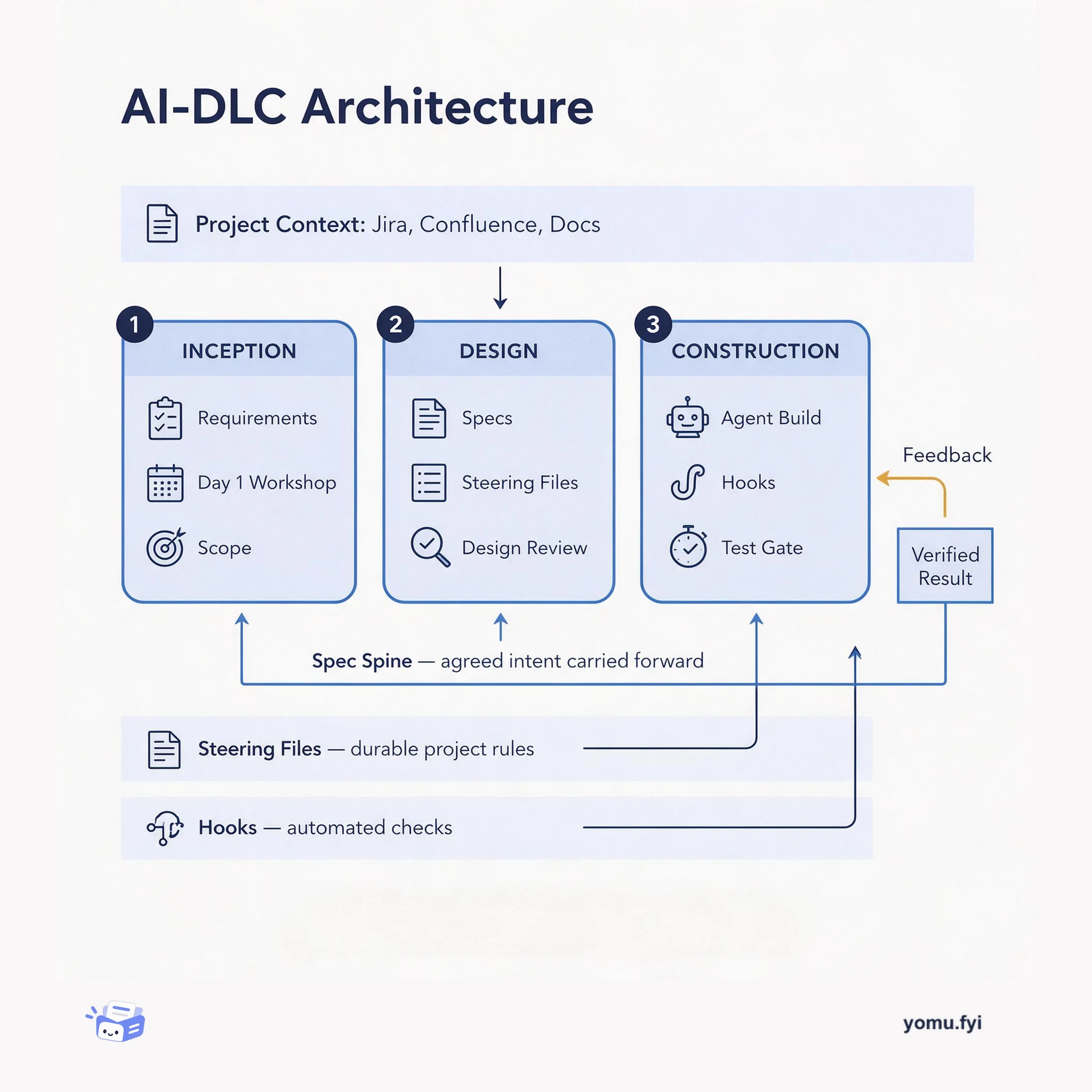
AI-DLC is an AI-driven development lifecycle that runs delivery through Inception, Design, and Construction, with specs, steering files, and hooks keeping agents aligned to agreed intent.
Apple Silicon's defining choice is one shared memory pool for CPU, GPU, and Neural Engine. This diagram maps that fabric, the on-package bandwidth it buys, and the scaling limits it imposes.
Antimicrobial resistance surveillance is a layered data architecture: raw reads and demand signals flow in, get normalized into governed tables, and answer plain-language queries. The diagram maps each boundary.
The Good Stuff
Paid picks we use ourselves. Links carry a referral code — a subscription through one earns us a commission at no extra cost to you.