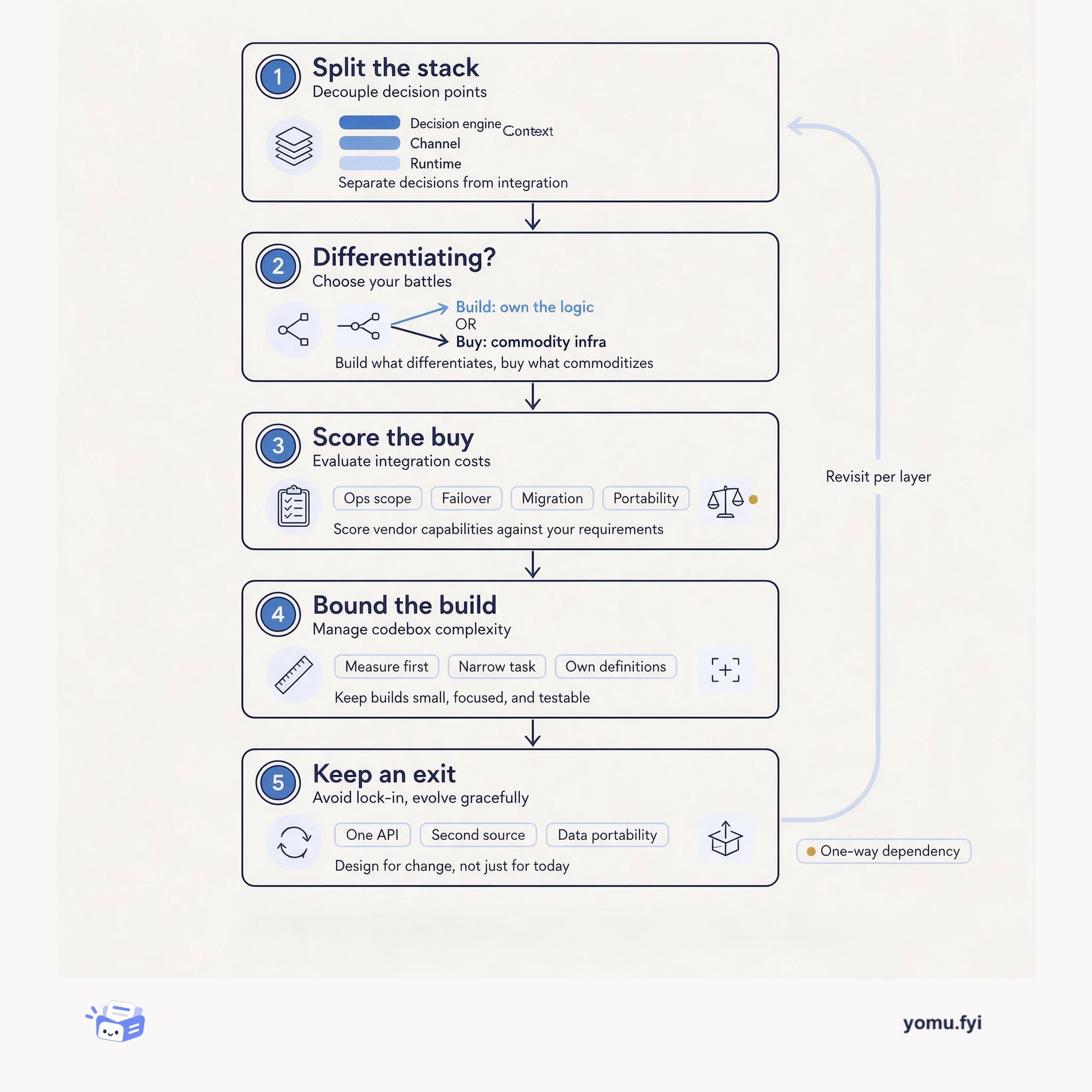
The orchestration layer comprises four distinct components—decision engine, context layer, channel layer, and agent runtime—each requiring a separate build-versus-buy decision rather than a single platform choice. The decision engine, which encodes core business logic such as eligibility rules and risk thresholds, should be built and owned in-house to avoid outsourcing the part that differentiates the business. The context layer, responsible for identity resolution and customer profile freshness, should be bought as infrastructure while the business owns the definition of customer attributes; 48% of companies cite cross-channel data connection as their top obstacle. The channel layer, handling carrier relationships, number provisioning, and per-market compliance, is almost always better bought because it requires specialist maintenance that changes frequently. The agent runtime, including speech pipelines and interruption handling, should be bought as infrastructure while the business retains control over models, prompts, and guardrails, grounding responses in audited knowledge repositories.
Context
The build-versus-buy decision for an orchestration layer is often treated as a single question, but the orchestration layer actually comprises four distinct components—decision engine, context layer, channel layer, and agent runtime—each with different trade-offs that require separate evaluation.
Approach / What changed
Evaluate each of the four orchestration layers separately. Build the decision engine that encodes core business logic. Buy the context layer infrastructure while owning the definition of customer attributes. Buy the channel layer for carrier relationships and compliance. Buy the agent runtime infrastructure while retaining control over models, prompts, and guardrails. Use five questions—such as whether the component encodes business decisions, whether it would need rebuilding every 18 months, and whether the team can staff it—to guide each decision.
Takeaways
1
The orchestration layer should be evaluated as four separate components—decision engine, context layer, channel layer, and agent runtime—rather than a single platform.
2
The decision engine, which encodes business logic like eligibility rules and risk thresholds, should always be built and owned in-house.
3
The channel layer, involving carrier relationships and per-market compliance, is almost always better bought because it requires specialist maintenance that changes frequently.
FAQ
When does building in-house stop working?
Usually at a step change in volume, new market regulations, or when the original engineer leaves. Sweetwater moved off homegrown systems when interaction volumes surged past technical limits.
What should I never outsource?
Your decision engine. Nova Gestões' CTO recommends keeping your own orchestration layer and decision engine instead of handing core business logic to a third party, and integrating through documented APIs.
Which layer should I fix first?
The context layer. Lendi Group's CTO recommends unifying your real-time data layer before scaling AI. Twilio research found 84% of brands say their AI can access customer history while only 40% design personalization around it.
Build vs. buy is a per-layer decision, not a single platform choice. This flow splits a system into layers, tests each for differentiation, then sets the buy criteria and the exit path.
Keep reading
Related reading
The Good Stuff
Paid picks we use ourselves. Links carry a referral code — a subscription through one earns us a commission at no extra cost to you.