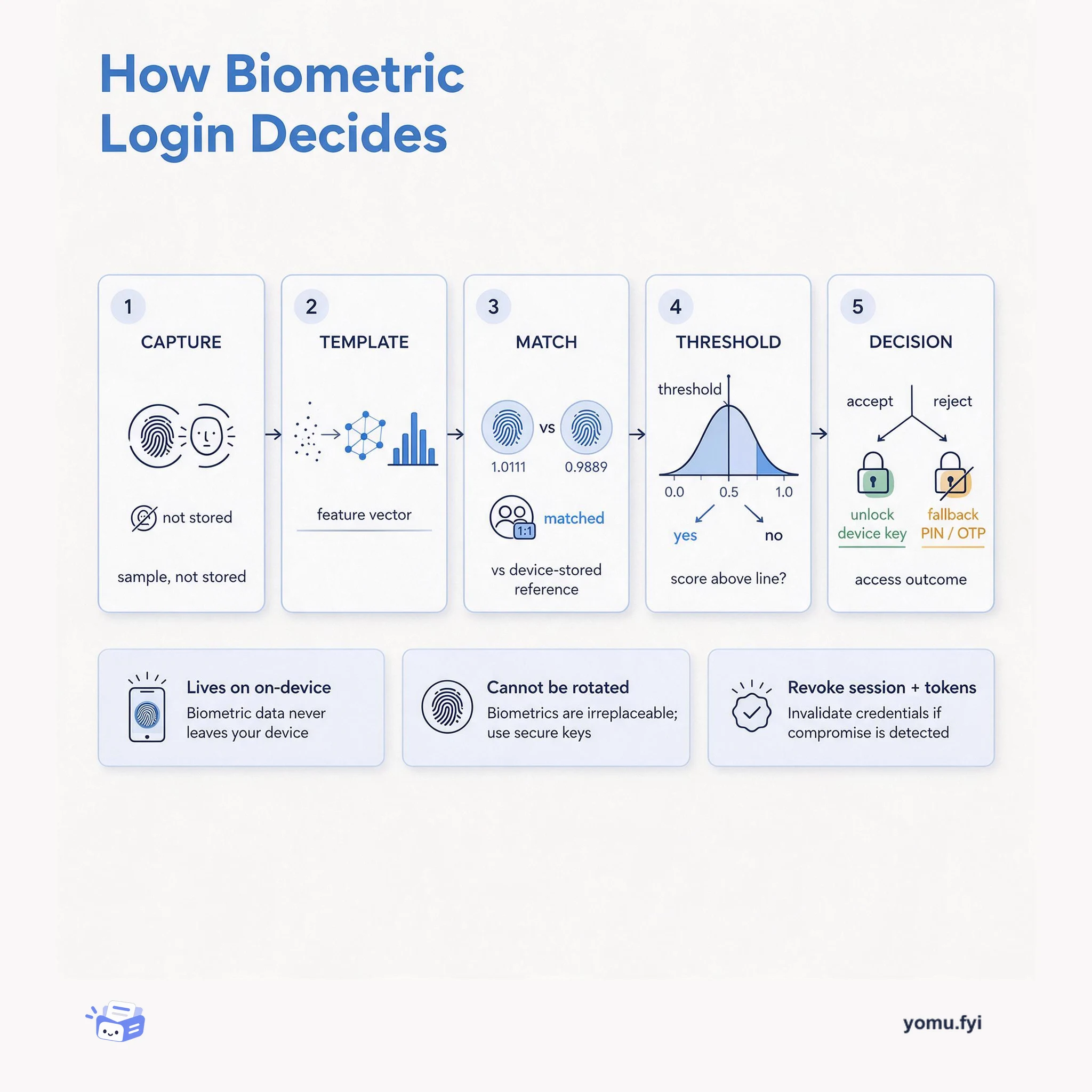
How Biometric Login Decides: Capture, Template, Threshold, Fallback
Biometric login is a local match against a stored template, not a secret kept on a server. Follow capture, template, threshold, and fallback to see where each decision happens.
 TwilioRavleen KaurExplainer
The post examines business authentication methods, including passwordless, password-based, multi-factor authentication (MFA), single sign-on (SSO), and biometrics, each with distinct security and usability trade-offs. It notes that U.S. cyber attack victims lost over $16 billion in 2024 and 46% of small businesses experienced attacks in 2025, highlighting the need for robust verification. Passwordless authentication eliminates passwords by using biometrics, tokens, or email links, while password-based systems, though common, are vulnerable to phishing and brute-force attacks. MFA requires two or more factors like OTPs and push notifications, and SSO allows login via identity providers such as Google or Facebook. The post concludes by advising businesses to evaluate security requirements, user experience, compliance, scalability, cost, and integration when selecting an authentication solution.
The article provides an overview of common business authentication methods and a framework for selecting the appropriate solution based on security, usability, and regulatory needs.
Passwordless authentication eliminates passwords by using biometrics, tokens, or email links, reducing vulnerability to brute-force attacks.
Multi-factor authentication (MFA) requires two or more verification factors, such as passwords and OTPs, making unauthorized access significantly harder but potentially impacting user experience.
When choosing an authentication method, businesses should balance security, user experience, compliance, scalability, cost, and integration with existing systems.
Multi-factor authentication (MFA) requires two or more verification steps, such as a password and a one-time code sent via SMS or email, to grant access. It adds layers of security beyond just a username and password, making it harder for attackers to bypass.
SSO allows users to log into multiple platforms using credentials from an identity provider like Google or Facebook, eliminating the need to remember separate passwords. Users authenticate once with the IdP, and your site communicates with the IdP to verify their identity.
Password-based authentication is vulnerable to phishing and brute-force attacks because users often choose weak or reused passwords. Without additional security measures like MFA, it provides the lowest level of security despite being the most common method.
Summaries are generated from the original by a language model. Check the original before relying on it.
See the idea
Biometric login is a local match against a stored template, not a secret kept on a server. Follow capture, template, threshold, and fallback to see where each decision happens.
Keep reading
The Good Stuff
Paid picks we use ourselves. Links carry a referral code — a subscription through one earns us a commission at no extra cost to you.
One useful email. Unsubscribe anytime.
