Enterprise customers deploying third-party applications on Red Hat OpenShift often encounter vendors claiming Kubernetes support without addressing the underlying architectural changes needed for containerization. These applications are frequently repackaged from legacy virtual machines, retain tight pod interdependencies, and demand cluster-admin privileges or unrestricted security context constraints, violating OpenShift’s default restricted-v2 SCC. Many products fail to support parallel dev, test, and staging environments because they depend on cluster-scoped resources, and they rely on legacy NFS shared storage instead of dynamic provisioning via OpenShift Data Foundation. Avoiding these pitfalls requires formal architectural reviews with vendor engineering, strict enforcement of non-root execution within defined SCC policies, and conversion of manual vendor scripts into declarative Helm charts managed through GitOps. Consultants must also manage expectations with evidence-based feedback and ensure thorough knowledge transfer so the customer’s own engineering team can maintain a clean, repeatable platform.
Context
The post is written from the perspective of a Red Hat consultant who is frequently brought in to bridge the gap between enterprise OpenShift platforms and third-party vendor applications that claim Kubernetes support but fail in practice.
Approach / What changed
The post recommends early architectural alignment with vendor engineering, enforcement of strict security context constraint (SCC) policies, standardization on GitOps automation by converting manual scripts into declarative Helm charts, and use of soft skills to manage expectations with evidence-based feedback and thorough knowledge transfer.
Takeaways
1
Third-party vendors commonly request cluster-admin privileges or unrestricted anyuid/privileged SCC, but OpenShift’s restricted-v2 SCC enforces least privilege and non-root execution.
2
Many vendor applications cannot run multiple parallel environments (dev, test, staging) in the same cluster because they rely on cluster-scoped resources that prevent independent upgrades.
3
Legacy NFS shared storage should be replaced with OpenShift Data Foundation using ReadWriteOnce (RWO) for databases and ReadWriteMany (RWX) for shared files, with a clear separation of application state.
FAQ
What is the most common security issue with vendor apps on OpenShift?
Vendors frequently demand cluster-admin privileges or the unrestricted privileged SCC. OpenShift's default restricted-v2 SCC prevents root execution, and granting higher permissions expands the blast radius and violates least-privilege security boundaries.
Why do vendor apps fail in multi-environment clusters?
Because they depend on cluster-scoped resources that prevent concurrent installations of dev, test, and staging in the same cluster. This blocks independent upgrades and lifecycle management across environments.
How should vendors handle storage on OpenShift?
Use OpenShift Data Foundation: ReadWriteOnce (RWO) block storage for databases and ReadWriteMany (RWX) shared filesystem for multi-pod access. Avoid legacy NFS shared host paths that lack dynamic provisioning and cause failover issues.
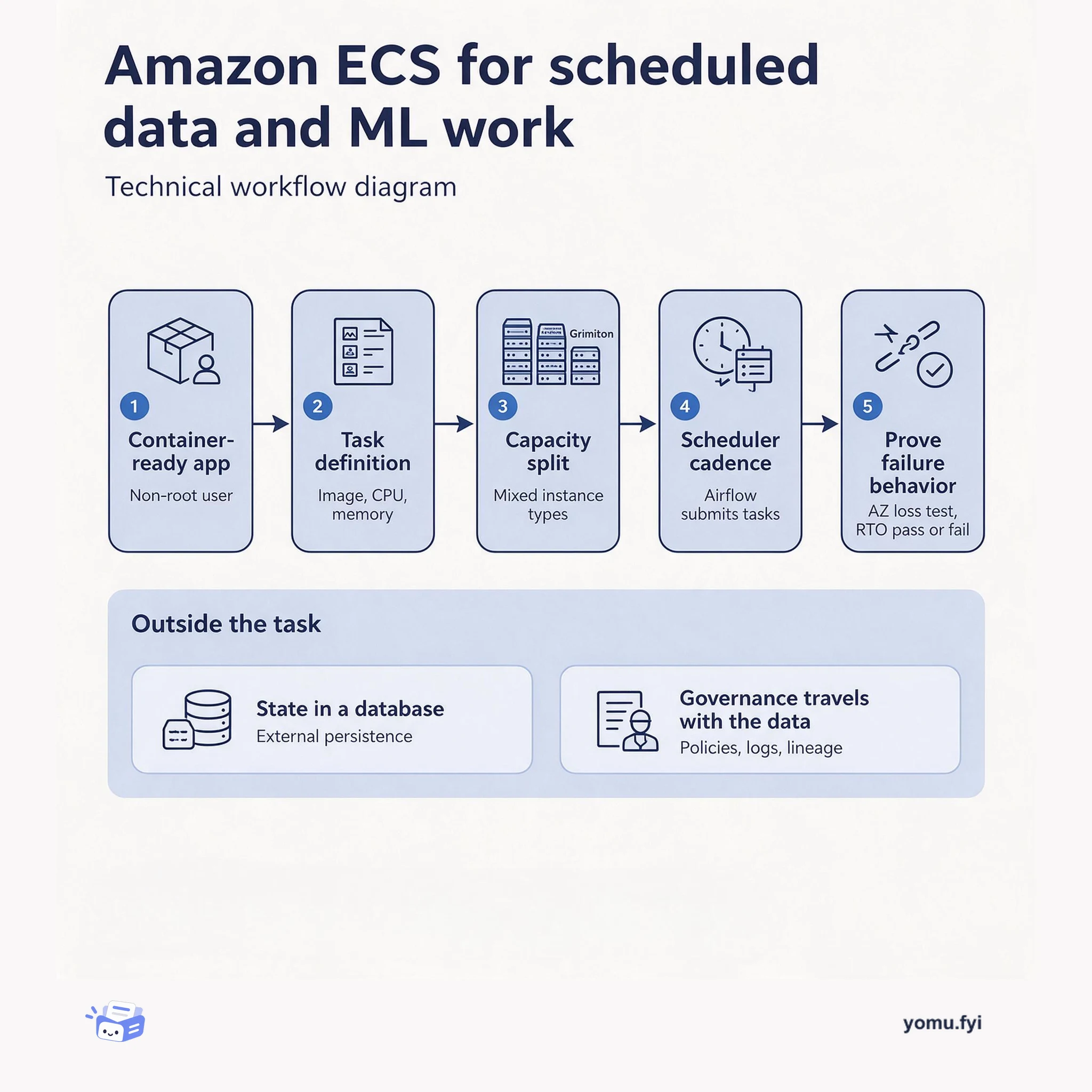
Amazon ECS runs containerized batch and ML jobs as scheduled tasks, but the hard parts are capacity, state, and failure behavior. This five-checkpoint path shows what to verify before you scale.
Keep reading
Related reading
The Good Stuff
Paid picks we use ourselves. Links carry a referral code — a subscription through one earns us a commission at no extra cost to you.