Managed Postgres services that keep data on network-attached storage can become I/O-bound, so adding compute does not necessarily improve reads, writes, WAL activity, or maintenance. A local synchronization layer can make reads local by subscribing to logical replication and materializing a declared subset, but it creates a second copy of data with its own lifecycle. Writes still go to central Postgres, and applications must reconcile optimistic local state with committed changes arriving asynchronously. AI agents make declared subsets harder to define because their query paths and working sets can change with each task, reducing reuse across local copies. ClickHouse Managed Postgres places Postgres on NVMe storage attached to the database compute; the recommended path is to measure the central database first, add read replicas where freshness allows, then offload analytical workloads to ClickHouse through pg_clickhouse when usage outgrows Postgres.
Context
Managed Postgres services often keep data on network-attached storage, and compute-storage separation adds network hops on cache misses. Local caches and sync engines create a second copy for reads while writes remain central. AI agents make working sets less predictable, complicating declared subsets.
Approach / What changed
Measure whether the central database meets the required latency and throughput before adding another data copy. ClickHouse Managed Postgres runs Postgres on NVMe storage attached to the database compute; add read replicas where freshness permits, and offload analytical workloads to ClickHouse through pg_clickhouse when usage outgrows Postgres. pg_clickhouse requires foreign tables and pushdown, and it does not automatically route every query. Replication to ClickHouse uses the physical WAL, remains asynchronous, and is in private preview with about 200 ms commit-to-visible latency.
Takeaways
1
Local sync layers handle only reads; writes still go to central Postgres, and clients must reconcile optimistic state with committed changes arriving through logical replication.
2
AI agents can change their query paths per task, so declared subsets must be broad, loaded progressively, or managed as task-specific subsets, each with trade-offs.
3
ClickHouse Managed Postgres uses NVMe storage attached to database compute to lower disk latency and provide more IOPS than network-attached Postgres; pg_clickhouse can send supported analytical queries to ClickHouse but does not automatically route every query.
FAQ
Why can adding compute fail to speed up an I/O-bound managed Postgres instance?
If data is on network-attached storage, cache misses still cross the network, writes generate WAL, and maintenance such as VACUUM competes for the same I/O budget. More CPU or memory does not remove those storage limits, so queries can slow and tail latency can grow as concurrency rises.
What does a sync layer require the application to manage?
The developer declares which tables, rows, and columns form the local subset, and someone must decide when that subset changes, how long clients keep it, and how schema changes are handled. Writes still use a separate path to central Postgres, and the application must reconcile optimistic local state with the committed change stream.
How does pg_clickhouse fit into a Postgres application?
It lets Postgres access ClickHouse tables and sends supported analytical queries down to ClickHouse, so transactional work can stay in Postgres while large scans and aggregations run on a columnar engine. Foreign tables and pushdown must be configured, and automatic routing of every query is not provided.
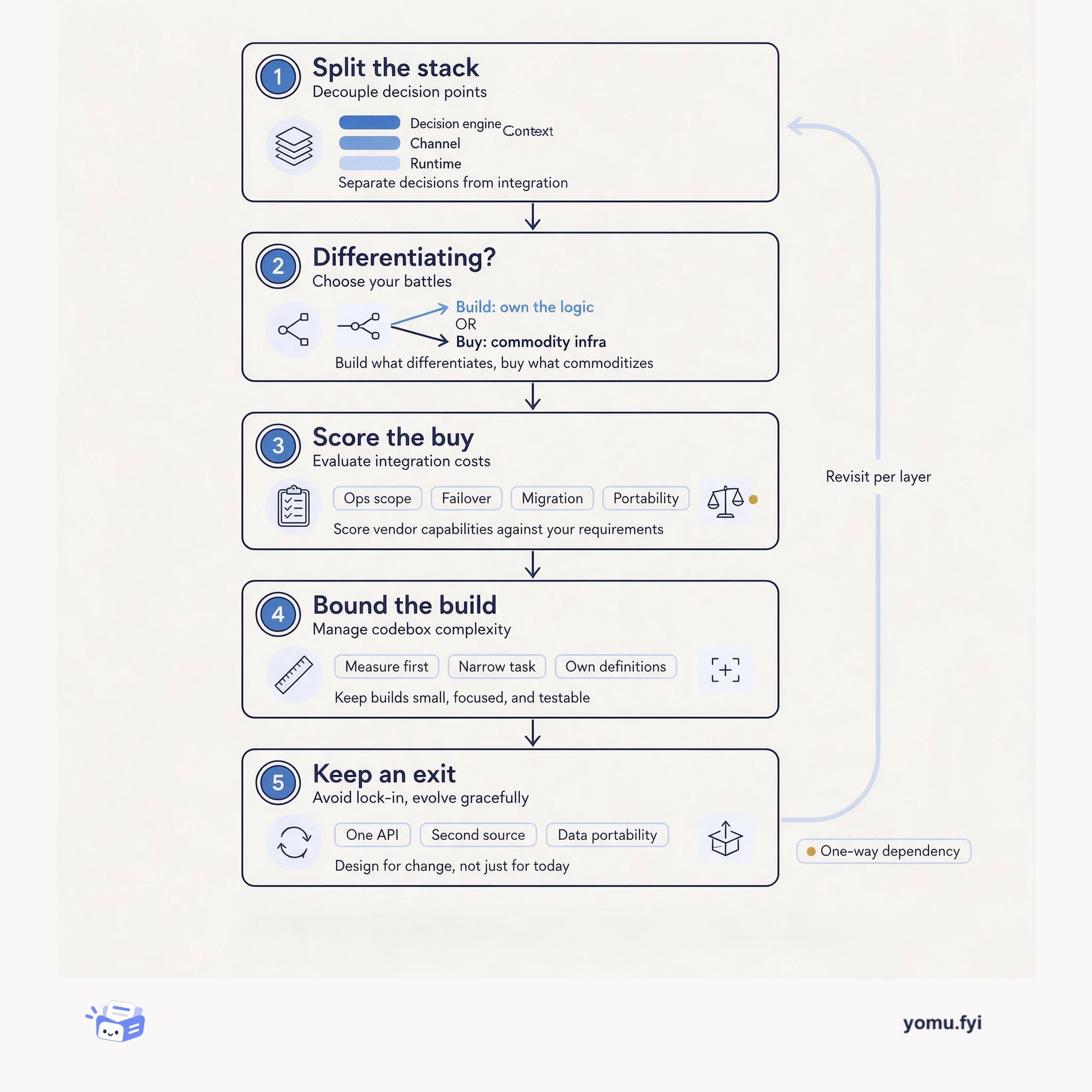
Build vs. buy is a per-layer decision, not a single platform choice. This flow splits a system into layers, tests each for differentiation, then sets the buy criteria and the exit path.
Keep reading
Related reading
The Good Stuff
Paid picks we use ourselves. Links carry a referral code — a subscription through one earns us a commission at no extra cost to you.