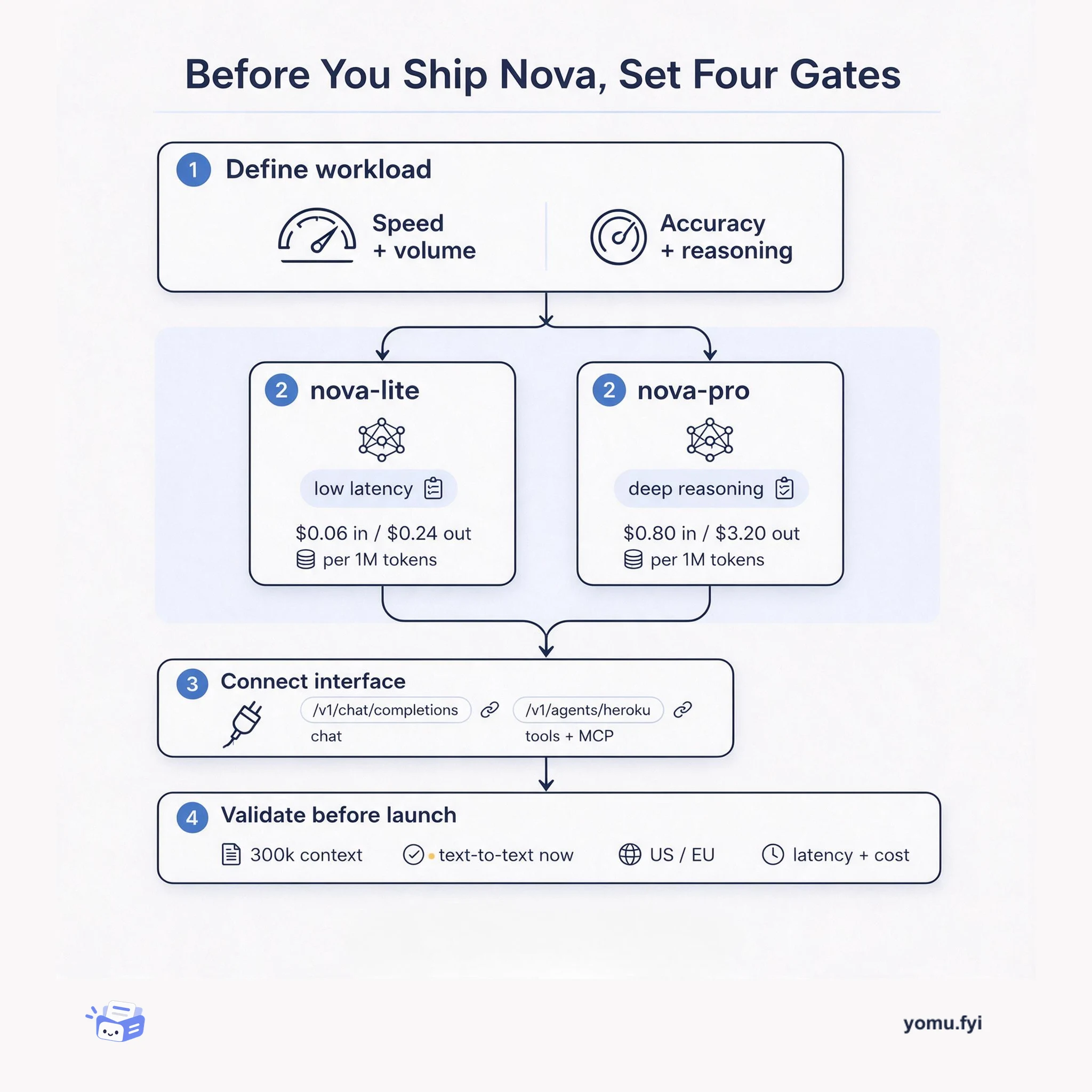
Before You Ship Nova, Set Four Gates
A practical checklist for putting Amazon Nova into an application: choose nova-lite or nova-pro by workload, expose tools, and verify context, modality, region, and cost constraints.
 AWSHyunsoo Kim, Ph.D.Problem & solution
This post presents an inventory automation architecture that moves from zero-shot demand forecasts to validated purchase orders while applying safety stock, minimum order quantities, budgets, and promotional adjustments. It combines Amazon Chronos2, hosted on SageMaker Serverless Inference, with four Claude-powered agents built using the Strands Agents SDK and deployed on Amazon Bedrock AgentCore; deterministic Python tools perform computation and agents handle judgment. Product data and future covariates arrive through CSV files in S3, while business rules remain in JSON, enabling what-if forecasts and onboarding without per-SKU training. In internal testing across 50 SKUs over a four-week horizon, the system reached 12.3% median WAPE, reduced onboarding from 2–3 weeks to under five minutes, and lowered estimated monthly inference cost from about $1,091 to $15. A conditional retry loop surfaces budget violations for user decisions instead of silently truncating orders, with traces and evaluator scores supporting auditability.
Inventory managers must forecast demand across many SKUs and convert those forecasts into purchase orders while handling asymmetric overstock and stock-out costs, supplier lead times, promotions, pricing changes, safety stock, minimum order quantities, and budget constraints. Existing per-SKU forecasting and manual business-rule workflows create substantial operational and auditability burdens.
The architecture stores product data in CSV files on Amazon S3 and business rules in JSON, uses Amazon Chronos2 for zero-shot probabilistic forecasting with covariates, and orchestrates four Claude-powered agents through the Strands Agents SDK and Amazon Bedrock AgentCore. Deterministic Python tools perform calculations and file operations, while conditional retries, observability, and evaluations support recovery and auditability.
Chronos2 accepts historical and future covariates through the predict_df() API, enabling promotion and price what-if scenarios without per-SKU fine-tuning.
In internal testing across 50 SKUs over a four-week horizon, the system achieved 12.3% median WAPE and averaged 8 seconds of end-to-end latency per SKU, excluding cold start.
When a budget constraint would cause a shortfall, the Supervisor presents options such as raising the budget, expediting delivery, or delaying a promotion instead of silently truncating the order.
Summaries are generated from the original by a language model. Check the original before relying on it.
See the idea
A practical checklist for putting Amazon Nova into an application: choose nova-lite or nova-pro by workload, expose tools, and verify context, modality, region, and cost constraints.
Keep reading
The Good Stuff
Paid picks we use ourselves. Links carry a referral code — a subscription through one earns us a commission at no extra cost to you.
One useful email. Unsubscribe anytime.
