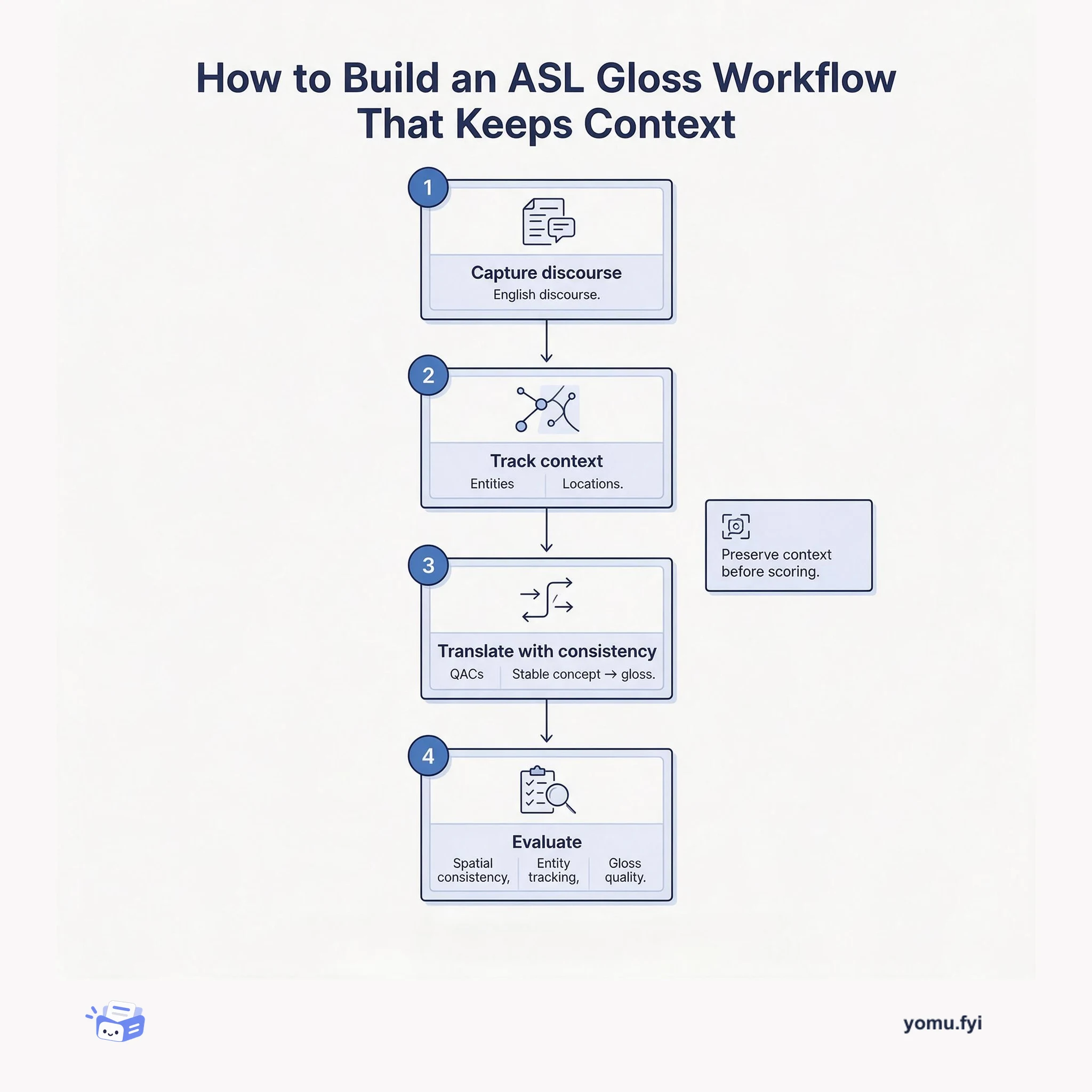
How to Build an ASL Gloss Workflow That Keeps Context
Learn a practical workflow for translating English discourse into ASL gloss while preserving spatial references, question-answer structure, and consistent concept-to-gloss mappings.
Loading…
Topic
489 posts about AI. Every summary links to the original.
See the idea
Learn a practical workflow for translating English discourse into ASL gloss while preserving spatial references, question-answer structure, and consistent concept-to-gloss mappings.
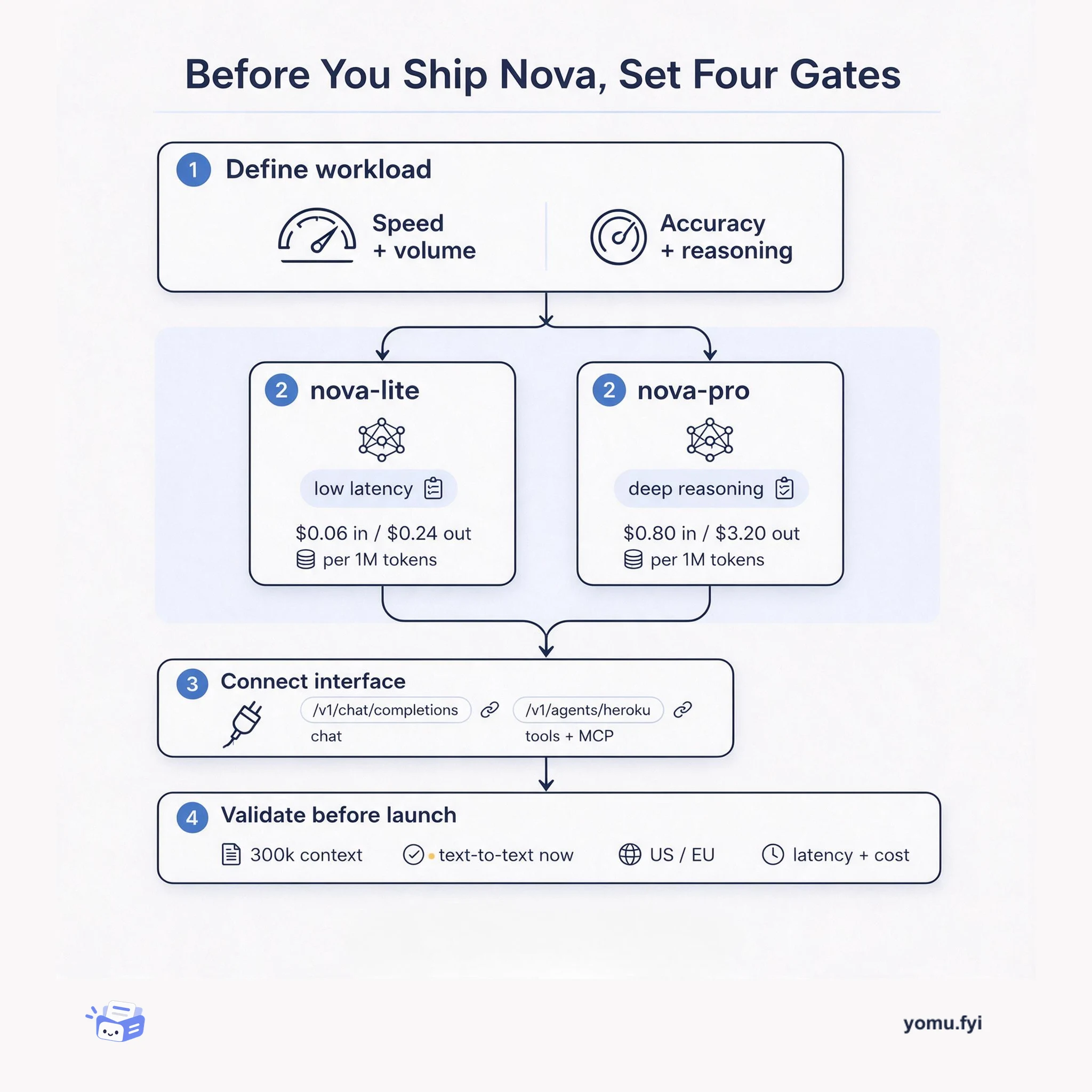
A practical checklist for putting Amazon Nova into an application: choose nova-lite or nova-pro by workload, expose tools, and verify context, modality, region, and cost constraints.
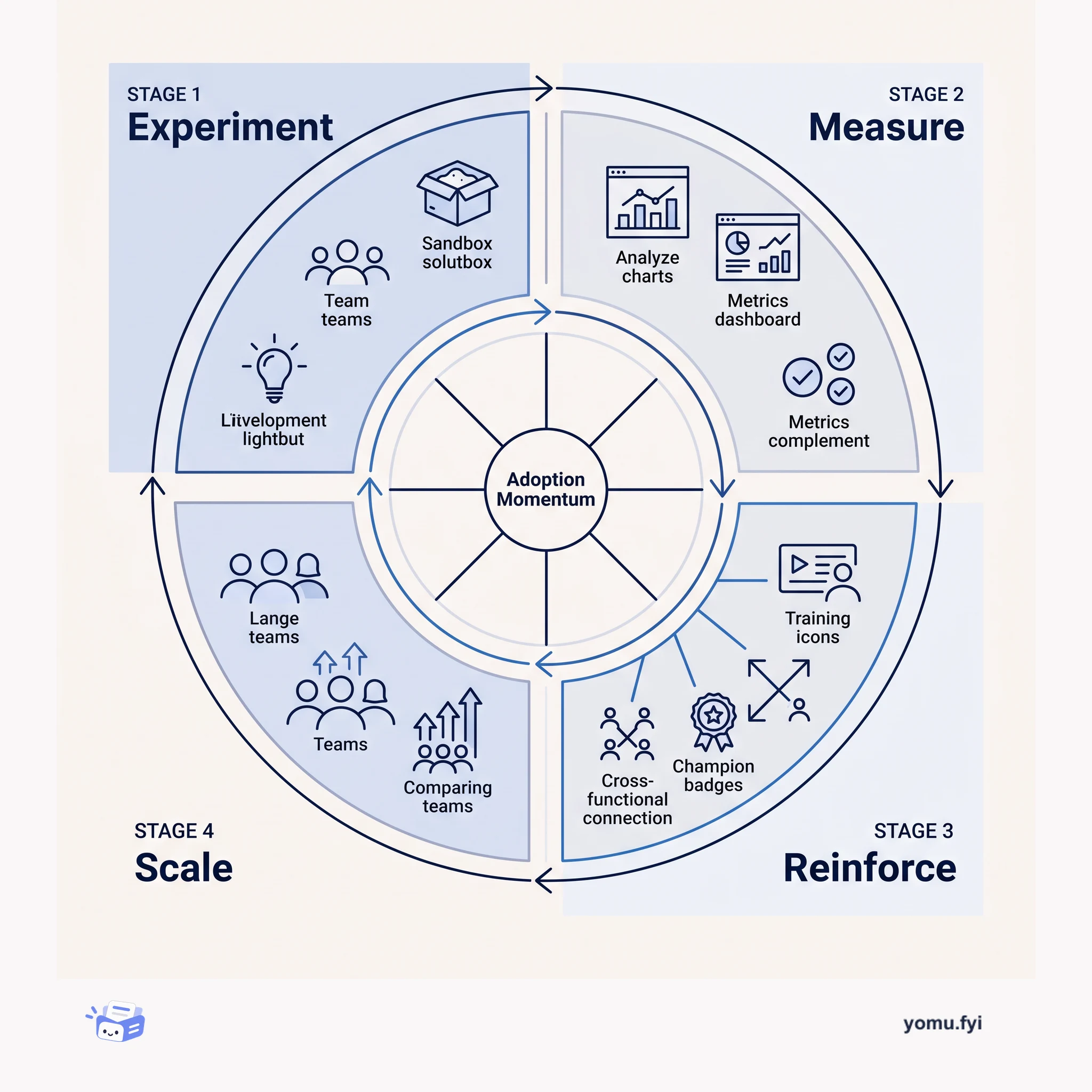
Adoption moves through experimentation, measurement, and reinforcement loops. Learn how leading companies build momentum from pilot programs into enterprise-wide habits and measurable business impact.
The Good Stuff
Paid picks we use ourselves. Links carry a referral code — a subscription through one earns us a commission at no extra cost to you.
Newest first
AI databases extend traditional databases with vector search, full-text search, and hybrid search to support production AI applications like RAG and AI agents. This guide evaluates 10 AI database solutions across seven criteria: search capabilities, serverless scaling, elasticity, Postgres compatibility, high concurrency, low latency, unified governance, and analytics integration. Solutions are grouped into purpose-built vector databases, such as Pinecone, Milvus, Weaviate, and Qdrant, and relational databases with AI search, like PostgreSQL with pgvector and Databricks Lakebase. The choice depends on whether retrieval is the primary requirement or if AI search must coexist with transactional and analytical workloads. Dedicated vector databases suit large-scale retrieval, pgvector fits existing Postgres teams, and Lakebase unifies AI search, transactions, and analytics on the Databricks platform.
By August 2026, Cloudflare’s AI code reviewer average cost had doubled to $2.46 per review, driven by a switch to Anthropic models and tripled token usage per session. Analysis showed 77% of spend went to prompt caching, yet first-request cache hits were only 14-26% because the shared prefix lacked an independent cache breakpoint. Adding a breakpoint on September 16 enabled cross-repository cache reuse, immediately cutting cost from $2.47 to $2.02. Subsequent changes—inline reference indices, tool removal, parallel file reads, and skipping reviewers on re-reviews—reduced cost by another $0.20 per review. The final result: $0.77 average cost (68% reduction), 1m32s median time (from 4m9s), and code quality at high effort maintained real-problem detection with reduced noise.
Cloudflare announces Clairic, a preview extraction model hosted on Workers AI, designed as a System One model for fast, one-pass value extraction from unstructured inputs. Unlike decision models such as Jev or Clef that output probabilities, Clairic returns extracted, computed, estimated, or forecasted typed values like numbers, dates, durations, and spans with character offsets and confidence scores. It processes only input tokens in a single forward pass, resulting in under-one-second responses and no output token charges, ensuring every answer is a valid typed value or null. The model handles extraction tasks like invoice numbers, estimation with distributions providing a median and 80% interval, and forecasting per future step with intervals, all without token generation. Cloudflare plans to release Clairic as open-weights soon and offers it via Workers AI with a typed field request structure accessible through env.AI.run() or the REST API.
Databricks is doubling its New York City office space at 5 Bryant Park to approximately 120,000 square feet across five floors, with plans to grow headcount significantly. The expansion includes a dedicated Engineering and Research floor for focused R&D, an Executive Briefing Center, and room for future growth. The NYC hub is home to AI research teams led by the Chief AI Scientist, infrastructure teams building Unity Gateway for cost and model governance, and applications teams developing CustomerLake for enterprise marketing. Databricks cites industry proximity to Fortune 500 companies in finance, media, and healthcare, access to talent from Columbia, NYU, and Princeton, and New York’s time zone connectivity to Europe and India as strategic advantages. The company is investing in New York as a premier AI talent hub where engineers build products alongside enterprises rather than in isolation.
Meta’s Prometheus supercluster in New Albany, Ohio, is a gigawatt-scale AI infrastructure project designed to train frontier models like Muse Wonder. The first phase is complete, comprising hundreds of thousands of GPUs across multiple interconnected buildings, with a target of roughly 1 million GPUs at full scale. Prometheus deploys multiple NVIDIA GPU platforms, including Catalina (GB200 NVL72) with 13.4 TB of HBM3e and Clemente (GB300 NVL72) with 20.7 TB of HBM3e, with Vera Rubin NVL72 arriving soon. The cluster uses a dedicated Back-End Ethernet network for GPU-to-GPU communication, and employs closed-loop liquid cooling and power management via Dynamo Dimmer to maintain high goodput. By focusing on stability, Meta achieved over 85% goodput for pre-training and over 90% for reinforcement learning runs, with a mean time between interruptions of ~47k GPU hours, later improved to over 54k GPU hours.
JetBrains’ Developer Ecosystem and AI Pulse surveys spanning 2024 to 2026 reveal rapidly changing developer sentiment and attitudes toward AI. Delegation readiness surged: writing application logic code jumped from 18% to 50%, test writing from 50% to 75%, and refactoring from 38% to 60% over one year. However, code review and debugging remain tasks that most developers are not yet ready to fully delegate, though readiness is climbing — code review from 33% to 43% and debugging reluctance dropping from 76% to 54%. The vast majority (79%) now expect employers to require AI tool proficiency, up from 59% in 2024. Concerns about AI reducing developer demand rose to 37% from 28%, and 25% believe AI will fully replace human developers, with 37% of heavy AI agent users sharing that view.
Notion used the Model Context Protocol (MCP), an open standard for connecting AI tools to other apps, to expand its AI integrations. Previously, each new MCP connection required hours of manual setup, including creating accounts, navigating developer settings, and testing, so only 25 apps were connected. In three weeks, Notion grew that number to 185 by building a Notion agent that automates the pipeline from setup to production. The agent handles sign-ups, browser clicks, and tests, while humans still review code changes, design assets, and partner with vendors. A key lesson was that private developer apps could pass internal tests but fail for customers, so the agent now tests from a second account simulating real users.
Databricks’ AI Research team uses AI Runtime (AIR) to manage hundreds of parallel research workstreams for products like Genie, Smart Routing, and AI Functions, training models from a few billion to nearly a trillion parameters. AIR performs preflight checks on GPU nodes to ensure health and communication before training, and monitors node health during execution to detect issues like NCCL failures or thermal throttling. The AIR CLI and custom Docker containers enable fast experimentation by launching jobs in seconds without rebuilding environments, supporting both supervised fine-tuning and reinforcement learning. MLflow integration automatically tracks experiments, while Unity Catalog FUSE mounting gives governed access to research data across workspaces without changing training code. The team has scaled to agent-led training, where AI agents propose changes, launch trials, and evaluate results, increasing training job volume by 8x across AI Functions research workloads.
Reflection released Beam, a 501B-parameter mixture-of-experts model with 23B active parameters per token, under the Apache 2.0 license, targeting coding and agentic use cases. The model supports a 1M-token context window using hybrid attention with 43 sliding-window and 9 global layers, and a residual stream that scales sublayer outputs by 1/sqrt(k) to maintain constant magnitude. Its MoE router uses a group-limited scheme with 256 experts, 8 routed per token, and the BF16 checkpoint occupies about 1 TB. Benchmarks show strong performance: 81.6% on SWE-bench Verified, 97.7% on AIME 2026, and 90.6% on GPQA Diamond, with minimal degradation in FP8 and NVFP4 quantizations. The model ships with a Rust-based harness, day-0 support in transformers, vLLM, and SGLang, and includes SFT and RL recipes, with a $10,000 Hub credits competition for community projects.
The post argues that the ability to go from idea to pull request using AI agents is now a commoditized problem, with two main approaches: vibe coding for rapid prototyping and human-supervised agentic development for mature products. The real challenges lie in deciding what to build—using criteria such as customer value, clear objectives, product fit, and financial strategy—and validating that the generated code is safe to ship. Validation must cover functional correctness, performance, security, resilience, compliance, and internal code quality using tools like unit tests, contract tests, AI-generated runtime tests, DAST, SAST, dependency scanning, code quality analysis, LLM-based code review, progressive rollout, and formal methods. A risk-based approach applies deeper validation to high-risk components—such as security-critical or data-damaging code—while allowing automated merges for low-risk areas like documentation or demo apps. The focus should shift from code generation to crisp product definition and robust verification pipelines.
Anthropic is offering Claude for Enterprise and Claude for Government to all three branches of the U.S. government for $1, removing cost barriers to AI adoption. The offer builds on Claude’s addition to the GSA schedule and supports FedRAMP High workloads for sensitive unclassified data. Government partners already using Claude include the Department of Defense, Lawrence Livermore National Laboratory with 10,000 daily users, and the District of Columbia Department of Health. The package includes frontier models with continuous updates and technical support for one year, with coordination underway with GSA for implementation. This expanded access aims to accelerate AI adoption across the federal government for scientific research, national security, and constituent services.
Many engineering teams mistakenly think building an internal AI knowledge context layer is as simple as standing up a vector database and wiring a RAG pipeline to documentation. In reality, a production-grade pipeline requires five continuously maintained stages—capture, deliver, govern, organize, and validate—where each stage’s long-term cost compounds as vendor APIs change and content ages. The critical innovation is the knowledge node, a living record carrying source, ownership, and an automatically computed trust score based on authorship, usage, recency, and conflicts. Trust decays over time, prompting owners for lightweight revalidation when confidence drops, and knowledge is automatically scoped to the correct audience without manual filing. For product companies not in the knowledge-infrastructure business, the compounding maintenance burden makes building this pipeline a distraction compared to leveraging existing platforms like Stack Internal.
Dynata, a large first-party data company, sought to accelerate delivery across distributed teams while improving cross-functional alignment. They adopted a staged AI approach: first AI-assisted coding via Amazon Q Developer, then connecting AI to project context from Jira, Confluence, and Lucid, and finally implementing the AI-Driven Development Lifecycle (AI-DLC) methodology using Kiro IDE. AI-DLC, powered by Amazon Bedrock, structures delivery into Inception, Design, and Construction phases with Specs, steering files, and hooks. This process forced all teams to agree on requirements and design during a Day 1 workshop, surfacing gaps before coding began. Consequently, features that once took 3–4 sprints were completed in about one sprint, cutting development phase time by roughly 70% and reducing post-launch defects.
Cloudflare and OpenAI launched a research pilot in July 2026 to help ChatGPT users discover content more efficiently using network signals about page existence changes and potential harm. The pilot ran on a cohort of about one percent of Cloudflare’s network and has enabled OpenAI to index hundreds of millions of new web pages that are useful but sparsely linked. Cloudflare provides these discovery signals to OpenAI’s crawler while OpenAI independently evaluates and ranks pages by relevance and helpfulness for ChatGPT Search. The collaboration also tests signals that flag harmful pages like fake login forms so crawlers avoid them without penalizing the legitimate domain. The next phase will refine page selection test faster change signals and measure business outcomes for site owners whose content is discovered.
The post describes systematic performance optimization to reduce fine-tuning time for the Qwen 3.8 27B model on AI Runtime from 7 hours 44 minutes to 1 hour 17 minutes, a 6x improvement. The baseline showed 98% GPU utilization, but torch traces revealed the CPU was stalling the GPU with too many small operations. Installing manually fused kernels such as flash-linear-attention and causal-conv1d reduced the number of GPU operations by 15x and improved training speed by 3.7x. Further gains came from switching from 2D padded batches to 1D packed tensors with correct position_ids, which reduced the number of batches by 36% and eliminated dynamic shape recompilation. The post emphasizes measuring what matters beyond GPU utilization and leveraging pre-built community kernels and efficient batching.
Twilio launched the Twilio Video Media SDK in Public Beta, a server-side software package that connects applications to a Twilio Video Room as a secure virtual participant, streaming real-time audio and video to backend systems. This launch supports AI-enabled customer engagement by allowing teams to use consistent AI logic across chat, voice, and video channels while keeping sensitive data secure. The SDK enables use cases such as multimodal AI assistants that see and hear users, ambient healthcare documentation, remote verification with computer vision, and server-side compliance checks. By routing individual media tracks to a secure backend, the SDK supports HIPAA and GDPR requirements without client-side rendering. Early adopter GLOBO Language Solutions uses the SDK to enhance real-time quality and AI integration for patient care in healthcare environments.
Large language models can be unreliable, with serious consequences in regulated industries. Patronus AI, an industry-first automated evaluation platform, enables engineers to score and benchmark LLM performance on real-world scenarios, generate adversarial test cases, and monitor hallucinations and PII. Research using FinanceBench found that state-of-the-art LLMs hallucinated or incorrectly answered up to 81% of financial analysts’ questions, even with RAG and external context. Patronus partnered with MongoDB Atlas to offer a RAG evaluation API and published a 10-minute guide demonstrating evaluation of a RAG system built with LlamaIndex and Atlas Vector Search on an SEC 10-K filing. Developers can improve RAG performance by adjusting indexes, chunking sizes, prompts, or fine-tuning embedding models, and should continuously test to maintain improvements.
Meta released Muse Spark Open, an open-weight multimodal mixture-of-experts model with approximately 816 billion total parameters and around 42 billion active per token. It processes text, images, audio, and video inputs while generating text output, supporting a context window of up to one million tokens. The model uses 256 experts per MoE layer with 8 selected per token, and the BF16 checkpoint requires about 1.5 TB of storage. Meta trained Muse Spark Open for agentic coding tasks including reading codebases, writing and debugging code, and calling tools. The post provides recipes for running the model using transformers, llama.cpp, vLLM, and SGLang, as well as fine-tuning with LoRA on 64 H100 GPUs.
AI models depend on flexible, high-performance data infrastructure. Leading Italian enterprises including TeamSystem, altermAInd, Brembo Solutions, and Eni are using MongoDB Atlas to power their AI initiatives. TeamSystem built a centralized AI platform with hybrid search combining full-text and vector search that delivers precise, context-aware results while minimizing hallucinations, scaling from 50,000 to 500,000 users and cutting task times by 30–40%. altermAInd solved GDPR and EU AI Act compliance at the database layer, enabling secure innovation for over 200,000 customers. Brembo Solutions uses ALCHEMIX to slash R&D formulation from months to minutes by leveraging MongoDB’s document model for diverse material data. Eni uses Atlas Search and vector search to instantly analyze years of geoscience data and Atlas Charts for real-time interactive visualizations without hand-coded dashboards. These companies show that a robust, secure, and scalable data platform is foundational to enterprise AI success.
A survey of over 6,000 knowledge workers across the UK, France, and Germany, commissioned by Notion, reveals that daily AI users report significantly more benefits than occasional users. For example, 59% of daily users in the UK say AI agents are changing team collaboration, versus 37% overall, and 48% say AI helps them demonstrate more value, nearly double the overall 25%; similar patterns hold in France and Germany. Gen Z workers are especially likely to use AI to expand their responsibilities, but they also express higher concern about job security, notably in Germany where concern was 21 points above the national average. However, AI use remains largely individual: only about 20% of respondents embed AI agents in team-wide workflows. The post argues that the next step is rebuilding AI around shared workflows and company context, as demonstrated by companies like Pennylane and Brainlabs.
The best engineering reads, once a week.