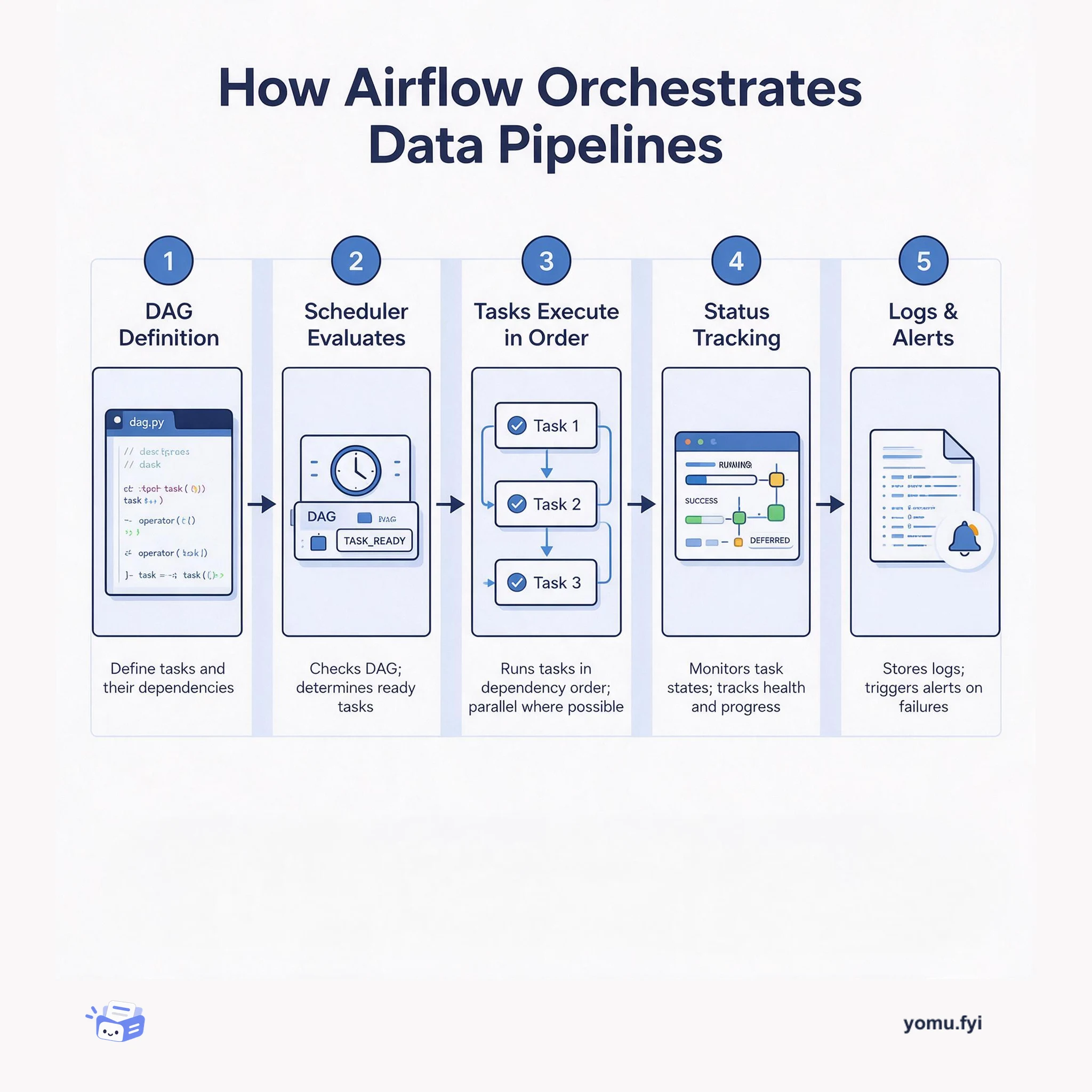
How Airflow Orchestrates Data Pipelines
Airflow is a workflow orchestration platform that schedules, monitors, and manages data pipelines by defining tasks as code, executing them in dependency order, and tracking their success or failure.
 RampPeyton McCulloughProblem & solution
Ramp describes how its machine-learning organization used Metaflow to shorten the path from prototype to production for models spanning credit risk, fraud, growth, product, and Ramp Intelligence. Its initial riskiness model exposed long vendor-managed jobs, weak logging, limited Docker support, and substantial platform friction; the model took months to build. Metaflow, with developer-experience improvements, lets teams define flows in Python, run them locally or on AWS Batch, visualize results with cards, and connect production execution to Step Functions and Airflow. Ramp chose AWS-managed infrastructure, initially using Fargate before encountering startup and resource constraints, and later built a MetaflowOperator to simplify Airflow triggering and log access. After adoption, Ramp shipped eight additional models in ten months, recorded more than 6,000 Flow runs, and reports that data scientists can largely self-service while platform engineers spend less time debugging infrastructure.
Ramp’s first riskiness model was slowed by a vendor platform that prevented local pipeline execution, required manual code pushes, produced slow and flaky jobs, offered poor logging and Docker support, and demanded substantial platform involvement. These issues created long feedback loops and made it difficult to move machine-learning models into production quickly.
Ramp adopted Metaflow alongside developer-experience improvements, using Python-defined Flows that can run locally or on AWS Batch. Its setup uses AWS-managed services, Step Functions for longer-running flow execution, Airflow for scheduling and triggering, and a custom MetaflowOperator for simpler execution and log access.
Metaflow enabled Ramp to define machine-learning pipelines in Python, run the same flows locally or in the cloud, and inspect results through UI cards.
Ramp initially used AWS Fargate but encountered long startup times and restrictive CPU-memory combinations; the source describes these as obstacles for interactive data-science jobs.
Ramp shipped eight additional models in ten months and surpassed 6,000 Flow runs, while reporting largely self-service use and less platform-team time spent debugging infrastructure.
Summaries are generated from the original by a language model. Check the original before relying on it.
See the idea
Airflow is a workflow orchestration platform that schedules, monitors, and manages data pipelines by defining tasks as code, executing them in dependency order, and tracking their success or failure.
Keep reading
The Good Stuff
Paid picks we use ourselves. Links carry a referral code — a subscription through one earns us a commission at no extra cost to you.
One useful email. Unsubscribe anytime.