AI agents that fail to recognize returning customers force them to repeat information, with 74% of consumers reporting repetition and 71% willing to abandon conversations early. Twilio’s approach uses three capabilities: identity resolution to match profiles across channels, recall to pull observations and summaries from Conversation Memory, and write-back to save new facts via the Memory API. Conversation Memory stores structured traits, extracted observations from conversations, and short conversation summaries, with the Recall API returning up to 20 observations and 5 summaries per profile. Agent Connect loads relevant context before the agent replies, running in Orchestrator mode with memory modes of always or once, and it uses ConversationRelay for voice calls. New facts are saved mid-conversation by agent tools calling the Memory API directly because automatic extraction only runs after a conversation closes, and memory carries across channels and human handoffs through Twilio Flex.
Context
AI agents often fail to recognize returning customers, leading to repeated questions and customer frustration. Research in the post shows 74% of consumers report having to repeat themselves, 71% are willing to abandon conversations early, and 91% of brands have seen customer satisfaction drop due to AI missteps, most notably when context is lost between channels or interactions.
Approach / What changed
Using Twilio Conversation Memory for storing traits, observations, and summaries; Conversation Orchestrator for identity resolution across channels; and Agent Connect with configurable memory modes to load context before replies and save new facts mid-conversation via the Memory API. The system relies on three capabilities: identity (matching profiles using phone numbers, handles, IDs), recall (Retrieving up to 20 observations and 5 summaries with date filters), and write-back (adding observations or updating traits during a conversation via the Memory API).
Takeaways
1
Twilio Conversation Memory resolves customer identity across channels using phone numbers, WhatsApp handles, email addresses, chat IDs, and user IDs, and Conversation Orchestrator applies this to every conversation.
2
The Recall API returns up to 20 observations and 5 summaries per profile, with date filters to focus on recent conversations, and Agent Connect’s memory mode can be set to always or once.
3
Automatic memory extraction runs after a conversation goes inactive or closes; mid-conversation updates must be written directly via the Memory API because there is no mid-conversation extraction.
FAQ
How do I stop my chatbot from asking the same questions every time a customer returns?
Twilio Conversation Memory stores what customers share as traits, observations, and conversation summaries. Agent Connect retrieves that memory before each reply, so the agent starts with what it already knows, preventing repeated questions.
What tools let an AI agent update a customer profile mid-conversation based on new information?
Twilio Conversation Memory's API lets an agent tool create observations or update traits during a live conversation. Automatic extraction runs later, after the conversation goes inactive or closes, so direct API calls are needed for immediate updates.
Why does my AI agent forget customers between conversations?
Twilio Conversation Memory can only recall a profile it can identify, and it extracts observations after a conversation goes inactive or closes. Check identifier links, extraction settings, and the agent's memory mode to ensure proper memory persistence.
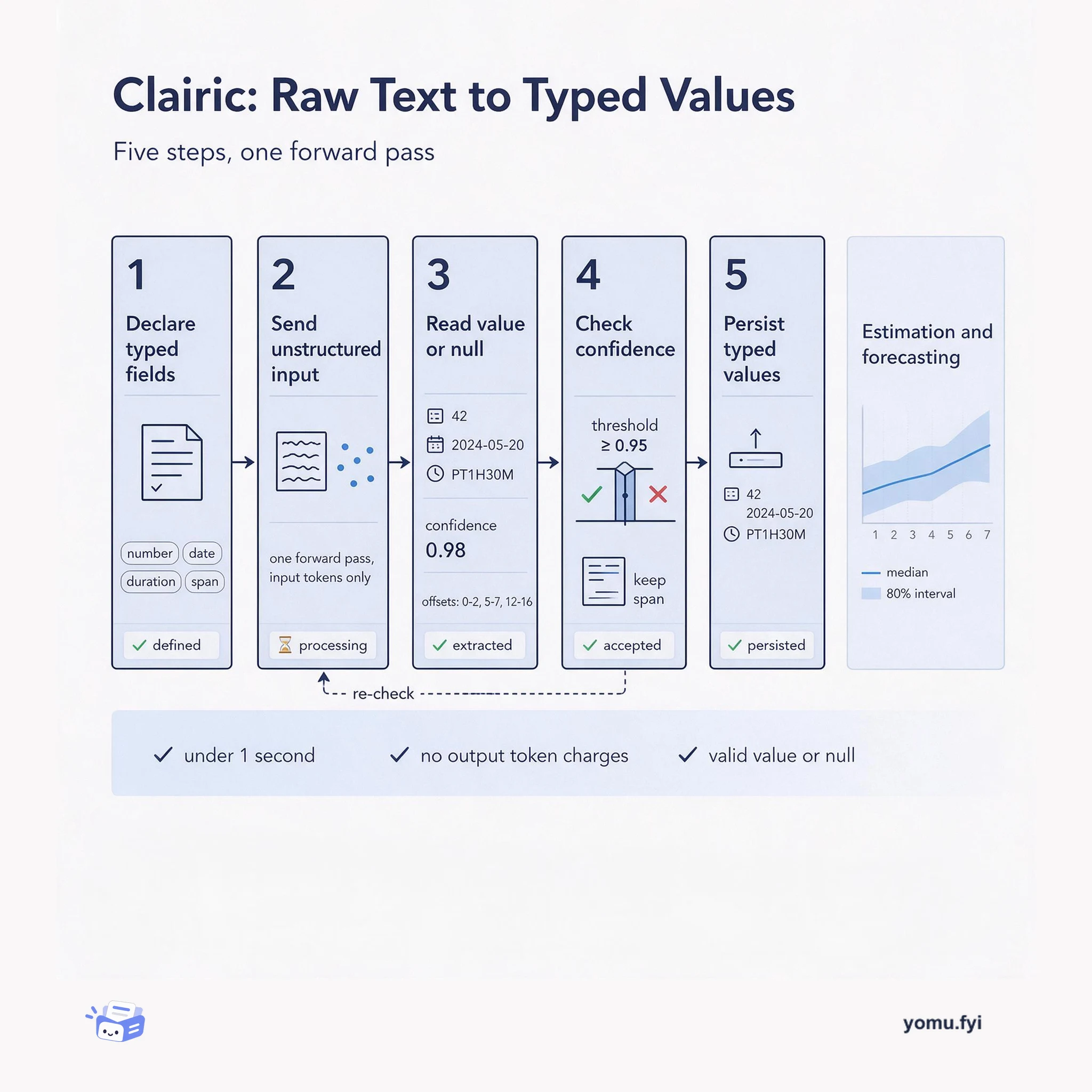
Clairic is a System One extraction model that turns unstructured input into typed values in a single forward pass. This five-step flow shows how to declare fields, call it, and use the results.
Keep reading
Related reading
The Good Stuff
Paid picks we use ourselves. Links carry a referral code — a subscription through one earns us a commission at no extra cost to you.