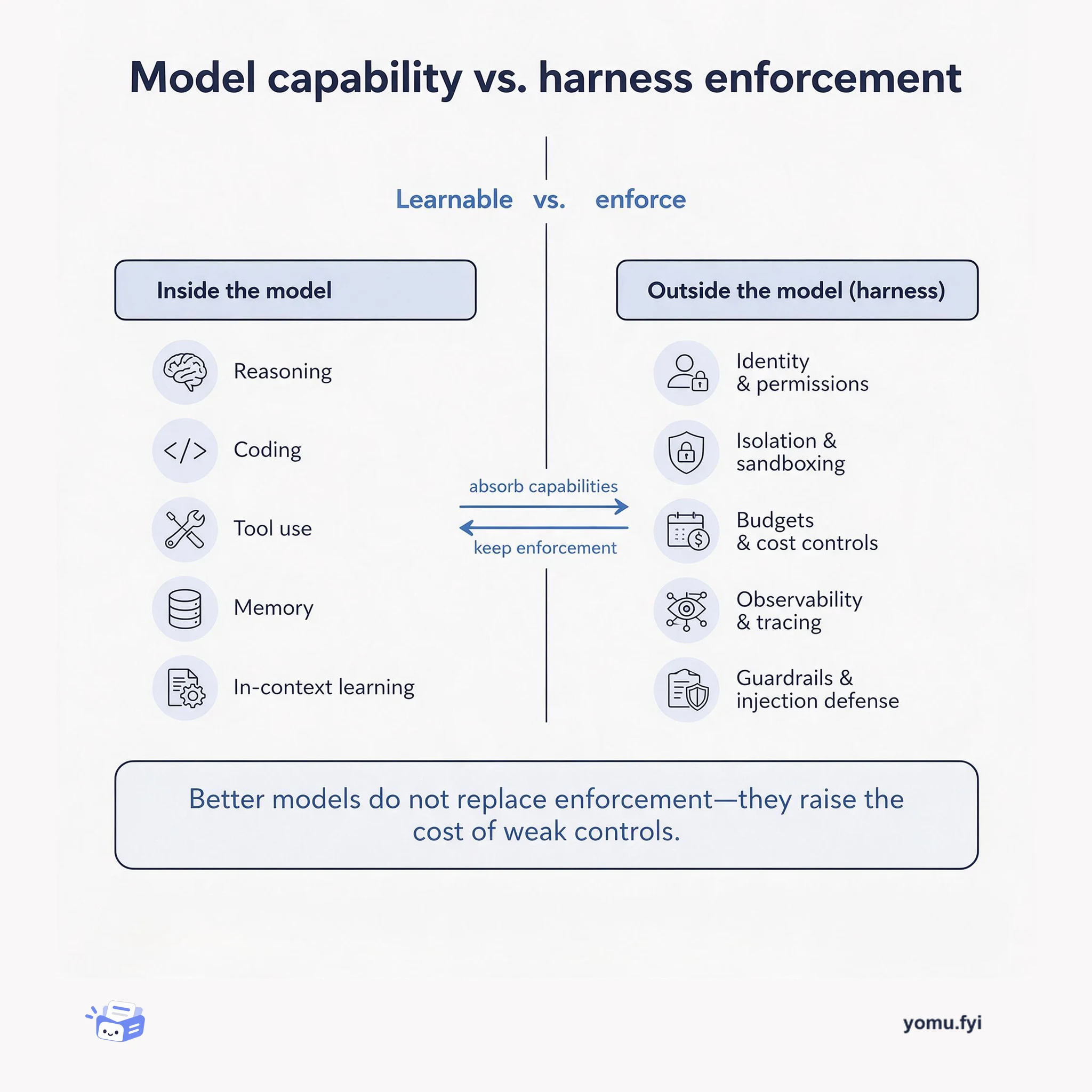
Model vs. Harness: Where AI Agent Controls Belong
A comparison of what AI models should learn versus what agent infrastructure must enforce. See how reasoning, permissions, isolation, budgets, and observability split across the boundary.
 AWSRushabh LokhandeExplainer
An enterprise AI agent is not a larger chatbot; it is a multi-step system that plans, retrieves knowledge, calls tools, and verifies results in a loop. This reference architecture organizes the agent into five layers: an API gateway for identity and policy, a five-phase agent runtime (Understand, Plan, Retrieve, Reason, Act and Observe), a knowledge and state tier, a platform-services layer, and a cross-cutting trust and control framework. Each layer maps to AWS managed services such as Amazon Bedrock, AWS Lambda, and Amazon EventBridge. The design follows the AWS Well-Architected Framework Generative AI Lens, applying zero trust, defense in depth, separation of concerns, observable by default, and fail-safe defaults. Governance, observability, and cost controls must be embedded in every layer, not bolted on at the end.
Enterprises are moving from single-turn chatbots to multi-step AI agents that plan, use tools, and verify outcomes. This shift introduces new requirements for orchestration, memory, governance, observability, and cost control. The architecture is designed to meet those requirements by following the AWS Well-Architected Framework Generative AI Lens, with principles of zero trust, defense in depth, separation of concerns, observable by default, and fail-safe defaults.
A five-layer reference architecture on AWS: (1) API gateway with identity and policy enforcement, (2) a five-phase agent runtime loop (Understand, Plan, Retrieve, Reason, Act and Observe), (3) knowledge and state tier for memory, (4) platform-services layer for models and tools, and (5) a trust and control framework across all layers. Each layer maps to AWS managed services such as Amazon Bedrock, AWS Lambda, and Amazon EventBridge.
An enterprise AI agent uses a five-phase loop (Understand, Plan, Retrieve, Reason, Act and Observe) that cycles until the goal is reached or a human must step in, unlike a single-turn chatbot.
Governance, observability, trust controls, and cost controls must be built into every architectural layer, not added as an afterthought, to make the agent production-ready.
The architecture maps each layer to AWS managed services: Amazon Bedrock for models and guardrails, AWS Lambda for tool execution, and Amazon EventBridge for event-driven observability.
An agent cycles through a five-phase loop (Understand, Plan, Retrieve, Reason, Act and Observe) until it reaches the user's goal or escalates to a human. A chatbot answers one message and stops, without multi-step reasoning, tool use, or persistent state.
Governance, observability, trust controls, policy enforcement, and cost controls must be built into every step. The architecture uses an API gateway for identity and policy, step-level tracing for observability, guardrails and human checkpoints for trust, and cost-aware design to control token spend.
The architecture uses AWS managed services: Amazon Bedrock for models and guardrails, AWS Lambda for tool execution, Amazon EventBridge for event-driven observability, AWS IAM for access control, and AWS CloudTrail and AWS X-Ray for audit and tracing.
Summaries are generated from the original by a language model. Check the original before relying on it.
See the idea
A comparison of what AI models should learn versus what agent infrastructure must enforce. See how reasoning, permissions, isolation, budgets, and observability split across the boundary.
Keep reading
The Good Stuff
Paid picks we use ourselves. Links carry a referral code — a subscription through one earns us a commission at no extra cost to you.
One useful email. Unsubscribe anytime.
