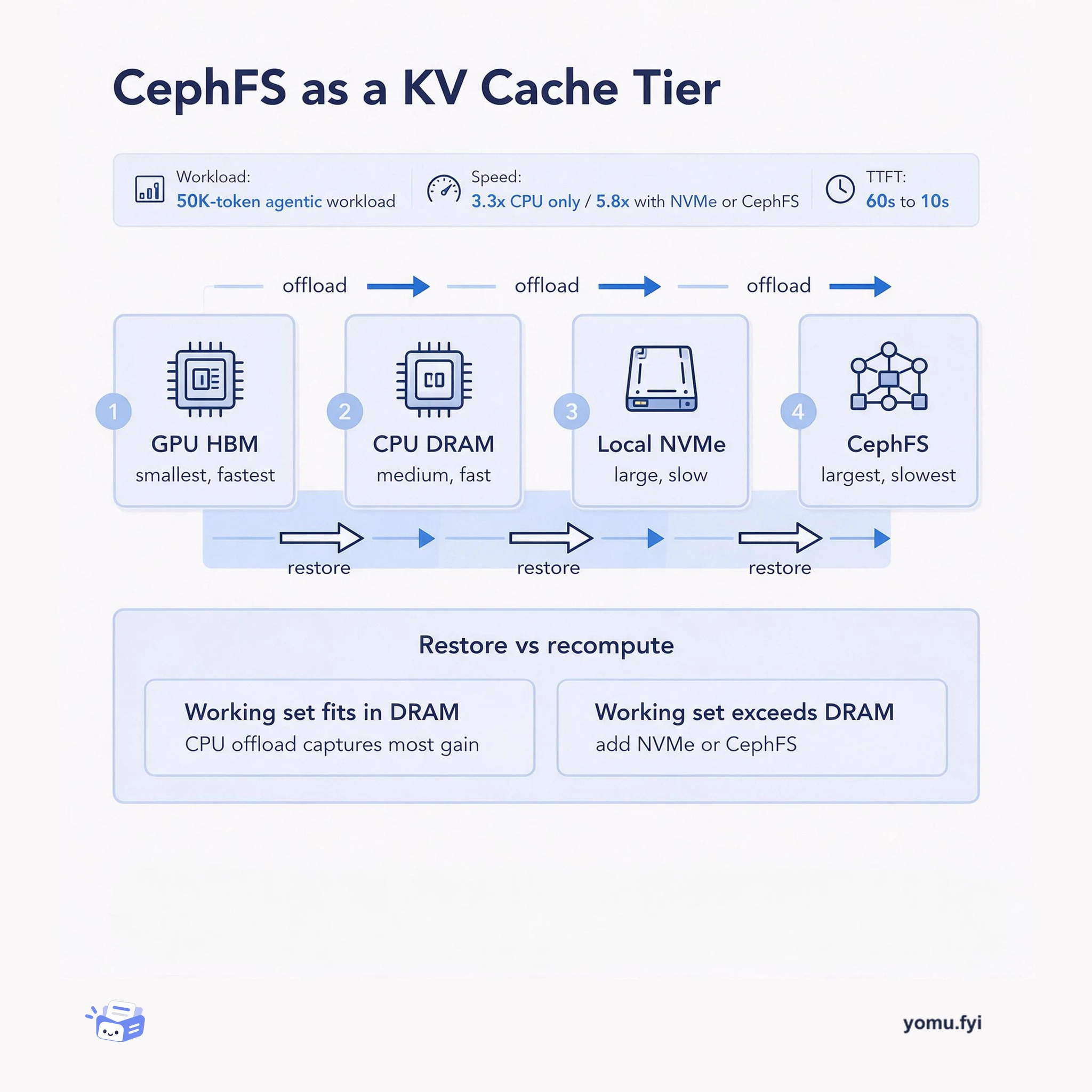
CephFS as a KV Cache Tier: When Restoring Beats Recomputation
A tiered KV cache flow that moves blocks from GPU HBM to DRAM, local NVMe, and CephFS—and shows how to decide when restoring a block beats recomputing it.
 DatabricksCassie MurrayAnnouncement
Lakebase Postgres is now generally available on Google Cloud, giving Databricks users a fully managed, serverless Postgres option for production and agentic workloads. Its architecture separates compute from storage and shares the same storage layer as analytical data, which removes pipeline maintenance and data duplication. The service offers serverless autoscaling with scale to zero, instant zero-copy branching, point-in-time recovery, standard Postgres tooling, pgvector-compatible search, and governance through Unity Catalog. On Google Cloud it provides multi-zone high availability with automatic failover and a 99.99% SLA, single-zone endpoints with a 99.9% SLA, beta private connectivity through Private Service Connect, and Databricks OAuth or native Postgres credentials. Lakebase Search is described as delivering twice the throughput of pgvector at four times lower cost, while direct writes can load 1TB in under five minutes; GA regions include asia-southeast1, europe-west3, us-central1, us-east4, and us-west1.
The announcement positions Lakebase within Databricks’ Lake Transactional/Analytical Processing (LTAP) architecture, which unifies operational and analytical data. It says transactional databases and analytics platforms have traditionally been separate, requiring ETL pipelines, duplicated storage, and accepting data lag. Lakebase aims to remove that split by running operational workloads on the same platform and governance model as analytics and AI.
Lakebase separates compute from storage and shares the analytical storage layer, so operational workloads run on the same platform with Unity Catalog governance. It provides serverless autoscaling and scale to zero, zero-copy branching, point-in-time recovery, standard Postgres tools and extensions, pgvector-compatible search, and direct writes from lakehouse data. On Google Cloud it adds multi-zone high availability with automatic failover, Private Service Connect private connectivity in beta, and Databricks OAuth or native Postgres credentials.
Lakebase Postgres on Google Cloud offers multi-zone high-availability endpoints with automatic failover backed by a 99.99% SLA, while single-zone endpoints carry a 99.9% SLA.
Lakebase Search combines vector and full-text search in Postgres and is described as delivering 2x the throughput of pgvector at 4x lower cost, without a second system or sync pipelines.
Direct writes let teams push enriched lakehouse data into Lakebase Postgres; testing showed loading 1TB of data in less than five minutes.
It shares the same storage layer as analytical data, so operational workloads run on the same platform as analytics and AI. The announcement says this removes the need to build and maintain pipelines and avoids data movement to keep systems in sync.
Multi-zone high-availability endpoints include automatic failover and are backed by a 99.99% SLA. Single-zone endpoints are backed by a 99.9% SLA.
Private connectivity is available in beta through Google Cloud Private Service Connect. It lets enterprise customers keep database traffic off the public internet and connect applications in their own VPC directly to Lakebase.
Summaries are generated from the original by a language model. Check the original before relying on it.
See the idea
A tiered KV cache flow that moves blocks from GPU HBM to DRAM, local NVMe, and CephFS—and shows how to decide when restoring a block beats recomputing it.
Keep reading
The Good Stuff
Paid picks we use ourselves. Links carry a referral code — a subscription through one earns us a commission at no extra cost to you.
One useful email. Unsubscribe anytime.
