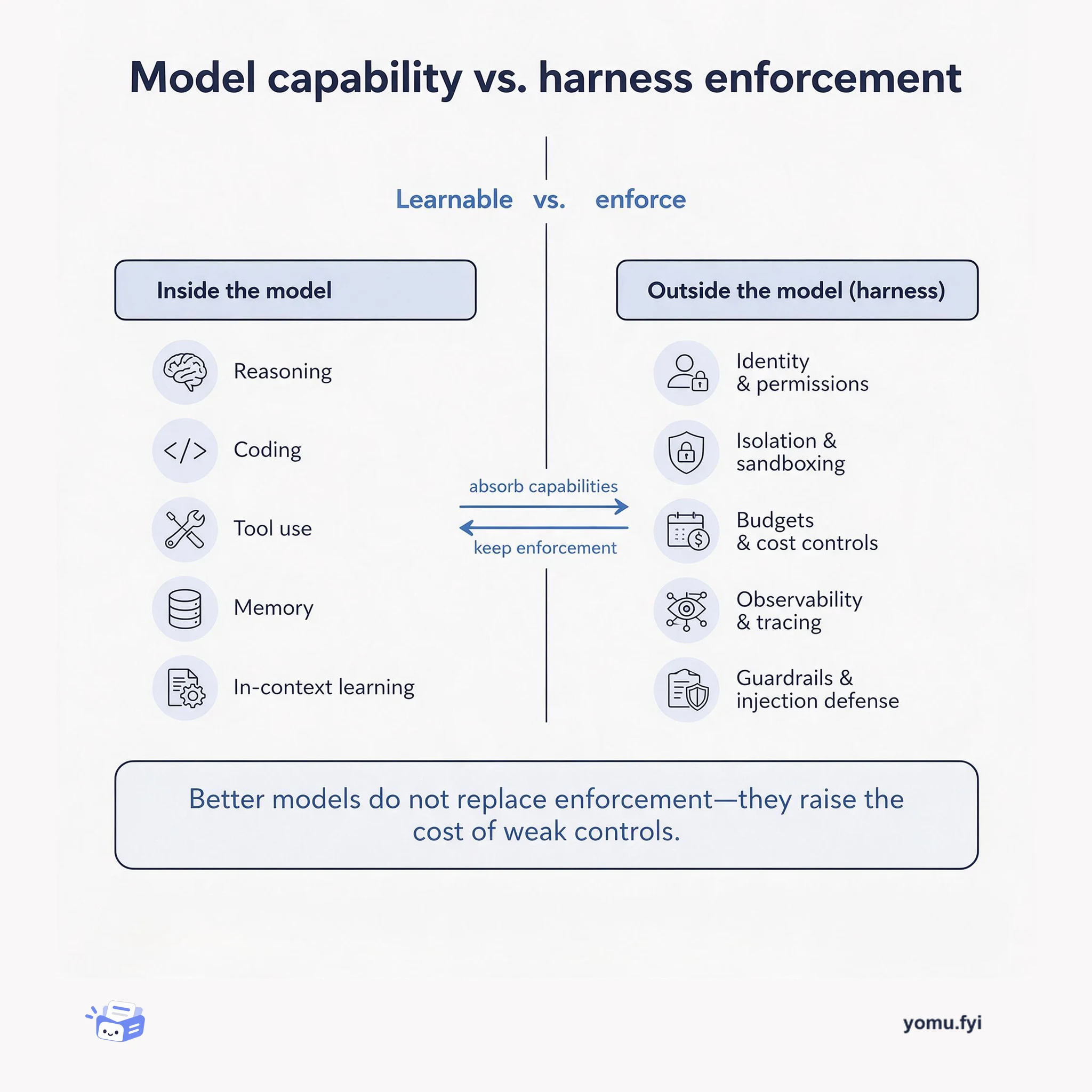
Model vs. Harness: Where AI Agent Controls Belong
A comparison of what AI models should learn versus what agent infrastructure must enforce. See how reasoning, permissions, isolation, budgets, and observability split across the boundary.
 Hugging FaceAbraham Daniels, Basel Shbita, Chad DeLuca, Dan Gutfreund, Michael Hind, Shub AAnnouncement
LLMON is a markup language that uses reserved special tokens to explicitly communicate structure and semantics to LLMs, addressing brittleness and prompt injection vulnerabilities. Components like instructions and data are marked with meaningful tags and unique IDs, enabling explicit binding between them. The authors release two experimental preview models derived from Granite 4.1 base models, trained to consume and generate LLMON-marked text. On the OPI benchmark, LLMON models achieve near-zero attack success rates for indirect prompt injections, outperforming the best frontier model by 47% while maintaining general capability comparable to Granite 4.1 Instruct models. LLMON enriches chat templates by adding component-level semantics and binding, and the models are trained through re-serialized instruction-tuning data and reinforcement learning.
LLMs rely on context that often lacks explicit structure, causing brittleness and vulnerability to prompt injections, especially in smaller models. Existing formats like JSON are designed for parsers, not LLMs.
LLMON uses reserved special tokens to mark semantically coherent components (instructions, data, requirements) with meaningful tags and unique IDs, enabling explicit binding. The preview models are trained from Granite 4.1 base checkpoints using re-serialized instruction-tuning data and reinforcement learning stages including GRPO and DPO.
LLMON uses reserved special tokens for structural delimiters, separating structure from content in the vocabulary, unlike JSON which uses characters that can appear in text.
LLMON models achieve near-zero attack success rates on indirect prompt injection benchmarks like OPI, outperforming frontier and open-source models significantly.
LLMON enriches chat templates by adding component-level semantics and binding, allowing explicit instruction/data separation without replacing the chat template.
LLMON separates instructions from data using explicit tags and an execution block that binds instructions to specific data. Instructions not bound in the execution block are ignored, so hidden instructions in data are not followed, reducing attack success rates to near zero.
JSON uses characters like quotes and brackets for structure, which are the same tokens as text, causing confusion for LLMs. LLMON uses reserved special tokens for structure, making boundaries explicit. Conversion tools allow lossless translation between JSON and LLMON.
Yes, you can define your own tag names and structure for your domain and fine-tune a LoRA adapter on top of the LLMON models to understand them, as demonstrated with the ScienceWorld benchmark.
Summaries are generated from the original by a language model. Check the original before relying on it.
See the idea
A comparison of what AI models should learn versus what agent infrastructure must enforce. See how reasoning, permissions, isolation, budgets, and observability split across the boundary.
Keep reading
The Good Stuff
Paid picks we use ourselves. Links carry a referral code — a subscription through one earns us a commission at no extra cost to you.
One useful email. Unsubscribe anytime.
