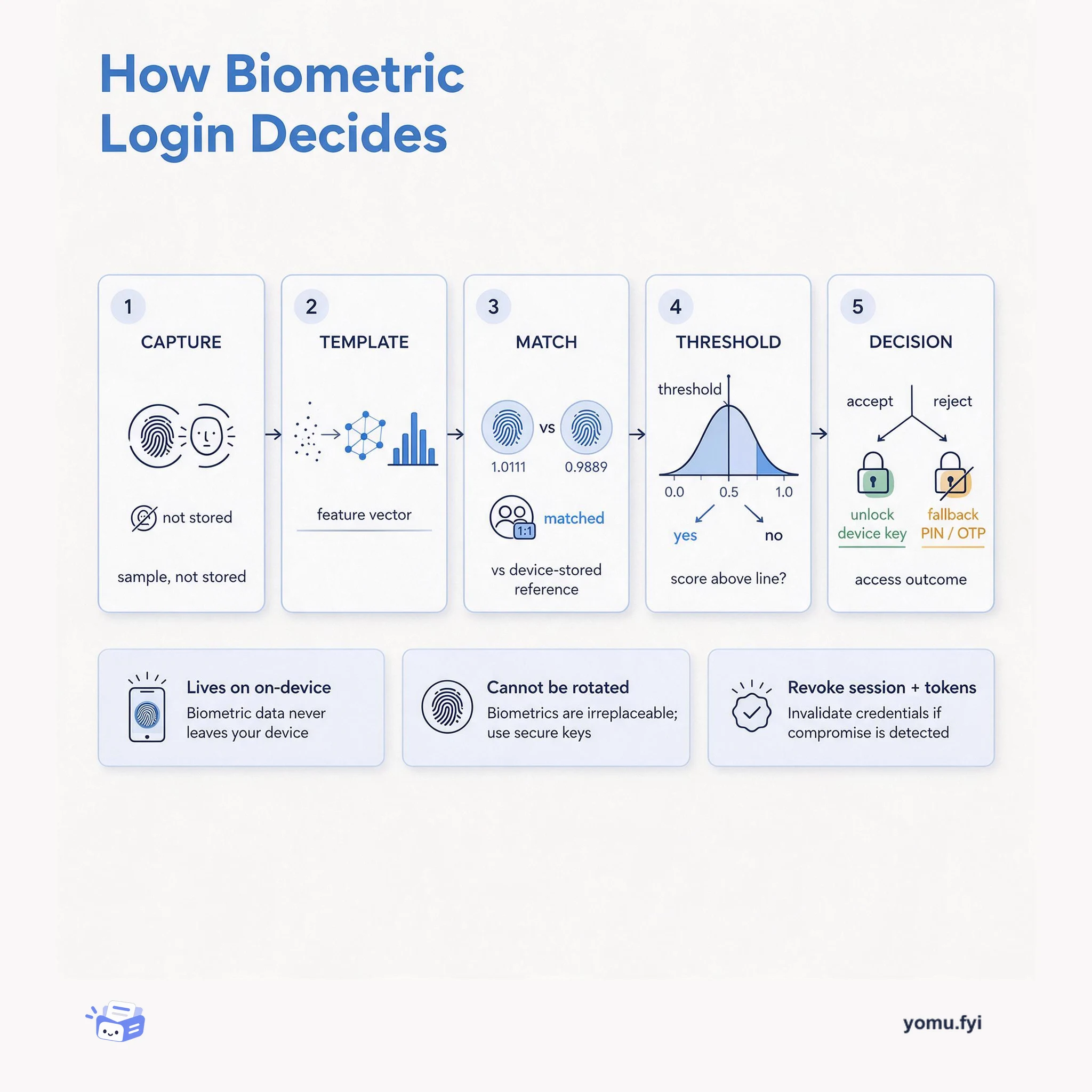
How Biometric Login Decides: Capture, Template, Threshold, Fallback
Biometric login is a local match against a stored template, not a secret kept on a server. Follow capture, template, threshold, and fallback to see where each decision happens.
 TwilioTwilioExplainer
Passwords remain the most common authentication method but are responsible for over 80% of data breaches due to reuse and predictability. Passwordless alternatives such as token-based authentication, certificate-based authentication, SMS OTP, email magic links, and biometrics each offer improved security but come with their own trade-offs in cost, deployment complexity, or vulnerability to phishing. Passkeys, built on the WebAuthn standard and FIDO, use public key cryptography to verify identities, with a private key stored on the user’s device and a public key on the service’s server. They eliminate password reuse, reduce phishing and credential stuffing risks, and improve login speed and user experience. However, passkeys face challenges in syncing across operating systems, and service providers can manage fallback options like SMS OTP through APIs such as Twilio Verify.
An overview of traditional password-based authentication and its security weaknesses, followed by a survey of passwordless methods including token-based, certificate-based, SMS OTP, email magic links, biometrics, and passkeys, with a focus on how passkeys work using WebAuthn public key cryptography.
Passwords are reused by up to 51% of users and are responsible for over 80% of data breaches, making them a weak authentication method.
Passkeys use public key cryptography: a private key stored on the user’s device and a public key on the server, eliminating shared secrets.
Passkeys reduce password-related costs and user abandonment: 89% of security professionals consider passwordless authentication more secure, and 47% of consumers have abandoned purchases due to forgotten passwords.
Passkeys use public key cryptography instead of shared secrets. The server stores a public key while the private key remains on the user's device, making them resistant to phishing and credential theft.
Passkeys can be difficult to sync across different operating systems, and service providers may need to manage fallback options like SMS OTP. However, APIs like Twilio Verify can handle multichannel authentication to mitigate these issues.
Passwords are free to generate and require no developer implementation, whereas passkeys require development effort. Additionally, passwords are familiar and universally understood, though they create security and usability problems.
Summaries are generated from the original by a language model. Check the original before relying on it.
See the idea
Biometric login is a local match against a stored template, not a secret kept on a server. Follow capture, template, threshold, and fallback to see where each decision happens.
Keep reading
The Good Stuff
Paid picks we use ourselves. Links carry a referral code — a subscription through one earns us a commission at no extra cost to you.
One useful email. Unsubscribe anytime.
