Production-grade LLM agents require deterministic machinery around the probabilistic model, not a larger model. A maturity model defines six levels: determinism, evaluation, confidence, safety and governance, operability, and production-grade build, each assuming the one below. Teams should fix their weakest level in order, starting with determinism before evals, and contain the model to a single node in a fixed graph where it proposes actions a separate component applies after approval. A self-assessment checklist with items like evals as a CI gate and layered guardrails helps teams identify their current level, with fewer than half ticked indicating they are earlier than the demo suggests. The post links to a series of 25 deep-dive articles covering each rung of the maturity model.
Context
The gap between a demo agent and a production-grade agent is not about model size but about the deterministic machinery around the model. The post presents a six-level maturity model and a self-assessment checklist to help teams identify and fix their weakest level.
Approach / What changed
A six-level maturity model: determinism, evaluation, confidence, safety & governance, operability, and production-grade build. Each level assumes the one below; teams should fix their weakest level in order, starting with determinism before evals.
Takeaways
1
The model should be contained to a single node in a fixed graph, proposing actions that a separate component applies after approval.
2
Evals should be a CI gate with baselines for drift, not just a pass/fail floor.
3
Guardrails should be layered (input, output, PII, verify, judge) and fail closed, with an append-only audit ledger.
FAQ
What is the first level to fix in the maturity model?
Determinism. The model should be contained to a single node in a fixed graph, proposing actions that a separate component applies after approval. Loops must be bounded.
How can I assess my team's current maturity level?
Use the self-assessment checklist. If fewer than half of the items are true, you are earlier than the demo suggests. Fix the weakest level in order.
What does production-grade build entail?
It means the build itself is disciplined, with an operating system for coding agents, parallel agents on a decision log, and decisions written in a log that humans and agents can read.
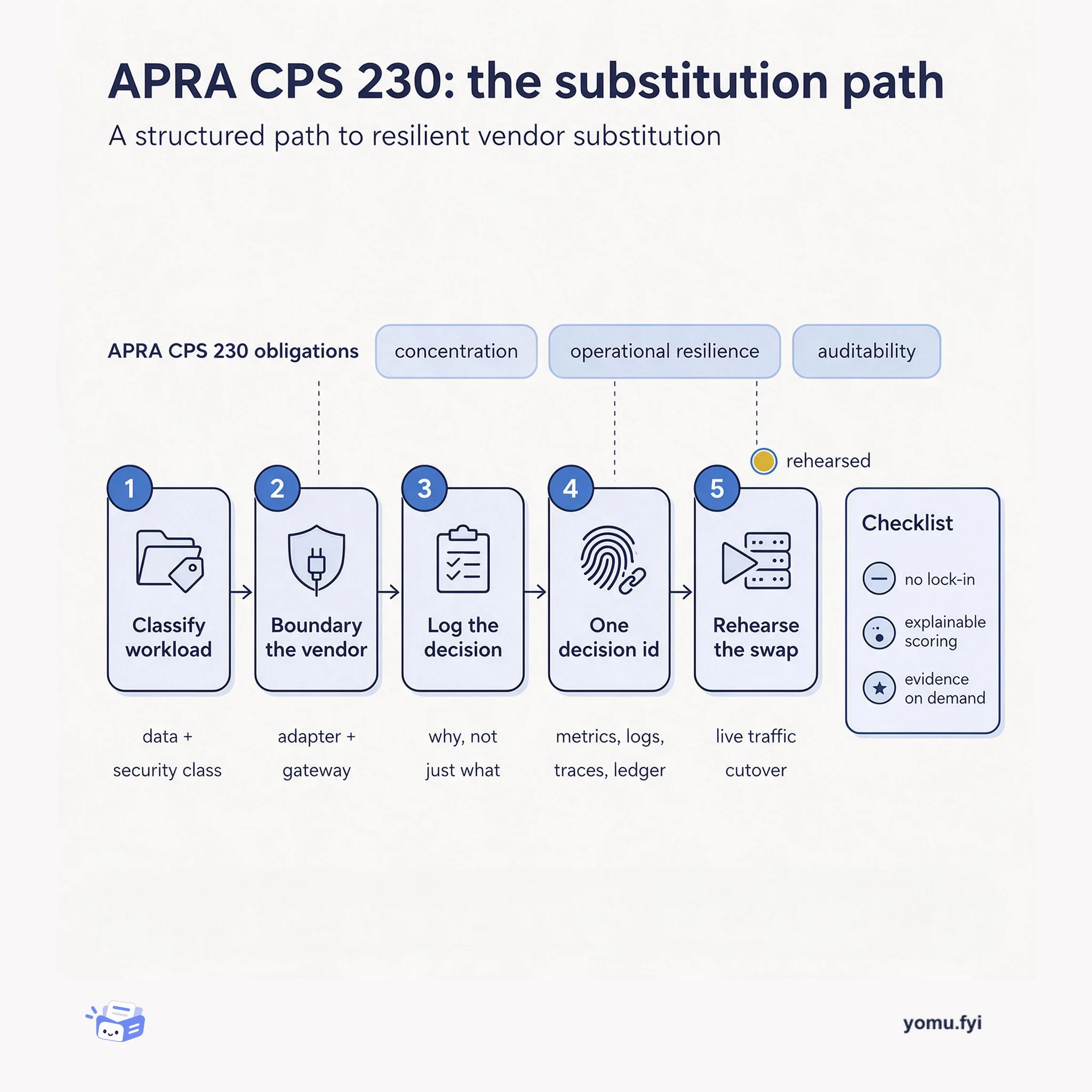
APRA's April 2026 letter flags single-provider concentration as a CPS 230 risk, so AI stacks need a rehearsed substitution path. This flow maps five stages, from workload classification to provider swap.
Keep reading
Related reading
The Good Stuff
Paid picks we use ourselves. Links carry a referral code — a subscription through one earns us a commission at no extra cost to you.