APAC Is Not One Region: The Regionalize vs. Standardize Tradeoff
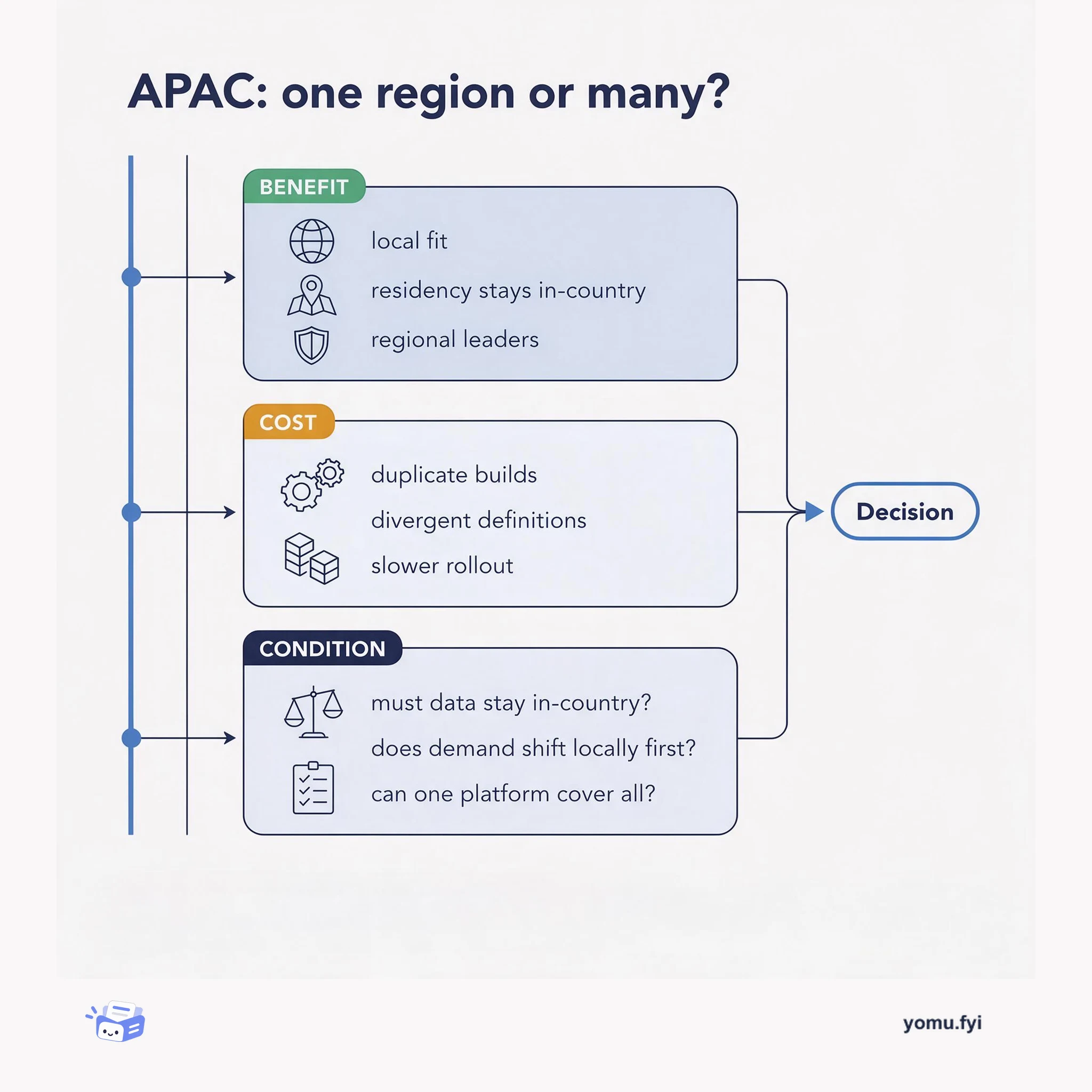
APAC is a federation of markets, not a single deployment region. This diagram maps the tradeoff between local autonomy and one shared platform, and the conditions that decide it.
Loading…
Topic
37 posts about Compliance. Every summary links to the original.
See the idea
APAC is a federation of markets, not a single deployment region. This diagram maps the tradeoff between local autonomy and one shared platform, and the conditions that decide it.
A five-checkpoint walkthrough of BYOC: name the control you need, split control and data planes, build the landing zone, govern data in place, then operate inside your own tenant.
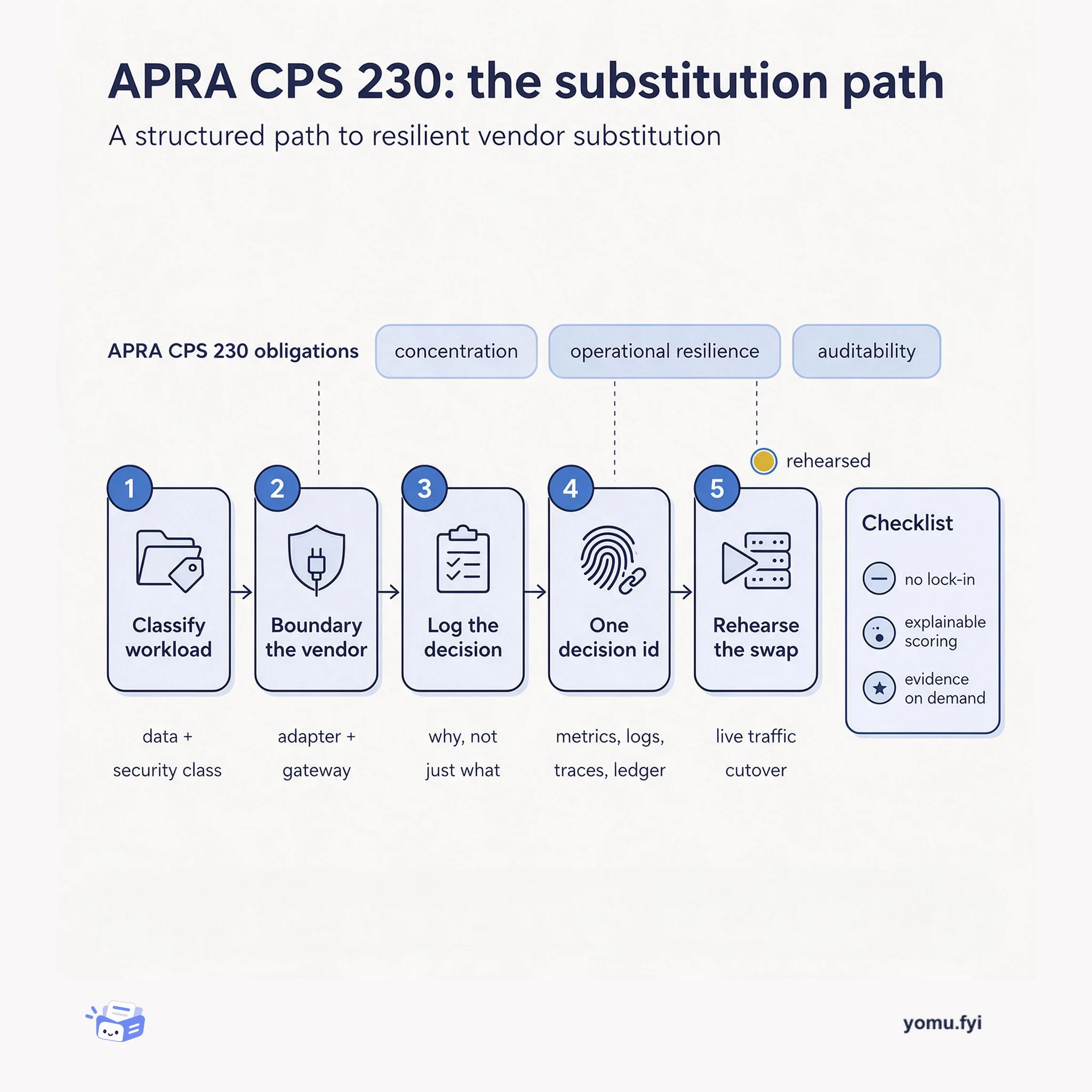
APRA's April 2026 letter flags single-provider concentration as a CPS 230 risk, so AI stacks need a rehearsed substitution path. This flow maps five stages, from workload classification to provider swap.
The Good Stuff
Paid picks we use ourselves. Links carry a referral code — a subscription through one earns us a commission at no extra cost to you.
Newest first
GDPR is a major regulatory change affecting all companies with EU customers globally, standardizing data handling and requiring legal justification for processing and user data rights. A privacy ecosystem includes all vendors and integrations sharing customer data, and the weakest link determines overall security, as a breach anywhere damages trust. Companies must invest in security programs with penetration testing, continuous monitoring, vulnerability disclosure, staff training, and a healthy paranoia about risks to protect against external attacks and data breaches. They should track and reduce unnecessary data access, choose vendors with contractual assurances and mature security, audit third-party providers regularly, and establish developer guidelines for integrations. Active communication and transparency about data storage, retention, and deletion are crucial for customer trust, and properly trained sales and support teams can turn GDPR compliance into a marketing differentiator.
Intercom released Engineer Chats, an internal podcast about engineering topics, making its episodes publicly available. The podcast explores disambiguation, described by Senior Principal Engineer Mike Stewart as narrowing a wide solution space based on evidence, applied throughout product development from roadmap planning to coding. Another episode recounts Intercom’s worst outage, where a premature automation command triggered a cascading failure that queued SMS messages incorrectly for hours, revealing risks of automation. The podcast also discusses the importance of speed for startups, advising teams to run and do things this week instead of next quarter. Additionally, a conversation between engineering and legal teams emphasizes that legal is not there to slow R&D but to ensure responsible growth within legal confines through compliance by design.
Fintech companies handling savings, credit, and investments require customer service that builds trust and meets strict regulatory requirements. Intercom’s Fin AI agent, powered by large language models, uses existing knowledge content to automatically resolve over half of customer queries on average. Fundrise reported Fin handled over 50% of support cases within three months, while Sharesies achieved an almost 70% resolution rate over email in 12 weeks. Fin delivers real-time personalization by pulling live transaction data from external systems, supports over 45 languages with real-time translation, and scales during peak periods like tax season. It includes compliance safeguards such as automatic escalation of regulated activities to licensed agents and integration with KYC and AML processes.
This guide compares AI contact center platforms for Philippine enterprises, focusing on regulatory and language constraints rather than feature lists. BSP Circular 1160 requires immediate written acknowledgement, 24/7 availability, and a dedicated fraud line, while BSP’s June 2026 AI governance principles hold institutions accountable for outsourced models. The NPC’s draft PIA circular would classify AI as high-risk, giving 90 days to comply after finalization. No independent Taglish benchmark exists, so the guide advises selecting a platform that allows swapping speech engines rather than committing to one vendor’s model. Philippine Airlines reduced wait times from two hours to under one minute and raised satisfaction from 67% to 95% using Twilio Flex.
Chinese enterprises expanding overseas face fragmented communication channels, strict compliance regimes, and data residency mandates across 180+ markets. A programmable communication platform (CPaaS) eliminates the need to negotiate carrier-by-carrier in every country. Twilio’s global infrastructure — 335,000+ customers, 218+ voice-capable countries, and a 99.95% API SLA — provides a single integration point for SMS, voice, email, WhatsApp, and RCS worldwide. The platform comprises five layers: programmable messaging, voice APIs, SendGrid email, Twilio Verify, and Twilio Segment. Compliance features such as 3-region data residency and email authentication help brands navigate GDPR, TCPA, and other regulations.
Data sovereignty is a market expression, not a universal legal standard, and IT leaders should evaluate it through architecture and governance questions rather than a single label. The assessment covers where data resides, who can access it, how it moves, and whether control is retained, with considerations varying by jurisdiction, industry, and risk posture. Physical location is only one part of a broader control boundary that includes operations, key custody, and access paths. The article proposes five technical lenses for evaluation: jurisdiction-native data placement, in-use encryption, customer-held keys, network isolation and identity-based access, and forensic-grade audit evidence. These lenses are practical reference points for architecture decisions, not a legal test or certification checklist, and organizations should assess their own requirements with qualified counsel.
Italy’s data protection authority, the Garante per la protezione dei dati personali, has issued guidelines governing tracking pixels in email communications. The guidance says recipients must be told about tracking pixels regardless of the email’s purpose or sender, and that prior consent is required for many uses. Senders must comply by October 28, 2026; existing subscribers who signed up before April 29, 2026 need an opt-out opportunity, while subscribers from April 29 onward require prior, explicit consent for open tracking pixels. The guidance also includes complexities, including exemptions for some email types and different rules for opaque pixels, so senders are advised to review opt-in processes with legal or privacy teams. The change follows France’s earlier rules and may foreshadow similar action elsewhere in Europe.
Anthropic and Deloitte announced an expanded alliance that will make Claude available to more than 470,000 Deloitte people across its global network and create industry-specific solutions powered by the model. Deloitte will establish a Claude Center of Excellence, with trained specialists developing implementation frameworks, sharing deployment practices, and providing ongoing technical support to move AI pilots into production at scale. The organizations are also creating a certification program for 15,000 professionals, while combining Claude’s safety-first design with Deloitte’s Trustworthy AI framework to build compliance-oriented tools for regulated industries including financial services, healthcare and life sciences, and public services. The announcement describes the deployment as Anthropic’s largest enterprise AI deployment to date, with Claude intended for uses ranging from coding and software development to customer engagement and industry-specific advisory.
California’s Transparency in Frontier AI Act (SB 53), taking effect January 1, requires frontier AI developers to publish frameworks explaining how they assess and manage catastrophic risks. Anthropic’s public Frontier Compliance Framework (FCF) covers cyber offense; chemical, biological, radiological, and nuclear threats; AI sabotage; loss of control; model-weight protection; and safety-incident response. It describes a tiered system for evaluating model capabilities across those risk categories and the mitigations used, while building on the company’s Responsible Scaling Policy and model system cards. Anthropic says the FCF will serve as its compliance framework for SB 53 and other regulatory requirements, while the RSP remains a voluntary policy that may go beyond current rules. The company also argues for a federal standard requiring public secure-development frameworks, deployment system cards, whistleblower protections, flexible minimum standards, and coverage limited to established frontier developers.
Solvency II reporting connects data, actuarial reserving, capital calculation, quantitative reporting templates (QRTs), the ORSA, approvals, and disclosure, but fragmented systems make readiness and cross-process questions difficult to manage. The described Databricks implementation provides a governed workflow and control tower around existing actuarial and capital suites, automating ingestion checks, data-quality review, reconciliation, orchestration, reporting, and audit trails. It uses MLflow-managed reserving models alongside engines such as Prophet, RAFM, and Igloo, while narrow-scope AI agents can investigate QRT mismatches, suggest remediation, route questions, and support human review. An LLM can draft an ORSA from current numbers, while scenario analysis assesses doubling a cyber book over 12 months; reviewers retain decision authority. The workflow is presented as easier to monitor and investigate.
Anthropic describes a text-watermarking system planned for Claude to estimate whether Claude was involved in generating or processing text, primarily to comply with the EU AI Act. The method uses a key and preceding words to influence the source of randomness in low-stakes word choices, creating a detectable pattern without adding characters, tokens, identifying information, or extra cost. Anthropic says internal testing found no impact on content, creativity, readability, or perceived quality, while detection confidence improves with longer passages and weakens when text offers few valid alternatives, such as factual statements, proofreading, or code. The watermark can indicate only that Claude was likely involved, not whether text was human-written, who authored it, or which person or organization used Claude; light editing may not remove it, but a complete rewrite will.
MongoDB announced the public preview of data residency in Europe and the United States for the Embedding and Reranking API Service (ERAS) on Atlas. This introduces a Geography, a named group of cloud regions, as a processing boundary for inference, distinct from the region-level cluster provisioning. Requests to a Designated Service are processed and logged only within the chosen Geography, with a 10% price premium for scoped processing. The Europe Geography initially covers EEA regions, and the US Geography covers US regions, with plans to expand. This approach supports data sovereignty goals for European organizations while maintaining a global endpoint for workloads without residency requirements.
Kentucky regulations require rideshare drivers to complete a two-hour driver safety training course each year, with collision prevention and safe driving habits as its focus. Starting June 25, 2019, drivers cannot receive trip requests in Kentucky through the Uber app until they upload a passing-course certificate to their account. The online course costs $15: drivers begin through the Online Training Center’s “New Partners” option, use the email address and phone number associated with their Uber account, and verify that the confirmation-page username matches the official name on their license. After training, drivers download the certificate or open the certificate page’s printable completion confirmation, then upload it to their Uber account; unfinished training can be resumed through the driver portal’s “My Courses” section.
Indian organizations in regulated industries are modernizing legacy data infrastructures with MongoDB to achieve scale and compliance. Physics Wallah, serving over 7 million students, built a compliant multi-tenant payment platform on MongoDB Atlas using ACID transactions, Change Streams for audit trails, and native search. Flipkart uses MongoDB Atlas for high-throughput writes and real-time payment aggregation during mega sales like The Big Billion Days, with seamless horizontal sharding. IBS Software scaled three mission-critical platforms, processing billions of records and millions of searches daily with sub-100ms API responses and 99.99% uptime, while iTravel Cruise achieves 100,000 TPS at 5ms latency. Companies like Kore.ai and PineLabs use MongoDB Enterprise Advanced for on-premises deployments requiring high availability, strict security, and low-latency transaction processing.
Twilio’s Ireland region, IE1, provides EU data residency for Programmable SMS, keeping personal data such as recipient phone numbers and message bodies in the EU through the supplier edge. Adopting it requires separate IE1 credentials and an IE1 Messaging Service, while US1 Messaging Services cannot be reused; SMS to and from +1 numbers, RCS, and WhatsApp are not currently supported. For API calls, the main code change is replacing api.twilio.com with api.dublin.ie1.twilio.com, while client SDK users switch the region parameter from us1 to ie1 and can retain the Dublin edge. Twilio’s logs include a region filter to verify where messages were processed, and the post notes that Studio and TaskRouter support in IE1 is still an initiative.
Uber’s Seattle Fraudulent Use Policy identifies activity that may constitute fraud across rides and deliveries, including increasing trip time or distance, creating improper accounts, claiming false fees, falsifying records, and certain cancellations. Manipulating the Uber platform or GPS system with unauthorized devices, apps, or programs is also covered. Violations may cause immediate loss of access to some or all of the Marketplace Platform, holds or adjustments to suspected fraud-related earnings, restrictions on offers, or temporary deactivation during review. Affected couriers may be notified in pay statements or through in-app communication, phone, or email, and Uber may request additional information to assess a potential violation. Appeals require contacting Support or responding through the app; review typically takes up to seven business days, and the final decision is not subject to further review.
Cursor announces that it has earned AIUC-1 certification after an independent review of its organizational controls and agent behavior. AIUC-1 combines an organizational-controls audit with adversarial product testing, translating the NIST AI Risk Management Framework, MITRE ATLAS, and OWASP’s agentic threat taxonomy into requirements for live AI systems. Schellman reviewed documented controls and AI governance practices, while evaluators tested IDE and cloud agents in a representative enterprise configuration across several thousand scenarios and two rounds. Testing covered rules, hooks, Auto-review, model-level safeguards, secrets protection, secure code generation, MCP security, identity and permissions, and potentially destructive actions. Cursor says its safeguards held in benign and adversarial conditions, with certification requiring quarterly testing and an annual full audit as AIUC-1 evolves.
Uber’s Washington State driver-screening disclosure sets time-based limits on driving violations, criminal charges, and convictions for people seeking to provide rides on the platform. Drivers may have no more than three minor driving violations in three years, while major driving violations and pending criminal matters such as driving while unlicensed or uninsured are disqualifying during that period. A broader seven-year bar covers felonies and specified offenses including violence, theft, fraud, DUI-related violations, hit and run, reckless driving, and speeding over 100 MPH; the disclosure also bars serious offenses including sexual crimes, murder, kidnapping, and active warrants. Seattle and King County add a seven-year licensing-related rule, while Vancouver adds tighter recent-violation limits and separate felony and drug-offense lookbacks.
TCS and Anthropic are partnering to bring Claude to regulated industries, with TCS providing access to 50,000 employees across 56 countries and developing client offerings. As the partnership’s “customer zero,” TCS will use Claude across engineering, finance, legal, marketing, and sales, then apply those lessons through a dedicated practice of consultants, engineers, and industry specialists. The practice will package and operate industry-specific systems, including claims processing for insurers and lending advisory for banks, while TCS teams contribute reusable Claude Code skills and plugins focused initially on claims adjudication and lending advisory. Other announced work includes Diligenta using Claude for more than 22 million policyholders and TCS iON delivering training and certification after conducting more than 75 million annual assessments.
Anthropic says the US government issued an export-control directive requiring it to suspend Fable 5 and Mythos 5 access for every foreign national, including foreign-national Anthropic employees, inside or outside the United States. The directive arrived at 5:21 p.m. ET and did not specify the national-security concern; Anthropic says it understands the basis to be a potential narrow, non-universal jailbreak involving a request to inspect a codebase and fix software flaws. The company says it reviewed the underlying report, found only previously known minor vulnerabilities, and judged the demonstrated capability widely available from other models, including OpenAI’s GPT-5.5. Anthropic is complying by disabling both models for all customers and says it is working to restore access.
The best engineering reads, once a week.