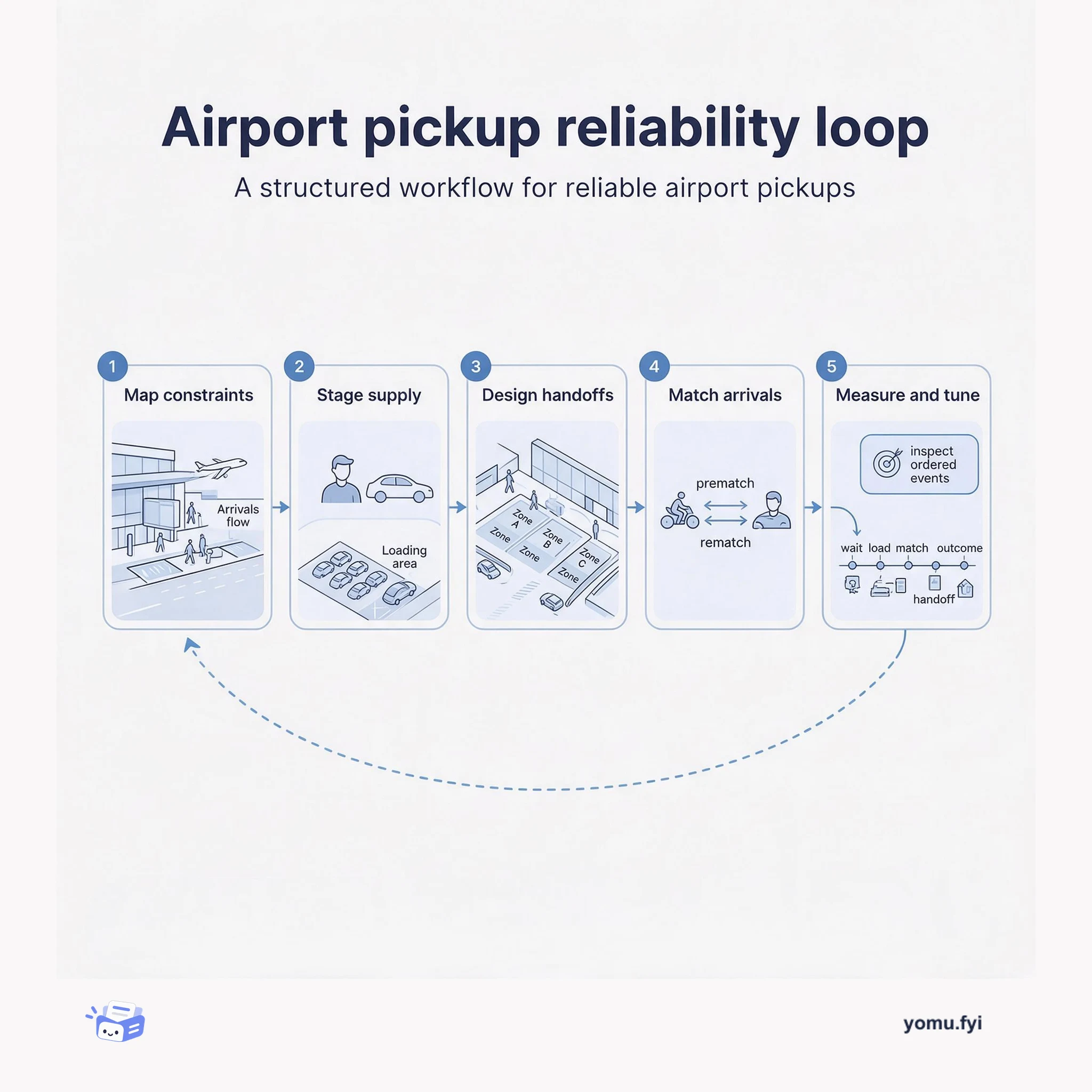
How to Turn Airport Pickup Into a Reliability Loop
A practical checklist for designing reliable airport pickups: map curb constraints, stage drivers, simplify matching, and measure each handoff so improvements target the real bottleneck.
 DatabricksKent Marten, Sergei FedorovExplainer
SQL's unordered-set model makes it difficult to detect ordered event sequences such as consecutive login failures followed by a success, especially when timing matters. MATCH_RECOGNIZE, now available in Databricks compute including Lakehouse Real-Time, expresses row sequences through regex-like states while supporting time anchoring and row-relative checks. The post shows its use for credential-stuffing anomalies, V-shaped stock reversals, checkout abandonment, and equipment-failure signals: FIRST can anchor a failure window, the end-of-partition marker $ can represent inactivity, and PREV/NEXT can compare sensor readings. By replacing chains of common table expressions, gaps-and-islands scaffolding, self-joins, and window-function logic, the clause is presented as easier to validate, maintain, and update for event-sequence analytics.
MATCH_RECOGNIZE is available in Databricks compute, including Lakehouse Real-Time, for pattern matching across ordered login events, market data, clickstream sessions, and sensor telemetry.
The clause partitions and orders rows, then defines regex-like states and conditions for the desired sequence. The examples use FIRST to anchor a time window, the end-of-partition marker $ to express inactivity, and PREV or NEXT for row-by-row comparisons.
FIRST(FAIL.event_time) can anchor a one-hour login-failure window so later FAIL events are checked against the initial attempt before a SUCCESS state.
The end-of-partition anchor $ expresses checkout abandonment by requiring the cart addition to be the session's last recorded event, combined with an idle-time filter.
PREV and NEXT support row-relative sensor rules such as detecting steadily rising temperature before a vibration spike, without manually chaining comparisons.
The DEFINE block can use FIRST(FAIL.event_time) to anchor the initial failure. Subsequent FAIL events are checked dynamically to ensure they remain within one hour of that first attempt before the pattern transitions to SUCCESS.
The end-of-partition anchor $ requires the cart addition to be the last recorded event in the session. A time filter then establishes the idle window that qualifies the session as abandoned.
MATCH_RECOGNIZE provides PREV and NEXT functions inside DEFINE, acting similarly to LAG and LEAD. A rising-temperature condition can be written as temperature > PREV(temperature).
Summaries are generated from the original by a language model. Check the original before relying on it.
See the idea
A practical checklist for designing reliable airport pickups: map curb constraints, stage drivers, simplify matching, and measure each handoff so improvements target the real bottleneck.
Keep reading
The Good Stuff
Paid picks we use ourselves. Links carry a referral code — a subscription through one earns us a commission at no extra cost to you.
One useful email. Unsubscribe anytime.
