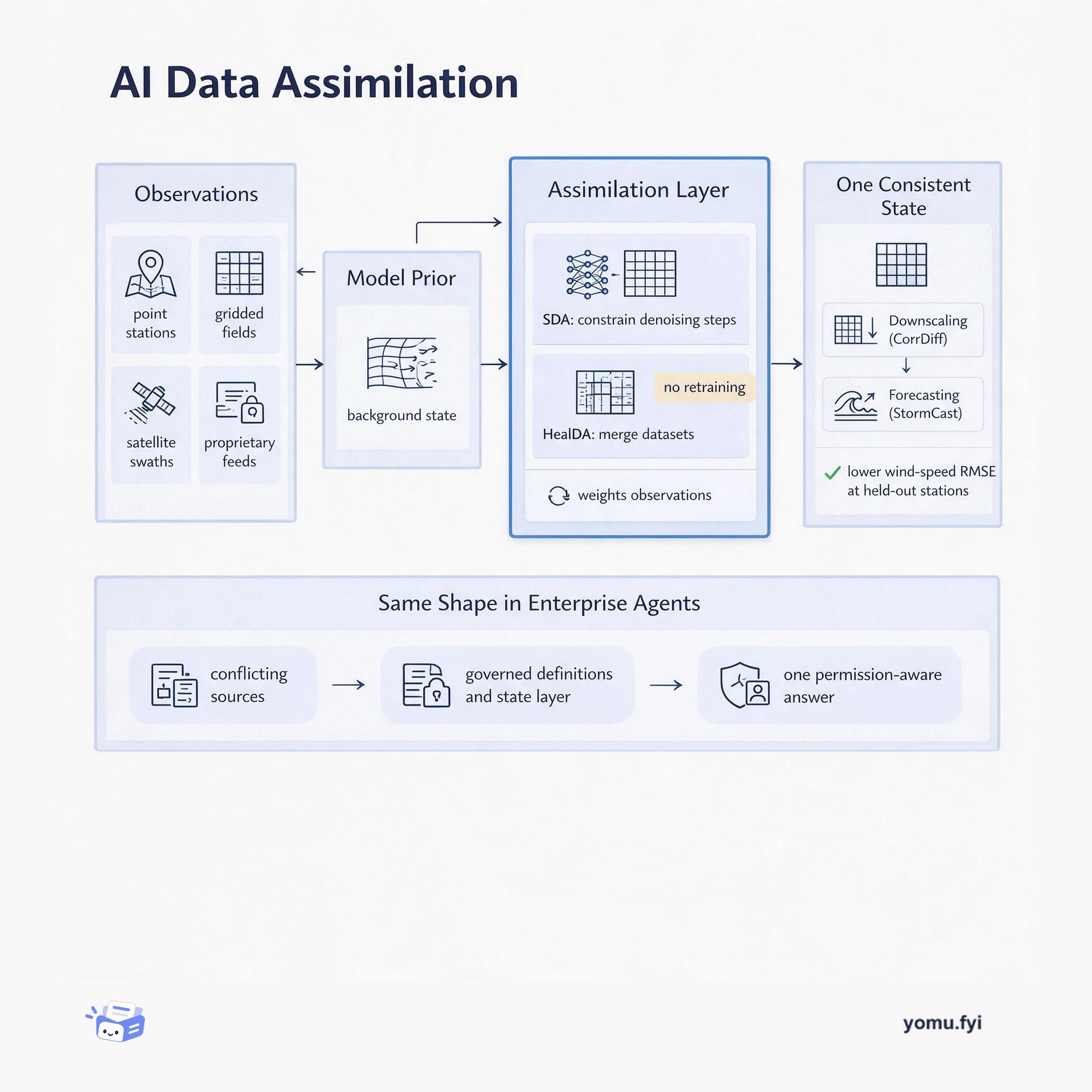
AI Data Assimilation: Turning Scattered Signals Into One State
AI data assimilation fuses a model's prior state with fresh, uneven observations into one consistent state. See the four-layer architecture and where each layer can break.
 TwilioCynthia GoldsworthyProblem & solution
The 2026 Customer Data Platform Report identifies a critical enterprise challenge: while AI tools grow individually smarter, fragmented customer data causes a worsening, not better, experience. The shift is from computational capacity to contextual continuity, as disconnected pipelines force AI agents to start every interaction from scratch. Three failures arise from fragmented systems: agent amnesia, escalating operational costs from wasted tokens, and trapped intelligence that never reaches active workflows. Modern CDPs have evolved from passive audience builders into API-first context engines that support three pillars: pre-execution context with working memory, unified behavioral and conversational data streams, and infrastructure-level governance enforcing compliance before data reaches AI models. Organizations like Twilio, Trustpilot, and Quartz demonstrate that embedding real-time customer context into the conversation layer outperforms deploying the smartest standalone models.
The post argues that as enterprises deploy more autonomous AI agents, the primary challenge shifts from model intelligence to contextual continuity, because fragmented customer data forces agents to start interactions from scratch, wastes processing tokens, and traps valuable insights within isolated systems.
The post describes a Context Engine Optimization (CEO) approach where a modern CDP (such as Twilio Segment) operates as an API-first context engine, resting on three pillars: pre-execution context and working memory that resolves identity and pre-computes predictive intelligence before an AI model runs; unified behavioral and conversational context that integrates real-time event streams with live conversational data; and governance at the infrastructure level that enforces schema validation, regional data sovereignty, and consent rules before data reaches downstream AI models.
Fragmented customer data systems cause three critical failures: agent amnesia (agents start each interaction from scratch), escalating operational costs from wasted tokens processing incomplete data, and trapped intelligence where predictive scores never reach active workflows.
A modern CDP foundation rests on three pillars: pre-execution context with working memory that resolves identity and pre-computes predictive intelligence before AI runs, unified behavioral and conversational data streams, and infrastructure-level governance enforcing compliance before data reaches AI models.
Leading organizations like Twilio (powering its autonomous agent Isa with Segment CDP), Trustpilot (routing reviews into fraud engines via Segment), and Quartz (privacy-first infrastructure with automated consent guardrails) demonstrate the real-world impact of a governed, composable data foundation.
Context Engine Optimization (CEO) is the shift from optimizing for static search (SEO) or answer retrieval (AEO) to ensuring autonomous agents have real-time, unified customer context at the moment of interaction. It relies on a modern CDP that acts as an API-first context engine for instantaneous, programmatic retrieval by AI systems.
A CDP provides pre-execution context by resolving identity, verifying data completeness, validating schemas, and pre-computing predictive intelligence like churn risk or LTV before an AI model runs. This gives agents token-friendly summaries that prevent hallucinations without overloading LLM context windows.
Real-world examples include Twilio using its Segment CDP to power its autonomous AI agent Isa with continuous customer context, Trustpilot routing user reviews into custom fraud engines via Segment for real-time identity validation, and Quartz building a privacy-first infrastructure with automated consent guardrails to maintain reader targeting and ad performance.
Summaries are generated from the original by a language model. Check the original before relying on it.
See the idea
AI data assimilation fuses a model's prior state with fresh, uneven observations into one consistent state. See the four-layer architecture and where each layer can break.
Keep reading
The Good Stuff
Paid picks we use ourselves. Links carry a referral code — a subscription through one earns us a commission at no extra cost to you.
One useful email. Unsubscribe anytime.
