AI Data Assimilation: Turning Scattered Signals Into One State
AI data assimilation fuses a model's prior state with fresh, uneven observations into one consistent state. See the four-layer architecture and where each layer can break.
AI data assimilation is the layer that turns a model's existing guess about the world into a state that agrees with the newest observations. Observations arrive in incompatible shapes, such as point readings, gridded fields, satellite swaths, and proprietary feeds, so the assimilation step decides how far each one is allowed to move the prior state. Score-based assimilation constrains a diffusion model's denoising steps without retraining, and the reconciled state is what downstream downscaling and forecasting models consume. Enterprise agents depend on the same shape: a governed state layer that settles conflicting sources before an answer is produced.
FAQ
Do I need to retrain a model to assimilate new observations?
No. Score-based data assimilation constrains the denoising steps of an existing diffusion model toward point observations, so fresh readings can be folded in at inference time without changing weights. That makes it practical for pipelines that must absorb new station data continuously.
What is the difference between SDA and HealDA?
SDA pushes a generative model's output toward sparse observations, and it is applied inside downscaling and forecasting models. HealDA handles the other direction: merging disparate, inconsistent datasets into a single coherent global state. Use SDA to nudge a prediction toward observations, HealDA to reconcile sources into one field.
Why do AI agents need the same reconciliation layer?
Agents face the same problem: many sources that are each correct alone but disagree on definitions, relationships, and authority. Without a governed state layer to settle those conflicts, an agent picks a definition arbitrarily and its answers become hard to trust, even when the underlying model is strong.
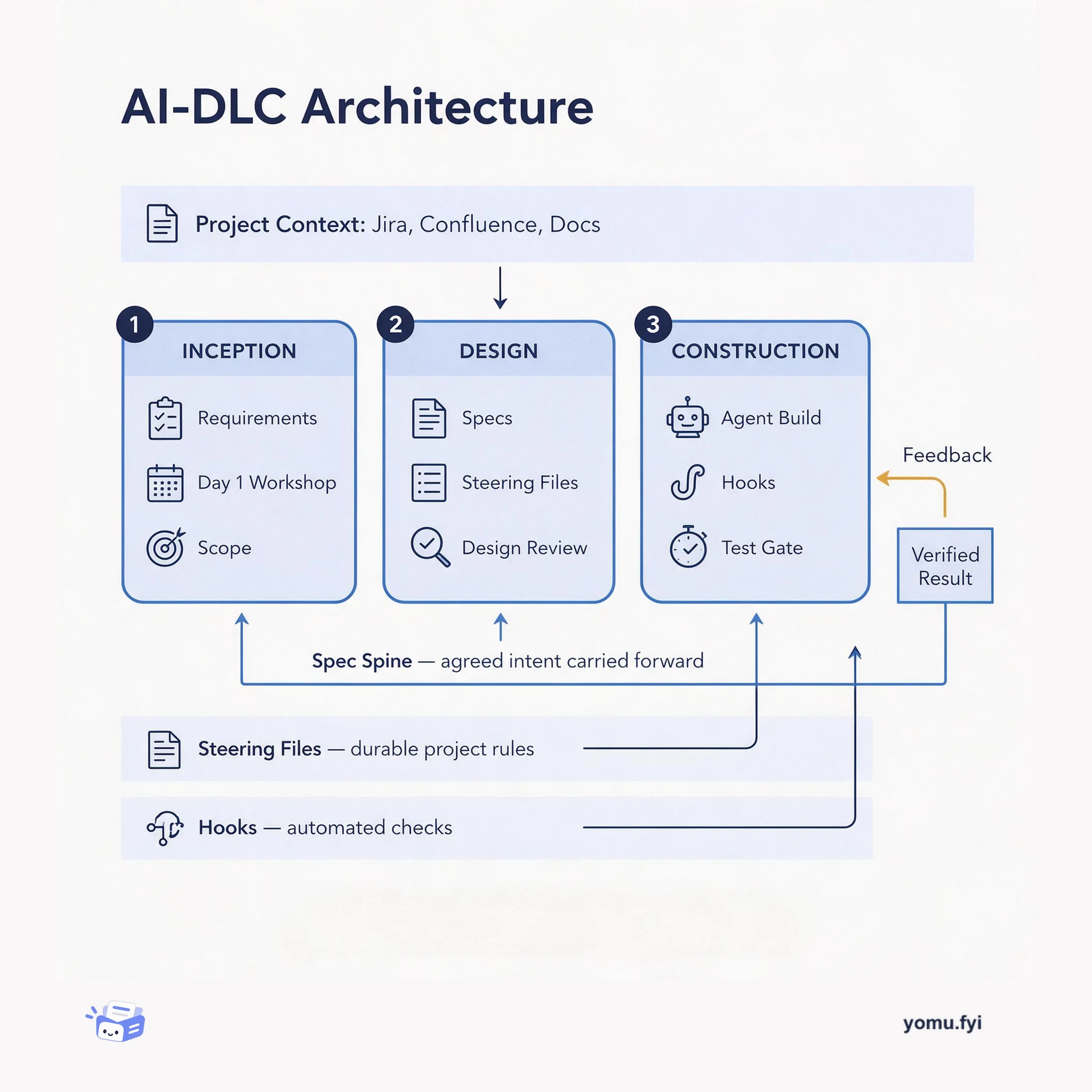
AI-DLC is an AI-driven development lifecycle that runs delivery through Inception, Design, and Construction, with specs, steering files, and hooks keeping agents aligned to agreed intent.
Apple Silicon's defining choice is one shared memory pool for CPU, GPU, and Neural Engine. This diagram maps that fabric, the on-package bandwidth it buys, and the scaling limits it imposes.
Antimicrobial resistance surveillance is a layered data architecture: raw reads and demand signals flow in, get normalized into governed tables, and answer plain-language queries. The diagram maps each boundary.
The Good Stuff
Paid picks we use ourselves. Links carry a referral code — a subscription through one earns us a commission at no extra cost to you.