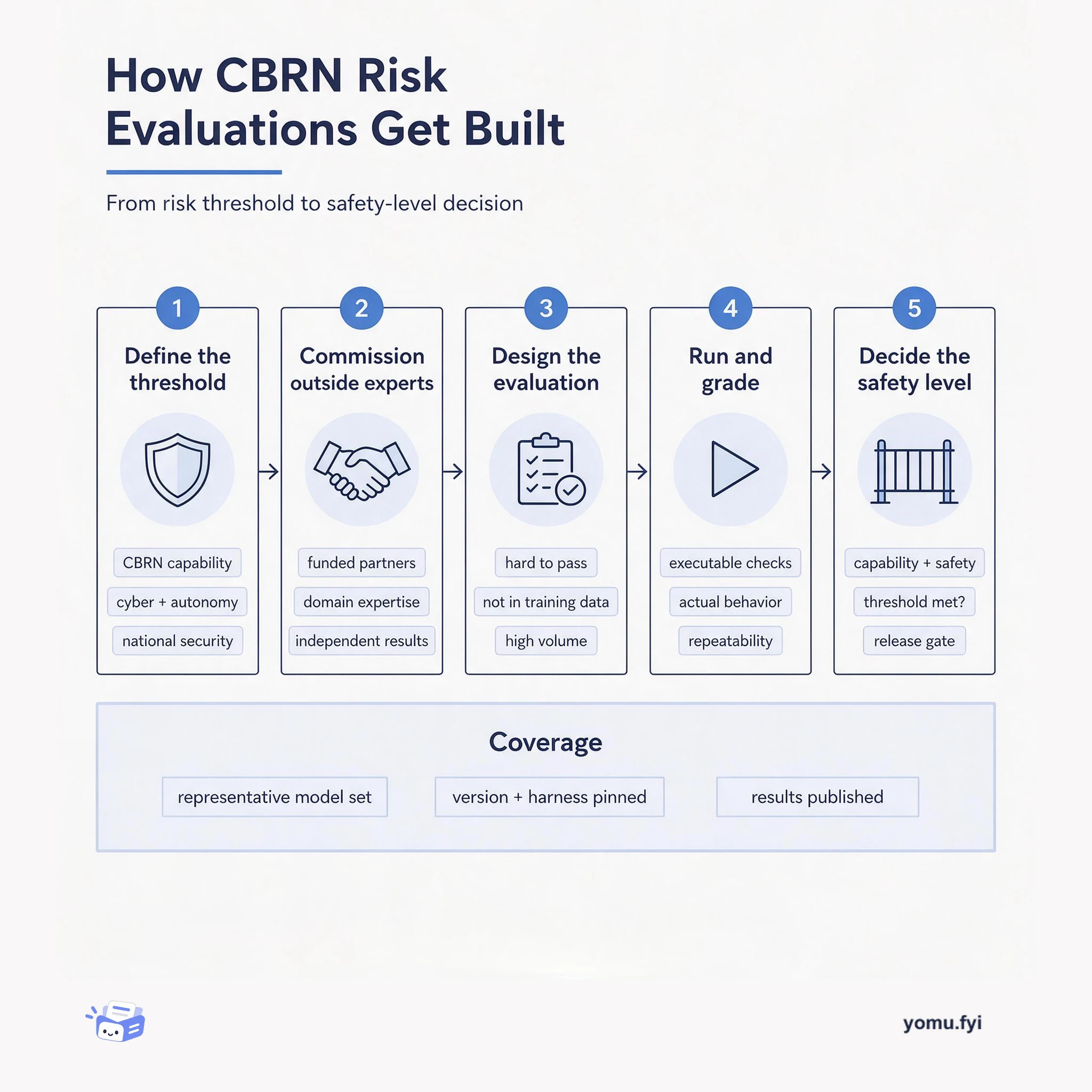
How CBRN Risk Evaluations Get Built for Frontier Models
A five-stage walkthrough of how CBRN risk evaluations are commissioned, designed, graded, and converted into safety-level decisions for frontier AI models.
 AWSRobert HundtAnnouncement
PyTorch is the dominant AI framework, operating on tensors, and AWS announced TorchNeuron, an open-source backend translating PyTorch code to run on Trainium. TorchNeuron’s adaptive eager mode compiles small subgraphs, overlapping compilation with execution to hide compile time while preserving source correlation for debugging. It employs multi-level caching of NEFF files and coordinates accelerators across an UltraServer to avoid redundant compilation, reducing time to first training step by a third. To evaluate performance, AI agents scanned Hugging Face repositories, classified models by architecture, and identified 841 representative models covering the full spectrum of architectures. From these, they derived a shape registry of tens of thousands of tensor dimensions for staged testing, ensuring accurate and efficient execution on Trainium.
AWS announced TorchNeuron, an open-source backend that allows PyTorch models to run on Trainium chips with minimal code changes.
TorchNeuron implements an adaptive eager execution mode that groups operations into small compiled subgraphs, caches compiled NEFF files at multiple levels, and uses AI agents to classify 841 representative models from Hugging Face to generate a shape registry for efficient testing and validation.
TorchNeuron’s adaptive eager mode groups operations into small subgraphs, compiles them, and overlaps compilation with execution to hide compile time while maintaining source correlation for debugging.
TorchNeuron caches compiled NEFF files in memory and on disk, and coordinates across accelerators to avoid redundant compilation, reducing the time to the first training step by about a third for a large language model.
AWS used AI agents to scan hundreds of thousands of open-source models, classify them by architecture, and identify 841 representative models; they also derived a shape registry of tens of thousands of tensor dimensions for efficient staged testing.
Standard eager mode executes operations one by one immediately. Adaptive eager mode groups operations into small graphs, compiles them, and overlaps compilation with execution, hiding compile time while preserving source correlation for debugging.
NEFF stands for Neuron executable file format. TorchNeuron converts compiled graphs into NEFF files and caches them in memory and on disk for reuse, reducing the cost of conversion.
AI agents classified models from Hugging Face by architecture, identifying 841 representative models covering all design characteristics. They also generated a shape registry of tensor dimensions for fast unit tests, then tested against the representative set before full model validation.
Summaries are generated from the original by a language model. Check the original before relying on it.
See the idea
A five-stage walkthrough of how CBRN risk evaluations are commissioned, designed, graded, and converted into safety-level decisions for frontier AI models.
Keep reading
The Good Stuff
Paid picks we use ourselves. Links carry a referral code — a subscription through one earns us a commission at no extra cost to you.
One useful email. Unsubscribe anytime.
