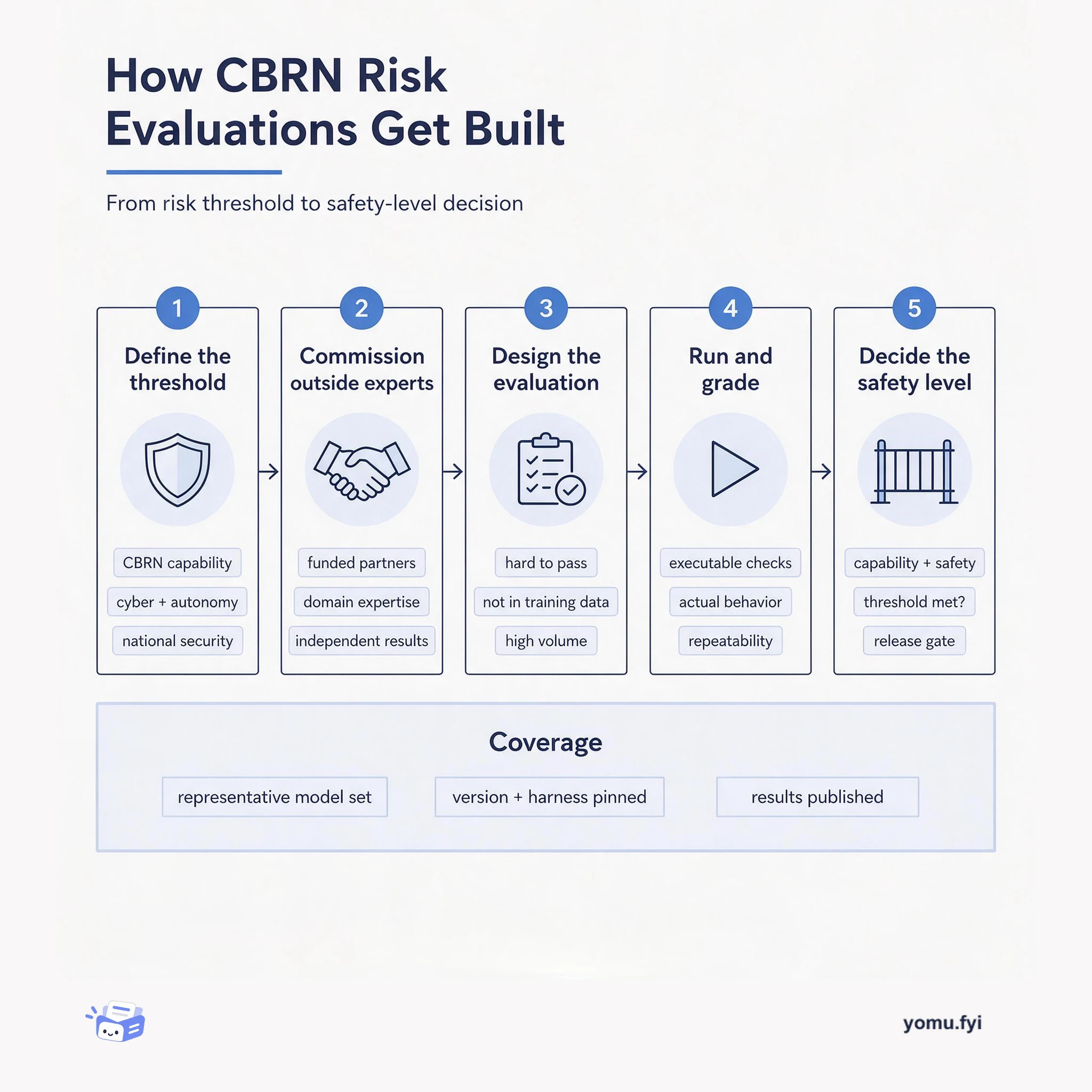
How CBRN Risk Evaluations Get Built for Frontier Models
A five-stage walkthrough of how CBRN risk evaluations are commissioned, designed, graded, and converted into safety-level decisions for frontier AI models.
Loading…
Topic
2 posts about CBRN. Every summary links to the original.
See the idea
A five-stage walkthrough of how CBRN risk evaluations are commissioned, designed, graded, and converted into safety-level decisions for frontier AI models.
The Good Stuff
Paid picks we use ourselves. Links carry a referral code — a subscription through one earns us a commission at no extra cost to you.
Newest first
Anthropic has activated AI Safety Level 3 (ASL-3) protections for its Claude Opus 4 model, a higher standard than the ASL-2 baseline used for all previous models. The decision was proactive, made before determining whether the model’s capabilities actually require the enhanced measures. ASL-3 deployment measures focus narrowly on preventing the model from assisting with extended, end-to-end CBRN weapons workflows. The approach includes Constitutional Classifiers that monitor inputs and outputs, a bug bounty program, and threat intelligence partnerships. Security controls include over 100 measures such as two-party authorization for model weight access and egress bandwidth controls that limit outbound data flow to prevent weight exfiltration.
Anthropic announced a new initiative to fund third-party organizations to develop evaluations for measuring advanced AI capabilities and safety risks. The initiative prioritizes three areas: AI Safety Level assessments for cybersecurity, CBRN, model autonomy, and other national security risks; advanced capability and safety metrics including science, harmfulness, multilingual, and societal impacts; and infrastructure, tools, and methods for evaluation development. The company seeks evaluations that are sufficiently difficult, not in training data, efficient, high-volume, and developed with domain expertise. Anthropic offers funding and direct collaboration with its domain experts from Frontier Red Team and other teams. The goal is to catalyze a robust third-party evaluation ecosystem to address the current limited landscape where demand for high-quality safety evaluations outpaces supply.
The best engineering reads, once a week.