ABAC: When Data Context Becomes the Access Rule
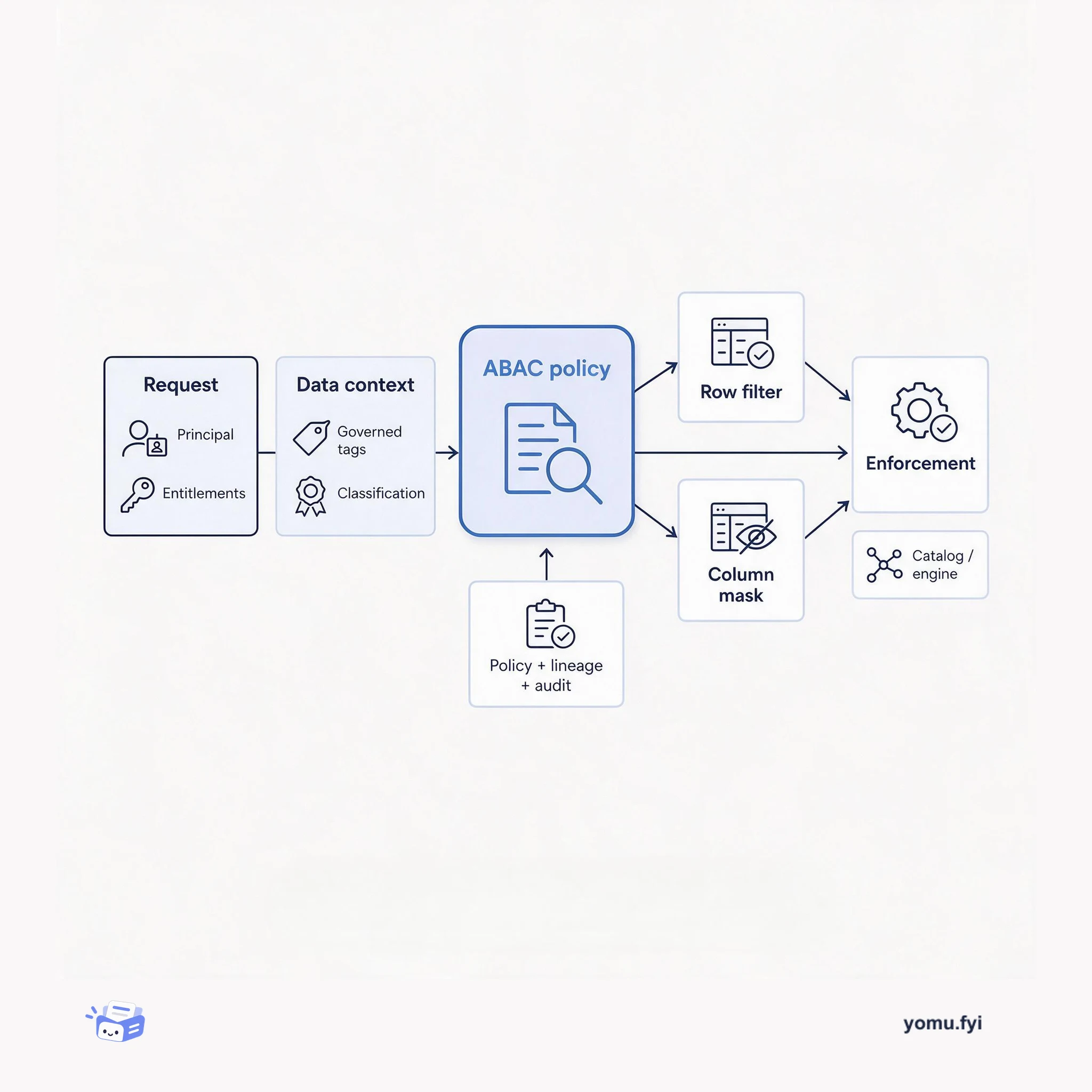
Attribute-Based Access Control uses identity and data attributes to decide access. This explainer shows how governed tags become row filters or column masks across data engines.
 DatabricksDaniel Weeks, Ryan Blue, Andrei TserakhauExplainer
Apache Iceberg’s REST Catalog additions—read restrictions and catalog labels—address different cross-platform governance problems: delegating enforcement to trusted engines and carrying governance context across federated catalogs. Read restrictions let a catalog evaluate policy for a principal and return bounded column-projection actions and row-filter expressions that a trusted engine must enforce, while leaving trust establishment outside the protocol. Catalog labels exchange opaque key-value metadata at table and column level, allowing a consuming catalog to map classifications locally, preserve native policy expressiveness, and maintain its own audit trail. Together with centralized enforcement through Cross-Engine ABAC, they provide distinct options for direct access and catalog federation, although read restrictions cannot express policies outside their standardized vocabulary.
Cross-platform governance must support data access from different engines and federation among heterogeneous catalogs, while addressing enforcement boundaries, policy expressiveness, auditability, performance, identity handling, and service dependencies.
The post explains three governance patterns: centralized enforcement through scan planning, read restrictions for delegating policy outcomes to trusted engines, and catalog labels for exchanging table- and column-level governance context between catalogs. It compares their enforcement models, identity and security requirements, scalability, auditability, and suitable deployment scenarios.
Read restrictions return principal-specific column-projection actions and standardized row-filter expressions; they do not transmit administrator-defined policies directly.
Catalog labels are opaque key-value pairs exchanged at table and column level, then mapped into the consuming catalog’s native classifications, attributes, or tags.
Read restrictions suit trusted engines with expressible policies, while catalog labels suit federation where each catalog performs local policy evaluation and enforcement.
Summaries are generated from the original by a language model. Check the original before relying on it.
See the idea
Attribute-Based Access Control uses identity and data attributes to decide access. This explainer shows how governed tags become row filters or column masks across data engines.
Keep reading
The Good Stuff
Paid picks we use ourselves. Links carry a referral code — a subscription through one earns us a commission at no extra cost to you.
One useful email. Unsubscribe anytime.
