Databricks
Capital-markets firms are revisiting the trade lifecycle as data volumes grow, AI moves toward production, settlement cycles shorten, and scrutiny increases. Fragmented data across research, trading, risk, operations, and surveillance can slow decision-making, complicate execution analysis, limit risk visibility, and hinder reconstruction of events. The proposed response starts with decisions such as execution-cost divergence, shock impacts, and exception or settlement-fail rates, then identifies the data domains needed for a few high-value workflows rather than migrating everything at once. It emphasizes a governed, reusable foundation connecting real-time and historical data, analytics, and AI, with access controls, lineage, traceability, and evaluation. Databricks components named include Unity Catalog for governance, discovery, and lineage, Agent Bricks for domain-specific agents, and AI/BI for governed exploration; the stated conclusion is that this operating-model approach can support faster decisions, resilience, and scalable use cases.
Databricks
Databricks says it was recognized as a Customers’ Choice in Gartner Peer Insights’ Voice of the Customer for Analytics and Business Intelligence Platforms, based on verified reviews from customers using platforms in production. The post reports a 4.8 out of 5 overall rating and 94% willingness to recommend, while noting that the designation reflects customer adoption and overall experience meeting or exceeding market averages. It presents Databricks AI/BI, AI/BI Dashboards, Genie Spaces, and Genie as a unified architecture combining governed live data, AI, business intelligence, and Unity Catalog controls without moving or duplicating datasets. The described use cases include conversational exploration, dashboard and visualization development, consolidating fragmented reporting, and expanding governed analytics access, with the company positioning these capabilities as a foundation for agentic analytics.
Databricks
Memory scaling is proposed as an agent’s performance improving when it accumulates past conversations, feedback, interaction trajectories, and business context in persistent external memory. Unlike model-parameter or inference-time scaling, it relies on selective retrieval to supply relevant information without filling long context windows. In MemAlign experiments on Databricks Genie Spaces, adding labeled examples raised test scores from near zero to 70%, about 5% above an expert-curated baseline, while average reasoning steps fell from about 20 to 5; filtered user logs produced similarly strong gains, exceeding 50% after 62 records. Production use requires storage and retrieval for episodic and semantic memories with organizational and user-level scoping, plus controls that preserve permissions and sensitivity labels.
Databricks
Business analytics tools have evolved beyond static reporting as organizations seek explanations, forecasts, and immediate actions. This guide categorizes visualization and dashboard platforms, self-service analytics, statistical tools, spreadsheets, and SQL-based query tools, then examines how AI adds natural-language querying, anomaly detection, summaries, and forecasting. It argues that inconsistent, duplicated, or differently governed data can undermine even sophisticated dashboards. Lakehouse architecture combines data-lake scalability with warehouse governance, performance, and SQL compatibility, enabling tools such as Tableau, Power BI, and Looker to use broader, fresher datasets alongside analytics and AI workloads. Reported examples include 94% faster BI queries at Anker Innovations, 98% faster query performance at AnyClip, and consolidation across 120+ global analysts at JLL.
Databricks
Databricks announces the general availability of Unity Catalog Business Semantics, a unified semantic foundation for consistent business definitions across BI dashboards, notebooks, SQL applications, and AI agents. Built into Unity Catalog, it applies existing governance, security, lineage, and access controls to centrally defined Metric Views, whose metadata includes display names, formats, and synonyms. Metric Views are authored declaratively in SQL, compiled and executed deterministically at query time, and can use materializations with automatic pre-aggregation, incremental refresh, intelligent query rewriting, and transparent routing; materialization remains in Preview. The core Metric View implementation is being open sourced in Apache Spark OSS for an upcoming release, with Unity Catalog OSS v0.5 support coming soon, while a point-and-click authoring UI is in Public Preview.
Databricks
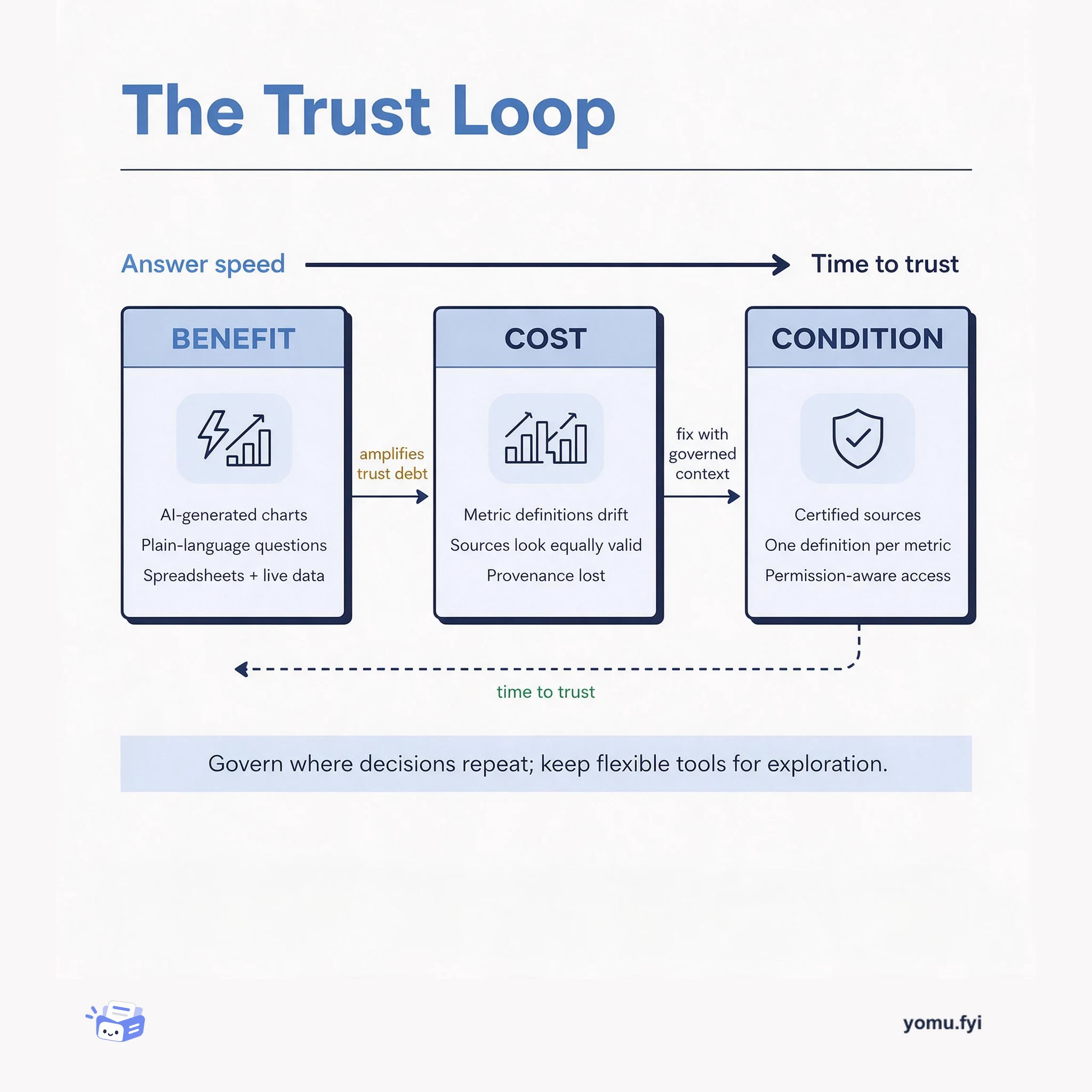
Agentic analytics increases the need for trustworthy semantics and governance because AI systems must interpret business definitions, trace outputs, and support follow-up questions beyond static dashboards. Nick Eayrs argues that fragmented metrics across BI tools, proprietary semantic layers, and duplicated pipelines erode trust, slow decisions, and increase engineering cost. The proposed foundation is an open, interoperable semantic layer where certified metrics such as revenue, churn, and customer lifetime value are explicitly defined, reusable, and accessible through SQL to BI, AI interfaces, notebooks, and agents. Organizations should establish governed data foundations and a catalog first, certify metrics next, then add AI and evaluate its outputs. Examples include NTT Docomo reducing manual log-analysis time from 66 hours to 6 hours and Net One Systems cutting support response time by 75 percent.
Databricks
Databricks is introducing a Lakeflow Connect Free Tier to help teams ingest SaaS application and operational database data into the Databricks Data + AI Platform, addressing silos that can leave AI agents without complete enterprise context. Each workspace automatically receives 100 free DBUs per day for managed SaaS and database connectors only, with capacity advertised as up to 100 million records per workspace per day across eligible supported sources. Lakeflow Connect offers 30+ connectors, including SaaS services and databases, through a point-and-click UI and API, with Unity Catalog providing unified governance and end-to-end lineage. The offer uses standard pricing without volume-based premiums or row-based pricing, but actual capacity varies with workload characteristics, record sizes, and source types.