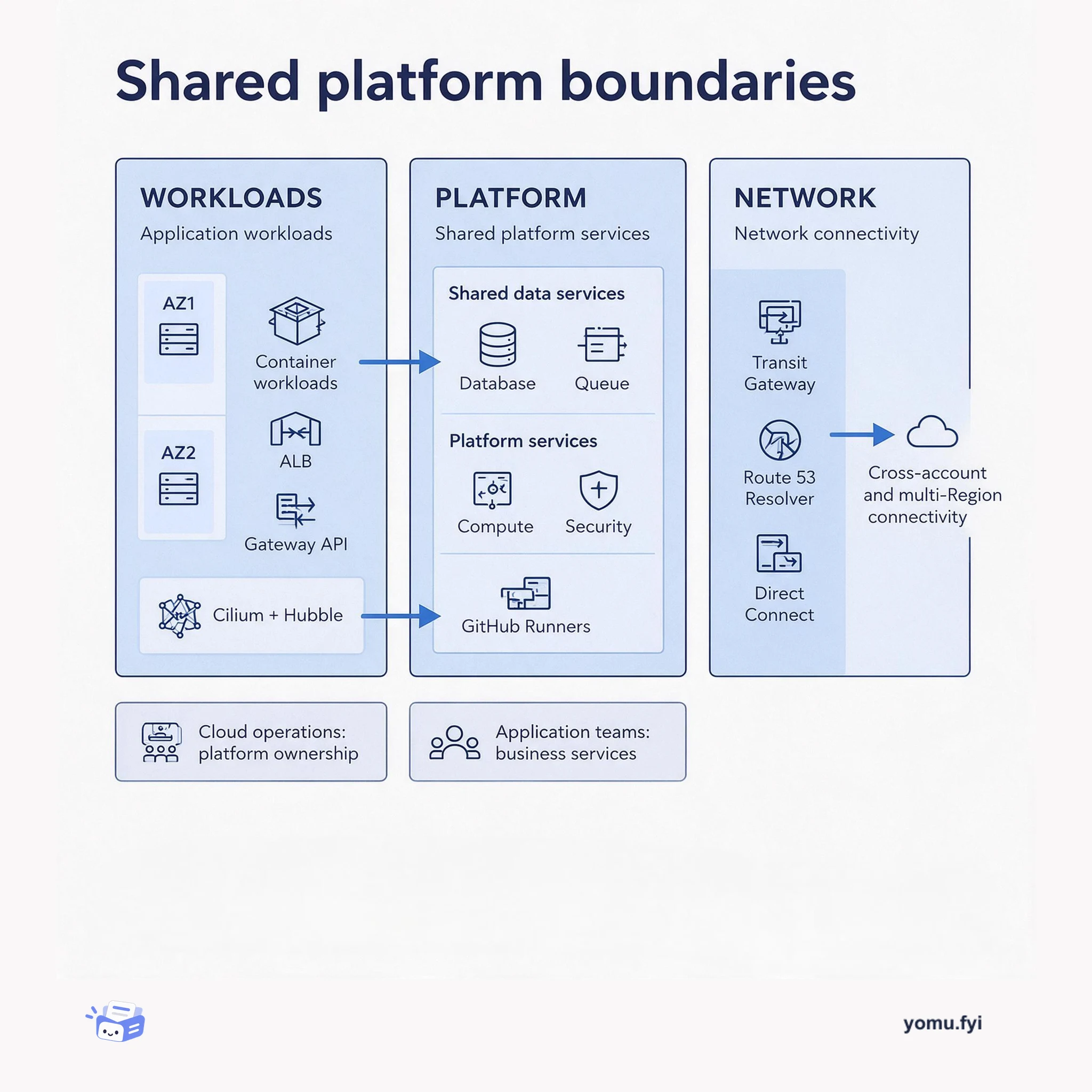
Amazon EKS as a Platform Boundary Map
See how a shared Amazon EKS architecture separates workloads, platform services, and network connectivity so teams can scale delivery without multiplying operational ownership.
 DatabricksDatabricks StaffExplainer
A cloud-based database management system stores, manages, and queries data on third-party cloud infrastructure instead of local or on-premises servers. It retains capabilities such as query optimization, security, transactions, and support for relational SQL, NoSQL, data warehouse, and in-memory workloads, while operating across distributed nodes. Organizations can self-manage database software on cloud virtual machines or use DBaaS, where the provider manages the software and infrastructure; connections typically use SQL, APIs, or web consoles. Virtualized resources can scale, and providers may handle patching, backups, maintenance, and failover, while replication across availability zones supports recovery and availability. The comparison with on-premises systems covers ownership, scalability, cost models, maintenance, accessibility, control, compliance, total cost, and emerging capabilities including AI integration, vector search, autonomous operation, multicloud, hybrid, and serverless architectures.
The piece defines cloud-based DBMS platforms, explains how they operate, categorizes major database models, and compares cloud deployments with on-premises systems. It also addresses operational considerations such as compliance, data residency, total cost of ownership, and evolving capabilities.
Cloud DBMS deployments can be self-managed on cloud virtual machines or delivered as DBaaS, where the provider manages both database software and underlying infrastructure.
Cloud databases support multiple workload models, including relational SQL, NoSQL, analytical data warehouses, and in-memory systems, each suited to different data structures and performance needs.
Cloud platforms may automate scaling, patching, backups, and failover, but deployment decisions still require attention to control, compliance, data residency, transfer costs, and administrative overhead.
In a self-managed deployment, an organization installs and operates database software on cloud virtual machines. In the DBaaS model, the cloud provider manages both the database software and the underlying infrastructure.
Virtualized compute and storage resources can scale as workloads change, and some platforms automatically provision capacity. Data is typically replicated across availability zones or data centers so workloads can recover or be redirected after hardware, server, or network failures.
On-premises systems require organizations to own infrastructure and pay upfront hardware and maintenance costs, while cloud systems generally use pay-as-you-go pricing. Cloud deployments offer easier access and integration with cloud services, but on-premises systems provide more direct control over hardware and infrastructure configuration.
Summaries are generated from the original by a language model. Check the original before relying on it.
See the idea
See how a shared Amazon EKS architecture separates workloads, platform services, and network connectivity so teams can scale delivery without multiplying operational ownership.
Keep reading
The Good Stuff
Paid picks we use ourselves. Links carry a referral code — a subscription through one earns us a commission at no extra cost to you.
One useful email. Unsubscribe anytime.
