See how a shared Amazon EKS architecture separates workloads, platform services, and network connectivity so teams can scale delivery without multiplying operational ownership.
Amazon EKS can be organized as a platform boundary rather than a collection of isolated clusters. The architecture separates Workloads, Platform, and Network accounts: application workloads span two Availability Zones, shared services and delivery tooling sit in the Platform account, and cross-account or multi-Region connectivity is handled in the Network account. This model clarifies ownership, reduces duplicated infrastructure practices, and gives engineers a practical way to reason about scale and operations.
FAQ
Why separate Workloads, Platform, and Network accounts?
The separation gives cloud operations ownership of shared platform capabilities while application teams focus on business services. It also makes cross-account connectivity and service boundaries explicit instead of repeating infrastructure practices in every cluster.
What belongs in the shared Platform account?
The supplied architecture places shared data services, GitHub Runners, and platform services there. These are common capabilities used by workload teams, rather than application-specific business services.
What is the main trade-off of this architecture?
Centralizing platform ownership can reduce operational sprawl and standardize infrastructure, but it creates a dependency on the cloud operations team. Clear ownership boundaries and reliable network connectivity are therefore important conditions for the model to work.
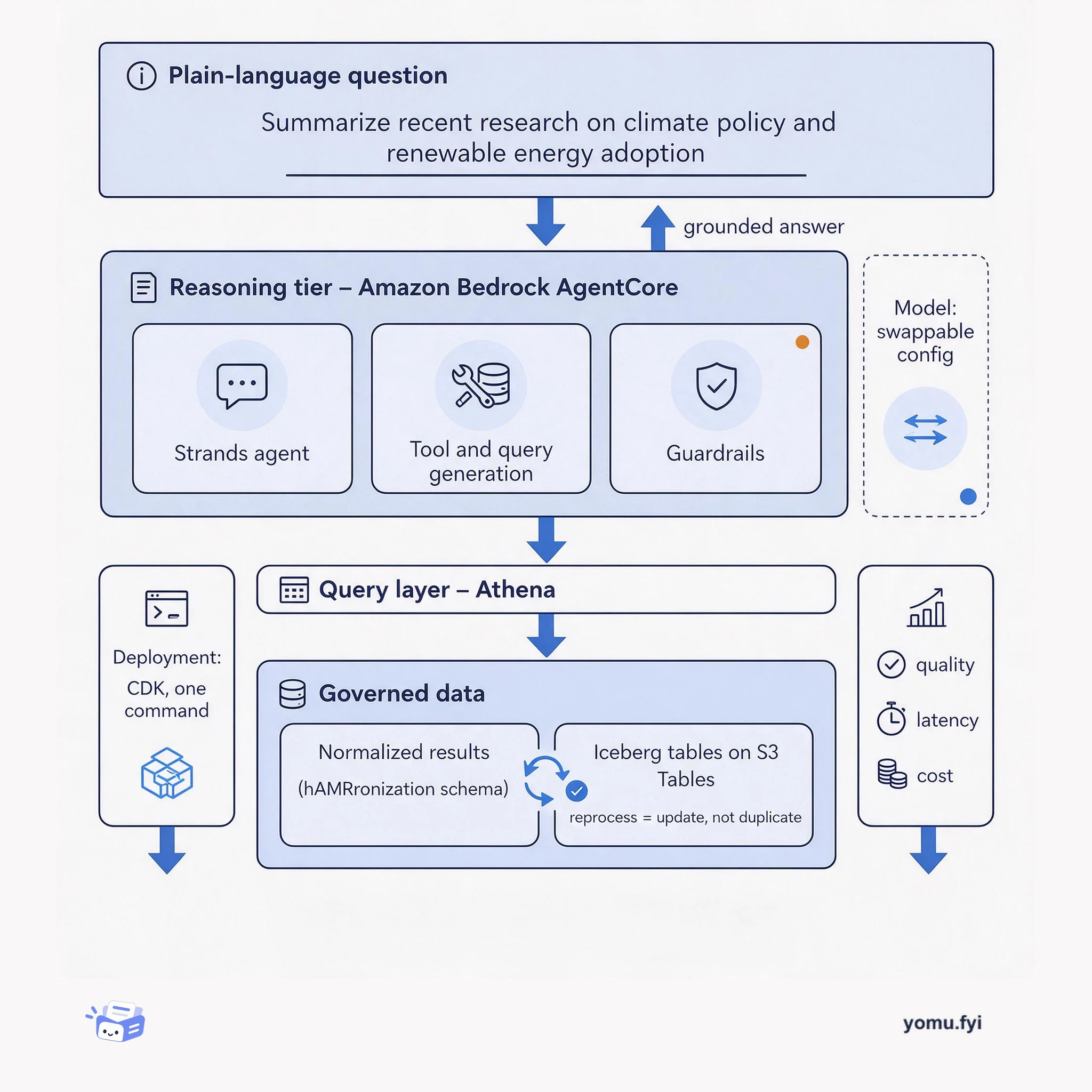
Antimicrobial resistance surveillance is a layered data architecture: raw reads and demand signals flow in, get normalized into governed tables, and answer plain-language queries. The diagram maps each boundary.
Amazon Bedrock is the managed reasoning tier in an agent architecture, not the whole system. This layered view shows the pipelines, governed tables, query layer, and guardrails around it.
API versioning as an architecture: requests enter through a version header, pass through a chain of reversible version changes, and reach controllers that only ever see the latest model.
The Good Stuff
Paid picks we use ourselves. Links carry a referral code — a subscription through one earns us a commission at no extra cost to you.