Evaluating a managed Postgres service requires checking operational control, high availability, disaster recovery, scaling, security, compatibility, migration, pricing, operations, and portability rather than relying on feature page claims. Operational scope includes who handles patching, whether minor updates are automatic with a maintenance window, and which PostgreSQL roles and parameters are restricted. High availability should use synchronous replication across availability zones with automatic failover and committed transaction guarantees, and backups must support point-in-time recovery via continuous WAL archiving with published RPO and RTO. Scaling requires separating compute from storage, supporting autoscaling, and ensuring connection pools handle reconnects, while security demands private networking and customer-managed keys. Migration should offer logical replication and change data capture rather than only dump and restore, and providers must demonstrate claims through a pilot covering failover, recovery, and data integrity tests.
Context
The post targets platform engineers, DBAs, data architects, and engineering managers evaluating a Postgres managed service for production use. It emphasizes verifying capabilities that tend to cause problems after migration, such as operational control, failover behavior, recovery objectives, and extension support.
Approach / What changed
A structured checklist covering operational scope, high availability, backups, disaster recovery, scaling, security, compatibility, migration, pricing, operations, and portability, with verification items, red flags, and suggestions for proving claims through a pilot.
Takeaways
1
Automatic failover should use synchronous replication across availability zones with committed transaction guarantees and a published recovery point objective.
2
Backups must support point-in-time recovery via continuous WAL archiving with self-service restores and stated RPO and RTO for regional and cross-region scenarios.
3
Scaling should separate compute from storage to allow independent scaling and support autoscaling to adjust capacity with workload demand.
FAQ
What should I look for in a managed Postgres service?
Focus on capabilities that affect production reliability and operations, such as high availability, backups, disaster recovery, scaling, security, and PostgreSQL compatibility. Providers should demonstrate claims through documentation and a production-like pilot before commitment.
What are the benefits of a managed Postgres service?
A managed service reduces operational work by taking responsibility for infrastructure, maintenance, backups, and routine tasks. It provides built-in capabilities for availability, scaling, security, and monitoring, but the value depends on how much operational responsibility the provider takes on.
How should I test a managed Postgres service before migration?
Use a representative workload and test failover, point-in-time recovery, scaling, migration, and rollback. Measure recovery times, connection behavior, data integrity, and application performance, and also cover monitoring, support escalation, and data export.
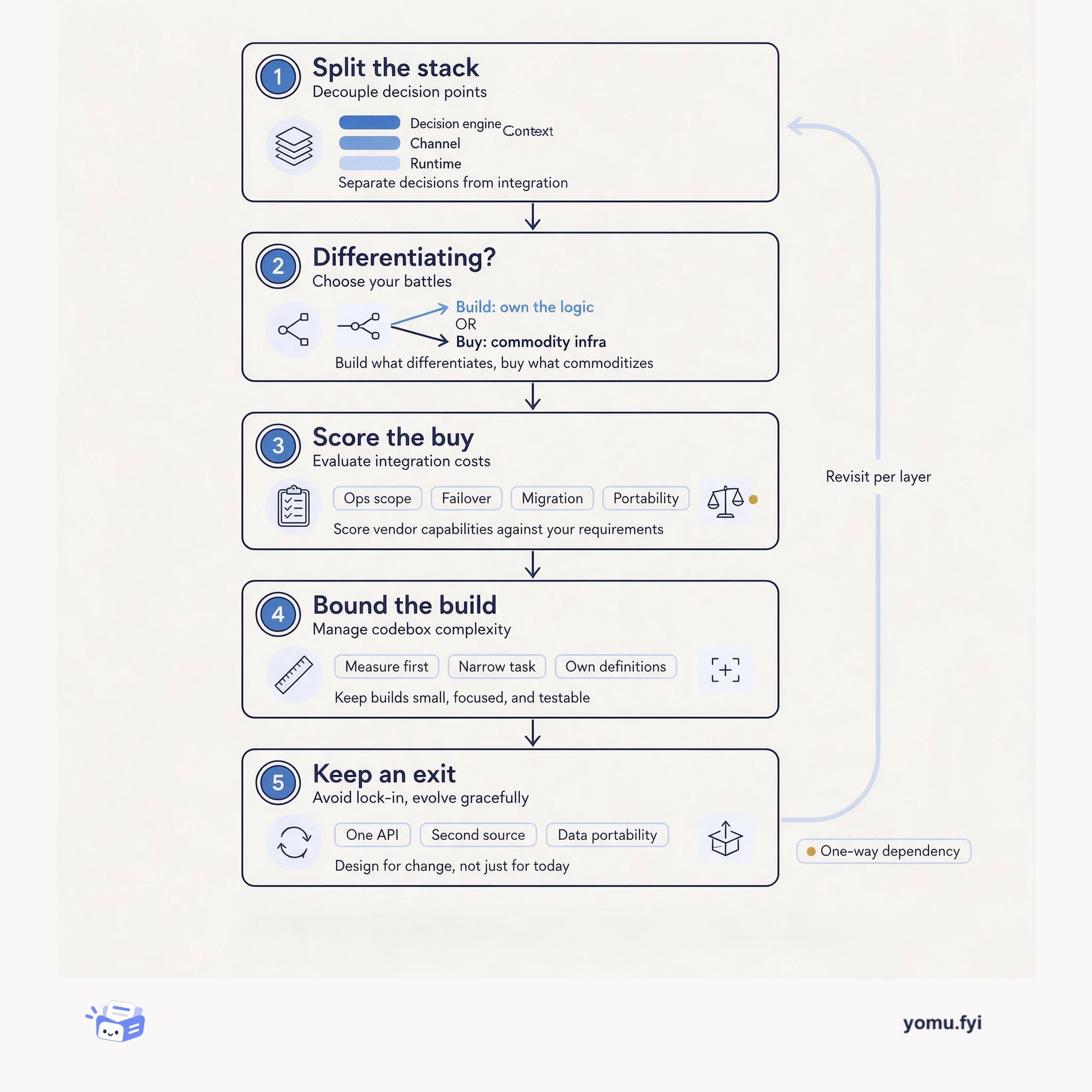
Build vs. buy is a per-layer decision, not a single platform choice. This flow splits a system into layers, tests each for differentiation, then sets the buy criteria and the exit path.
Keep reading
Related reading
The Good Stuff
Paid picks we use ourselves. Links carry a referral code — a subscription through one earns us a commission at no extra cost to you.