Actionable Banking: Architecting the Advice-to-Action Boundary
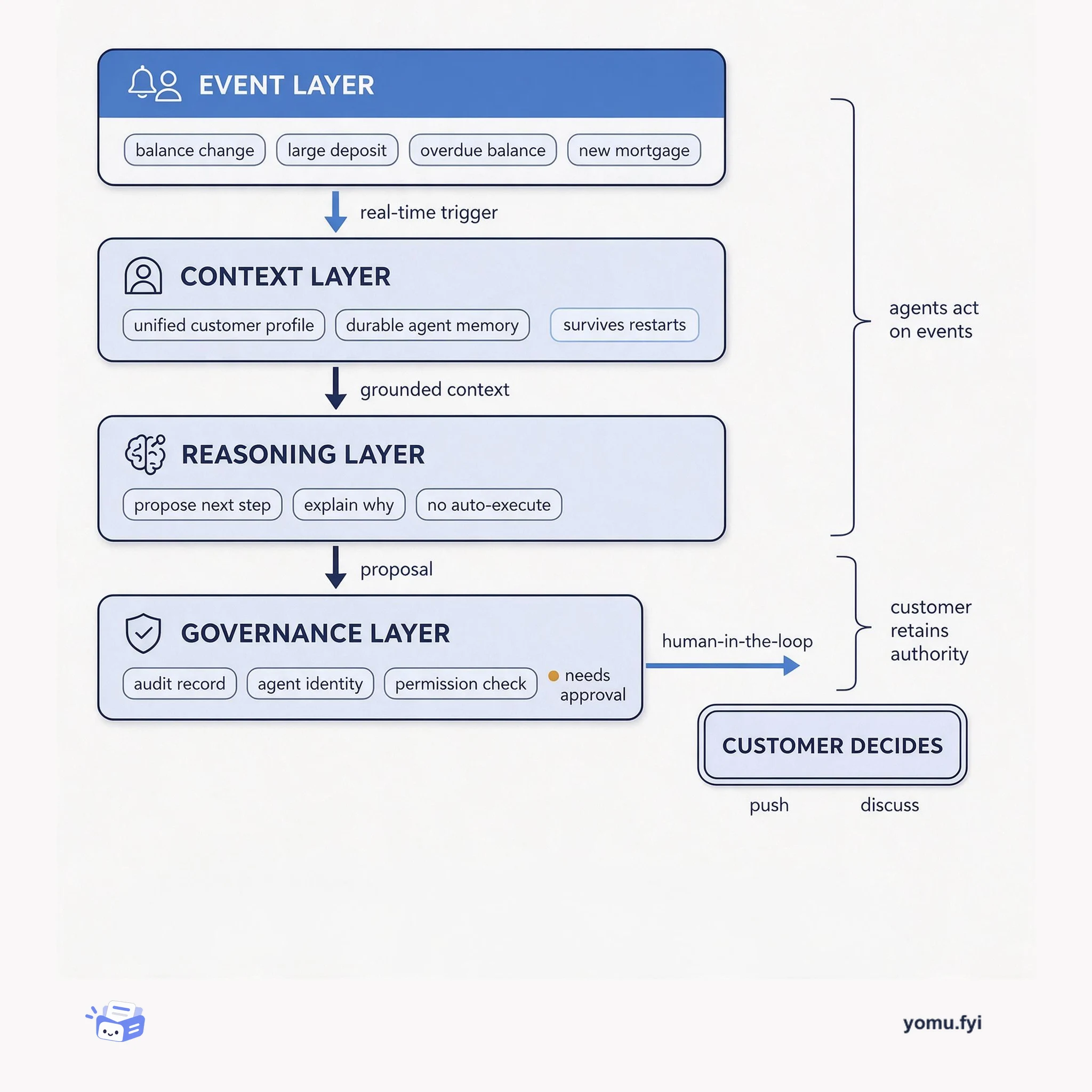
Actionable banking wires real-time event triggers, unified customer context, and agent memory into one pipeline that ends at a human decision, not an automatic transaction.
 MongoDBExplainer
Banking customers often lack immediate feedback on transactions, but actionable banking powered by agentic AI provides real-time, proactive advice on financial steps. A Personetics survey of 2,000 bank customers found that 70% strongly want their bank to proactively analyze finances and 84% would switch to a bank offering timely advice. Actionable banking serves as the stepping stone to autonomous banking, with agents acting on events while customers retain decision authority, and MongoDB Atlas enables this through real-time triggers, unified customer context, and an auditable record. The post outlines three agentic workflows — proactive investment on large deposits, proactive lending on overdue balances, and proactive added-value services on new mortgages — each ending in push and discuss rather than execution. Engineering challenges of fragmented context, agents that forget, and ungovernable actions are addressed by MongoDB’s unified document model, Atlas Agent Engine with built-in memory, and a single control plane for governance.
Banking customers lack real-time feedback and proactive advice on financial events like deposits, overdue balances, or mortgages, leading to delayed decision-making. Actionable banking uses agentic AI to close this gap by providing immediate, AI-powered insights and recommendations while keeping the human in control.
Implement actionable banking using agentic AI workflows on MongoDB Atlas and Atlas Agent Engine. A personal finance agent listens to banking events via change streams, delegates to specialist agents for proactive investment, lending, and added-value services, and returns a push-and-discuss proposal for the customer. The architecture uses unified customer context, built-in memory (semantic, episodic, procedural, taxonomic), and a single immutable audit trail for governance, with sandboxed execution and agent identity from Atlas Agent Engine.
Actionable banking uses agentic AI to provide proactive, real-time financial recommendations based on events like large deposits, overdue balances, or new mortgages, with the customer retaining decision authority.
The post identifies three engineering challenges that stall banking agent projects: fragmented customer context across systems, agents that forget past interactions, and ungovernable actions without proper audit trails.
MongoDB Atlas Agent Engine addresses these challenges with a unified document model, built-in memory (semantic, episodic, procedural, taxonomic), and one control plane that logs every action against a real identity under immutable policy.
In actionable banking, AI agents analyze events and propose actions, but the customer makes the final decision. In autonomous banking, a personal finance agent can act independently within preset limits the customer has defined and can revoke at any time. Actionable banking is the safe stepping stone because it logs evidence for audit trails, building trust before delegating decision-making.
Banks face three main challenges: fragmented context (customer data across different systems), agents that forget past interactions (each invocation starts from zero), and ungovernable actions (no quick way to see which agent did what on whose authority). These stall production deployments.
MongoDB Atlas provides change streams that turn banking events into real-time triggers for agents, a unified document model for customer context, and an immutable audit trail. Atlas Agent Engine adds built-in memory (semantic, episodic, procedural, taxonomic) and a single control plane that logs every agent action against a real identity under immutable policy.
Summaries are generated from the original by a language model. Check the original before relying on it.
See the idea
Actionable banking wires real-time event triggers, unified customer context, and agent memory into one pipeline that ends at a human decision, not an automatic transaction.
Keep reading
The Good Stuff
Paid picks we use ourselves. Links carry a referral code — a subscription through one earns us a commission at no extra cost to you.
One useful email. Unsubscribe anytime.
