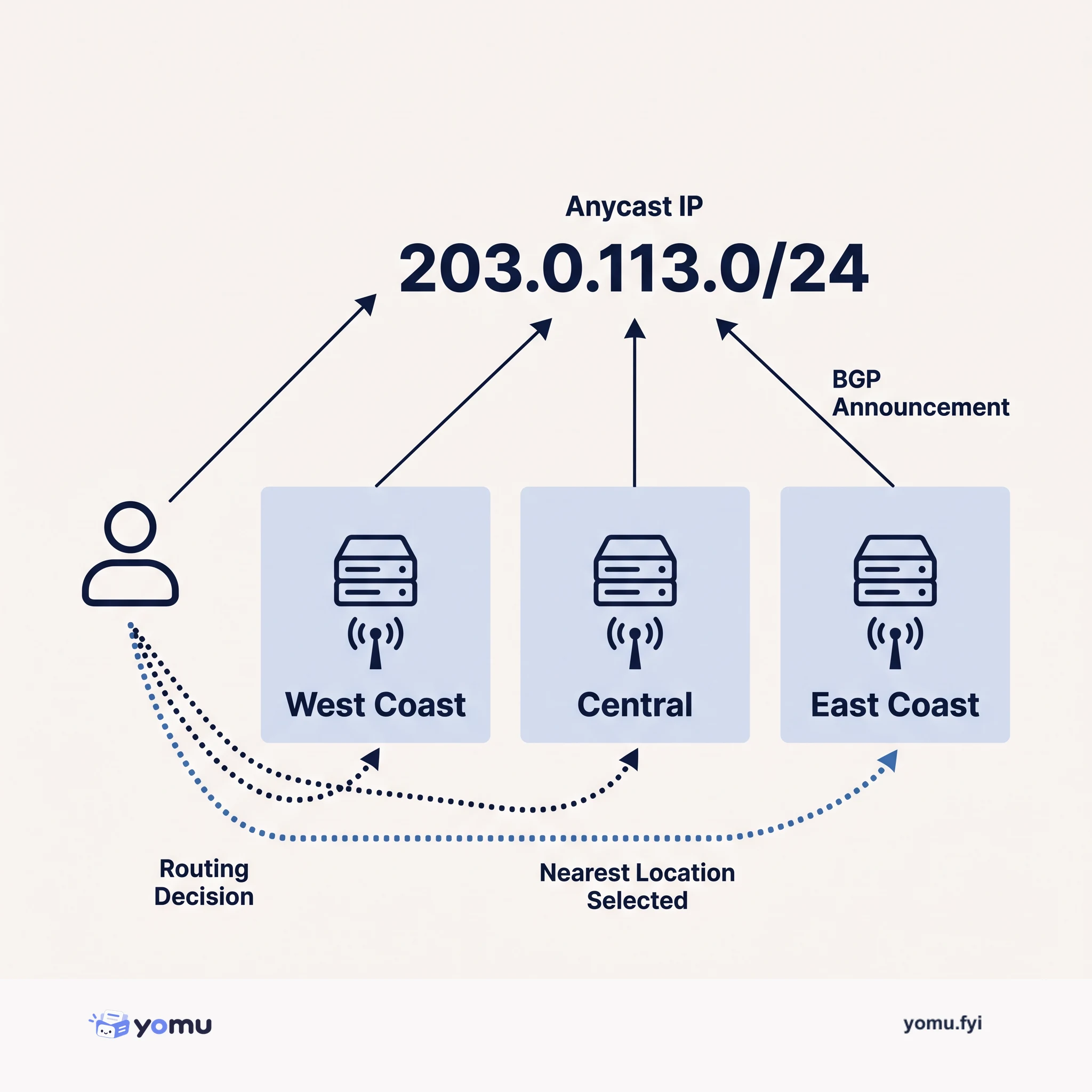
Anycast: One IP, Many Locations
Anycast announces a single IP address from multiple geographic locations so routers automatically direct users to the nearest server, improving latency and resilience without client changes.
Loading…
Topic
2 posts about BGP. Every summary links to the original.
See the idea
Anycast announces a single IP address from multiple geographic locations so routers automatically direct users to the nearest server, improving latency and resilience without client changes.
The Good Stuff
Paid picks we use ourselves. Links carry a referral code — a subscription through one earns us a commission at no extra cost to you.
Newest first
The article describes how to extend Layer 2 networks from a legacy data-center fabric into Red Hat OpenShift Virtualization using BGP and EVPN. It uses a three-node OpenShift lab with secondary NICs on a provider network, static IPv4 addressing, a VTEP CR for 172.19.0.0/24, FRRouting peering, and a Layer 2 primary CUDN with VNI 100. The configuration preserves imported VMs’ IP and MAC identities while maintaining isolation for tenant networks that may have overlapping address spaces. In the example, an external FRR router learns the VM MAC through EVPN and reaches 22.100.0.3; after the VM moves from node 3 to node 1, the MAC remains unchanged and the advertised VTEP changes from 172.19.0.102 to 172.19.0.100. The stated result is phased migration with Layer 2 adjacency to legacy application tiers and end-to-end tenant segmentation.
Anycast lets an operator announce one IP block from multiple locations so routers connect users to a “nearest” location, but a basic setup requires address space and BGP announcements. The described path involves registering with a Regional Internet Registry, acquiring IPv4 through a broker or obtaining an IPv6 block, and checking purchased addresses for transfer eligibility and abuse-list history. It specifies minimum announcement sizes of an IPv4 /24 or IPv6 /48, notes a roughly $25-per-IPv4-address market rate, and estimates cloud holdings using published ranges. An ASN, available free from RIPE according to the text, groups prefixes and enables independent announcements, while BGP details, traffic direction, and failure scenarios are identified as harder areas left for later.
The best engineering reads, once a week.


