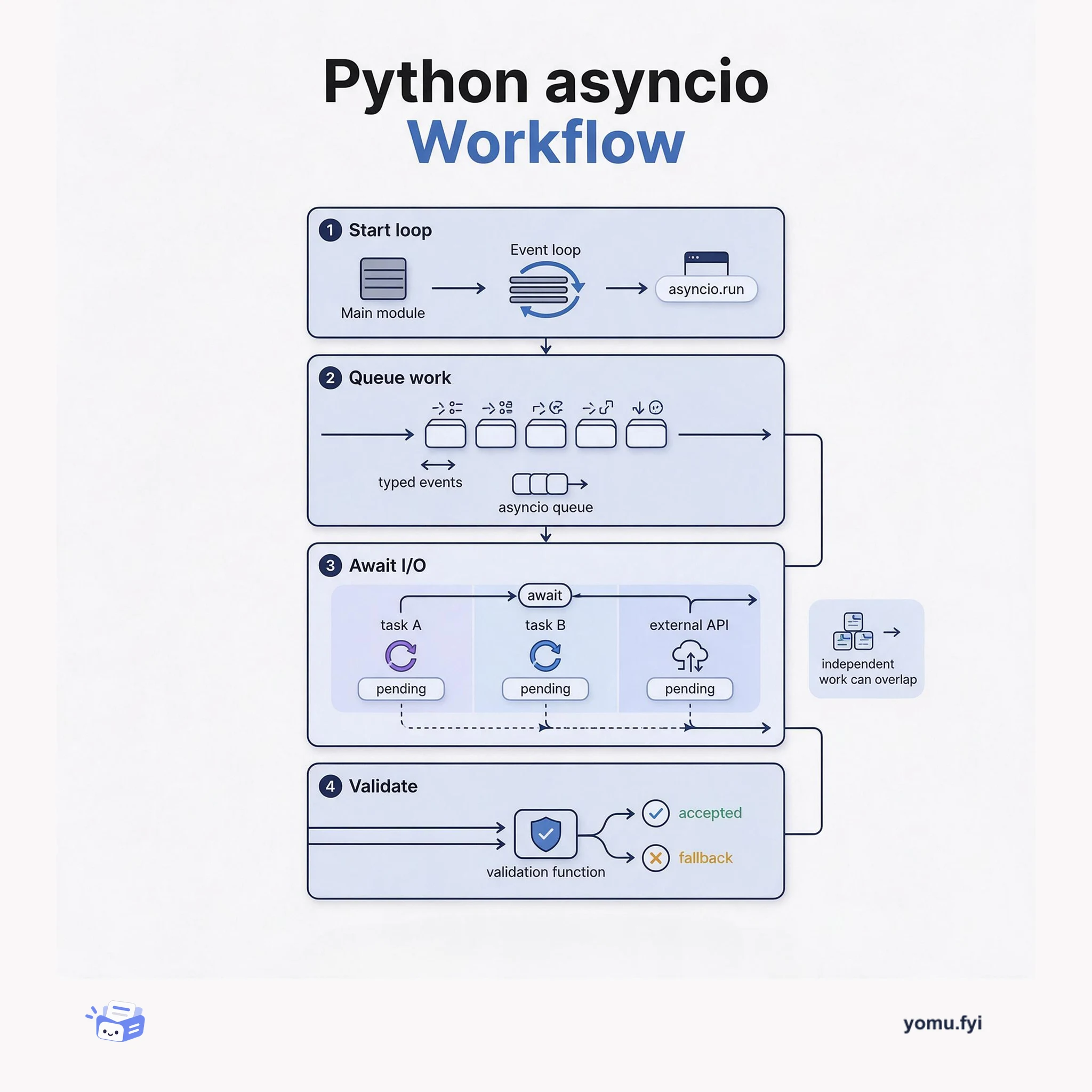
How to Move Independent Work Through an asyncio Pipeline
A practical asyncio workflow for moving independent work through typed events, queues, concurrent tasks, and awaited API calls. Learn where validation and fallback belong.
 GoogleSergio VillaniExplainer
The strongest submissions in the Google for Startups AI Agents Challenge repeatedly used four engineering patterns rather than merely labeling prompt chains as multi-agent systems. They exposed internally used tools through bidirectional MCP, used typed events and asyncio queues to let independent agents run concurrently, and routed fallback outputs through one shared validation function. They also reduced inference cost with tiered routing: regex or a cheap classifier handled simple intent before requests reached an expensive reasoning model, with one team reporting more than 40 percent handled before a real model call. The post argues these practices improve bounded data access, latency, resilience, and cost without requiring larger teams or newer models, and notes that Agent Development Kit and Agents CLI submissions showed them frequently.
Challenge submissions frequently claimed to be multi-agent systems, but inspection found that some were single models moving through prompt chains. The highest-ranked entries instead shared engineering decisions for handling tool access, concurrency, model failures, and inference cost.
The described systems use bidirectional MCP for agent-to-agent access, typed events on separate asyncio queues for concurrent reactions, a shared validation function across primary and fallback models, and tiered routing that applies regex or inexpensive classification before full model inference.
A telemetry agent can consume data through its own MCP tools and expose bounded, purpose-built answers as an MCP server, allowing other agents to call its reasoning layer directly.
Separate asyncio.Queue instances and typed event topics let agents react in parallel to shared signals instead of waiting through a serial call chain.
A single validation function applied to both primary and fallback model responses prevents an overload fallback from bypassing checks such as clinical-guideline citation validation.
Summaries are generated from the original by a language model. Check the original before relying on it.
See the idea
A practical asyncio workflow for moving independent work through typed events, queues, concurrent tasks, and awaited API calls. Learn where validation and fallback belong.
Keep reading
The Good Stuff
Paid picks we use ourselves. Links carry a referral code — a subscription through one earns us a commission at no extra cost to you.
One useful email. Unsubscribe anytime.
