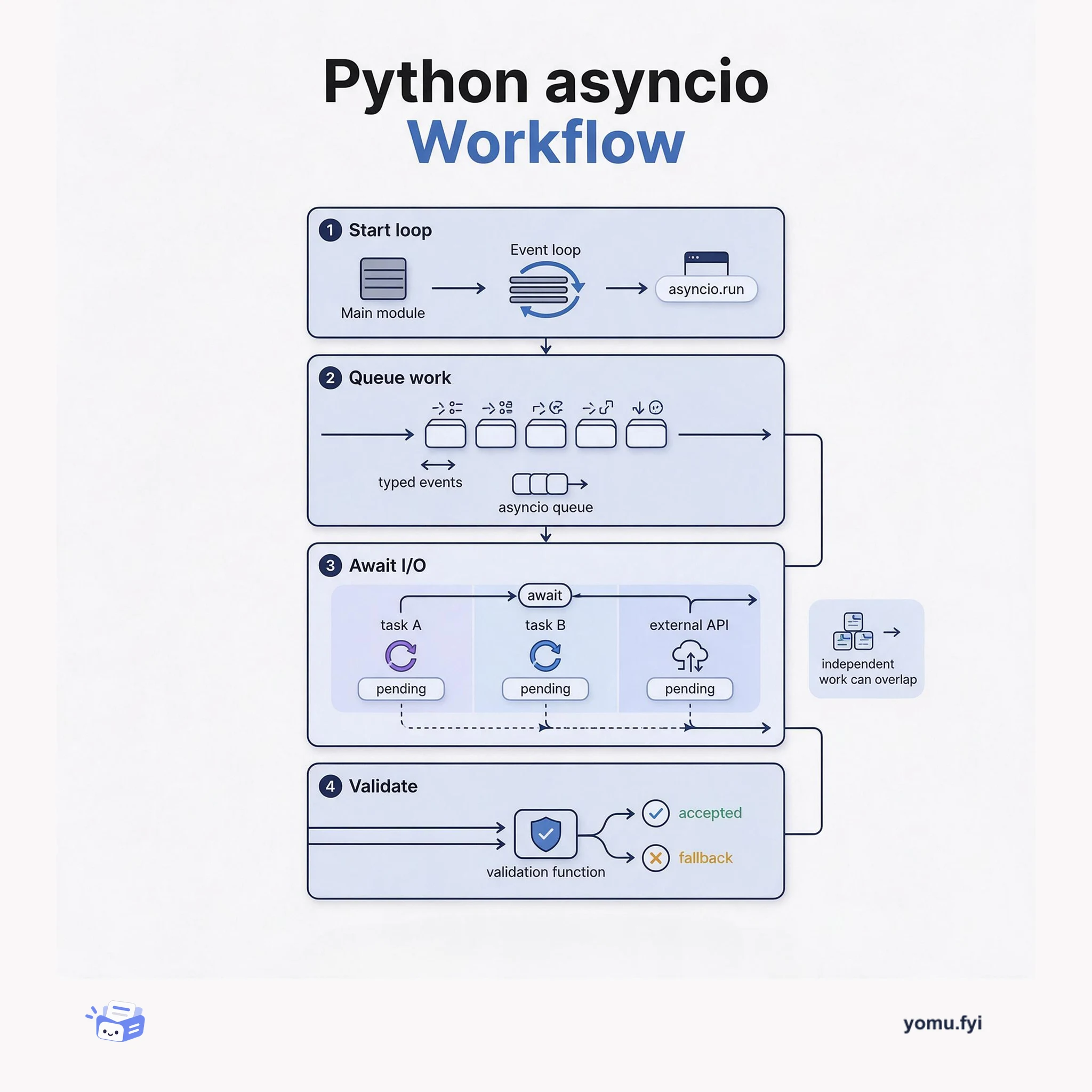
How to Move Independent Work Through an asyncio Pipeline
A practical asyncio workflow for moving independent work through typed events, queues, concurrent tasks, and awaited API calls. Learn where validation and fallback belong.
Loading…
Topic
2 posts about asyncio. Every summary links to the original.
See the idea
A practical asyncio workflow for moving independent work through typed events, queues, concurrent tasks, and awaited API calls. Learn where validation and fallback belong.
The Good Stuff
Paid picks we use ourselves. Links carry a referral code — a subscription through one earns us a commission at no extra cost to you.
Newest first
The strongest submissions in the Google for Startups AI Agents Challenge repeatedly used four engineering patterns rather than merely labeling prompt chains as multi-agent systems. They exposed internally used tools through bidirectional MCP, used typed events and asyncio queues to let independent agents run concurrently, and routed fallback outputs through one shared validation function. They also reduced inference cost with tiered routing: regex or a cheap classifier handled simple intent before requests reached an expensive reasoning model, with one team reporting more than 40 percent handled before a real model call. The post argues these practices improve bounded data access, latency, resilience, and cost without requiring larger teams or newer models, and notes that Agent Development Kit and Agents CLI submissions showed them frequently.
Python 3.7 is presented as an upgrade for developers seeking new language features, library improvements, and performance gains over earlier Python 3 releases. The article focuses on data classes, where the @dataclass decorator inspects typed attributes and generates an init method, reducing boilerplate for data-oriented classes. It also covers asyncio.run for simpler asynchronous execution, breakpoint() for entering pdb, module-level getattr for lazy loading, and context variables that keep values separate across execution contexts. Dictionary insertion order becomes part of the language specification in 3.7, while OrderedDict remains available for advanced behavior; reported improvements include 10–30% faster startup, 45–70% faster common sorting cases, 5.5-times-faster dict.copy(), and 4–6-times-faster namedtuple creation.
The best engineering reads, once a week.


