ADK for Kotlin 1.0 is announced as a general availability release for building AI agents with Kotlin across Android, JVM server applications, and Java-integrated systems. The release targets a production-ready toolkit while preserving an idiomatic, lightweight, composable approach, and it reaches feature parity with ADK 1.0 Core, including hierarchical agents, context compaction, human-in-the-loop confirmation, resumable sessions, annotated tools, and Java interoperability. A Kotlin Multiplatform core stays agnostic to model backends, session providers, and memory systems, while Android extensions support LiteRT-LM, ML Kit (beta), Firebase AI Logic, Room, AppSearch, and file artifacts. The database incident example combines compile-time KSP-generated function schemas, suspend-capable @Tool functions, and dynamically loaded SKILL.md playbooks with progressive disclosure. The release provides 1.0.0 dependencies, documentation, a repository, and sample applications.
Context
ADK for Kotlin was introduced to provide idiomatic, lightweight, and composable AI agent development for Kotlin, Java, and Android developers. Version 1.0 is presented as a production-ready toolkit with core feature parity and Android-first, on-device extensions, while also supporting server-side Kotlin developers.
Approach / What changed
The release uses a Kotlin Multiplatform core that is agnostic to model backends, session providers, and memory systems, complemented by Android extensions. It uses KSP to generate type-safe tool schemas at compile time without runtime reflection, supports declarative SkillToolset playbooks with progressive disclosure, and provides integrations for LiteRT-LM, ML Kit, Firebase AI Logic, Room, AppSearch, and file artifacts.
Takeaways
1
ADK for Kotlin 1.0 aligns with ADK Python and Java capabilities, including hierarchical multi-agent systems, context compaction, confirmation flows, session resumability, annotation-based tools, and Java interoperability.
2
KSP generates function-call definitions from Kotlin @Tool and @Param annotations at build time, supporting type-safe schemas, suspend functions, and zero runtime reflection.
3
Android examples combine Room session persistence, AppSearch memory, and file artifacts with multi-turn human approval for sensitive actions; the transfer example is explicitly not designed to meet compliance requirements.
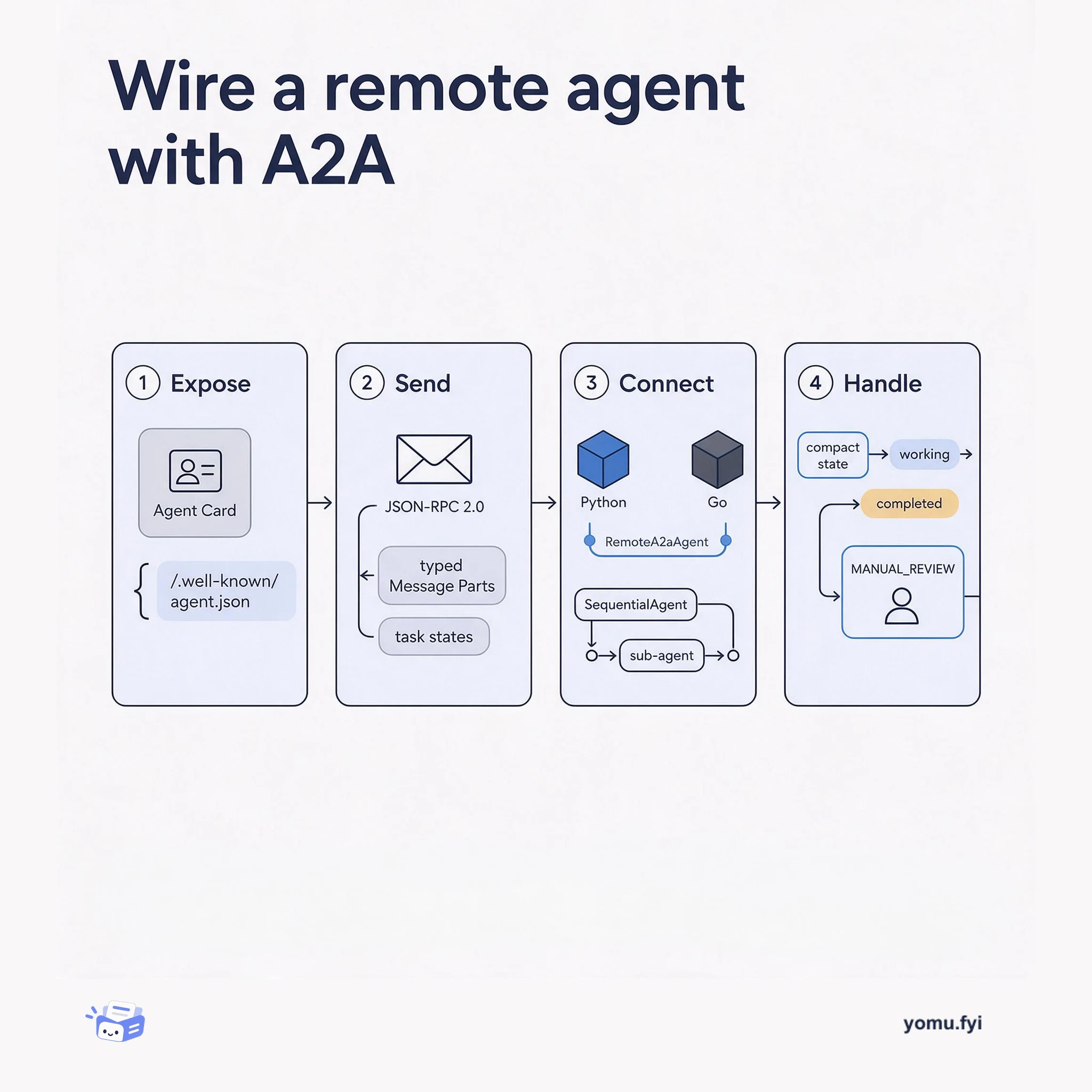
A2A lets agents discover each other and hand off tasks over JSON-RPC 2.0. This guide walks through exposing an Agent Card, sending typed messages, connecting a remote service, and routing failures to a human review checkpoint.
Keep reading
Related reading
The Good Stuff
Paid picks we use ourselves. Links carry a referral code — a subscription through one earns us a commission at no extra cost to you.