API Versioning as a Translation Layer
API versioning as an architecture: requests enter through a version header, pass through a chain of reversible version changes, and reach controllers that only ever see the latest model.
Loading…
Topic
81 posts about API. Every summary links to the original.
See the idea
API versioning as an architecture: requests enter through a version header, pass through a chain of reversible version changes, and reach controllers that only ever see the latest model.
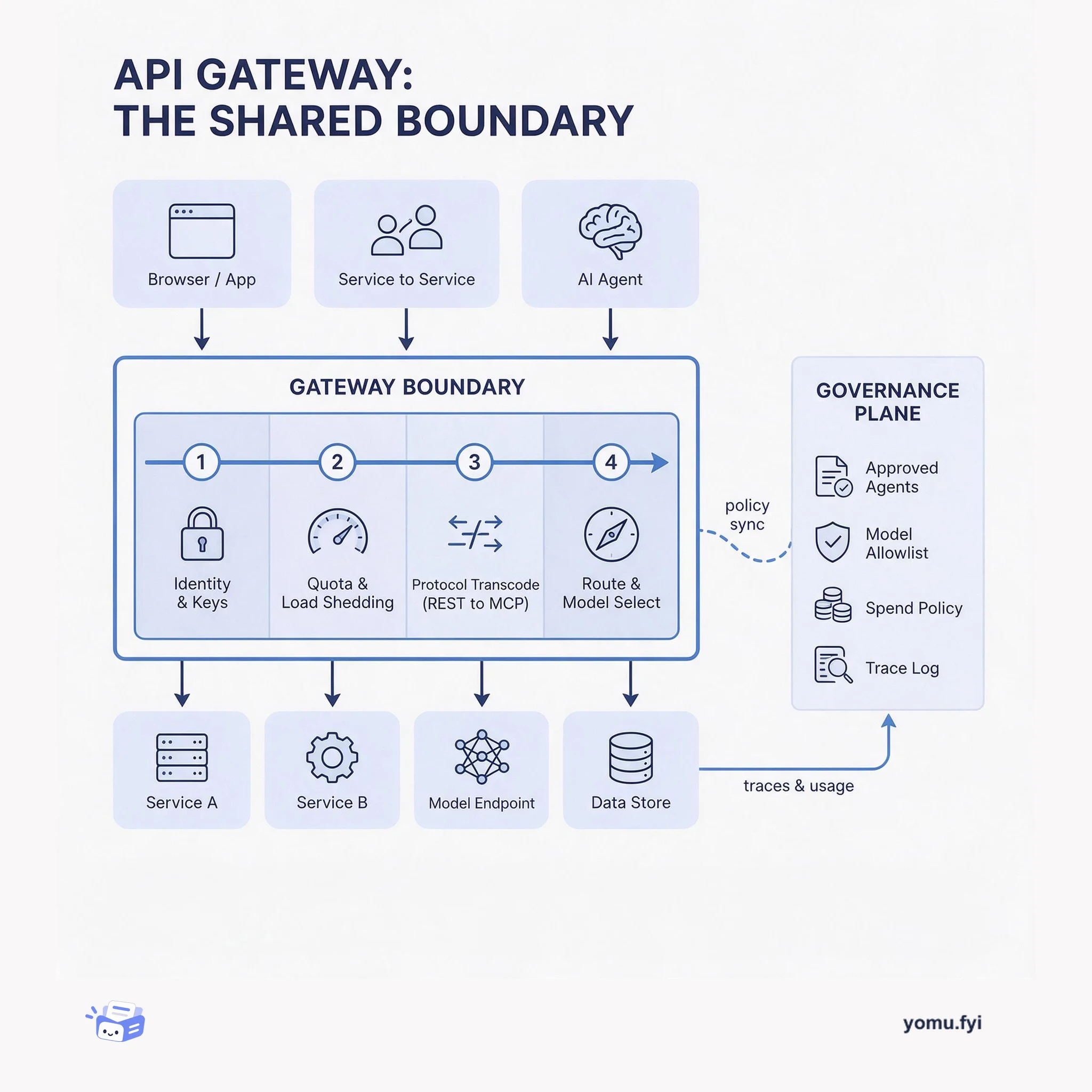
The API gateway is the single boundary where protocol translation, auth, quotas, and routing become shared policy instead of per-service code. This layered diagram shows what belongs there and why.
The Good Stuff
Paid picks we use ourselves. Links carry a referral code — a subscription through one earns us a commission at no extra cost to you.
Newest first
Tool-augmented LLM agents must discover relevant APIs from large registries before planning, but finite context windows prevent injecting all tool definitions into a single prompt. Two competing architectures are Retrieve-then-Plan (RtP), which embeds the query and retrieves similar tools via nearest-neighbor search, and Plan-then-Retrieve (PtR), which first generates abstract tool stubs as retrieval queries. Evaluating on ToolBench with 46,984 API endpoints across 50 categories reveals a clear complexity-dependent crossover: RtP outperforms PtR on single-tool queries while PtR outperforms RtP on multi-tool queries. PtR’s stub-hallucination failure mode acts as a double-edged sword—on simple queries it abstracts away proper-noun signals, yet on complex queries it decomposes multi-faceted intent into functional sub-needs. PtR roughly doubles inference cost, which pays off on multi-tool queries but hurts on single-tool ones, motivating complexity-adaptive routing driven by RtP’s top-1 retrieval score.
Databricks announces General Availability of Document Intelligence REST APIs for real-time document parsing, extraction, and classification, with the ai_decide API for routing in beta. These synchronous APIs eliminate the manual bottleneck of reading documents by transforming unstructured contracts, invoices, and insurance claims into structured insights in real time. The ai_parse_document API converts tables and figures into structured text with citation bounding boxes, while ai_extract pulls specified fields with optional citations and confidence scores for verification. The ai_classify API assigns labels using a business taxonomy with optional rationales, and ai_decide uses content to route or flag documents for review. Developers can integrate these APIs into Databricks Apps for human-in-the-loop workflows, such as a contract intake flow where a lawyer uploads an agreement and sees key terms prefilled, or into custom agents on Agent Bricks.
The post explains GitHub’s redesign of the stargazers API to provide star history without exposing user identities. The original endpoint returned paginated lists of stargazers, which tools used to reconstruct growth curves by fetching all pages, leading to privacy risks and expensive database queries that counted all stars on each request due to a pagination bug. GitHub first restricted access to stargazer lists to repository collaborators, but this broke tools that needed star history. Collaborating with maintainers and the Star History project, GitHub built a new endpoint that returns up to 30 weeks of daily star counts in a single request with no identities attached. The new endpoint reduces database work by filtering stars by time before aggregation, cutting requests for repositories like react/react from about 2,511 to 24.
SMS Pumping Fraud exploits phone number input fields to generate revenue from SMS messages sent to numbers controlled by a specific mobile network operator. Twilio’s Lookup v2 API provides an SMS Pumping Risk Score from 0 to 100, based on a proprietary model using network data including Verify Fraud Guard signals and unusual traffic patterns. This Rust tutorial uses the rustlio crate, dotenvy, serde, and tokio to call the API and retrieve the score along with carrier risk category and block status. Canadian numbers do not return carrier information, and Twilio advises against using the score for US or Canadian numbers. Guidelines recommend sending messages for scores 0-60, adding friction for 60-75, treating as suspicious for 75-90, and blocking for 90-100.
Origin’s App Marketplace now integrates with over 20 apps from partners including Cloudflare, Linear, Sentry, and Socket Security, covering deployments, CI, code review, security, monitoring, and project management. The marketplace is open to public submissions, allowing any team building developer tools to publish an app. To submit, developers create an app in their namespace, where it stays private while they build against the Origin API, and authenticate using an app JWT and installation access tokens. Apps receive webhook events and can write back check runs, pull request comments, and reviews. After making the app public, developers submit it with a slug, suggested tags, and a demo video showing install, uninstall, and core product flows; Origin reviews and lists approved apps.
The post compares building a developer ecosystem to creating a new country’s economy, requiring infrastructure, fair rules, and an efficient marketplace for trade. It cites a 2015 Deloitte report estimating Facebook’s 2014 platform effect at $29 billion and 660,000 jobs created by companies like King and BlaBlaCar, noting Facebook Platform launched in 2007. Intercom released its first developer APIs in June 2014 and has since added webhooks, OAuth, Bulk APIs, and SDKs for Ruby, PHP, Go, Java, Node, and Cordova. The company introduced new developer guidelines that emphasize innovation opportunities rather than restrictions, and built a new developer hub to simplify building integrations and apps. Intercom is exploring a marketplace to connect developers with customers who use Intercom, and over 50 integrations have been built; developers can join the Developer Program to get listed.
Intercom announced platform updates to make it easier for developers to build integrations and automate workflows, reflecting its commitment to supporting unexpected business use cases. The Acquire API now provides full API and webhooks support for logged-out users (Contacts), including creating, converting, and merging Contacts and Users. The Conversations API has been expanded to support initiating, replying, opening, closing, assigning conversations, and sending attachments. Intercom now maintains official client libraries for Ruby, Node.js, PHP, Java, and Go, with community-contributed clients for Haskell, Python, and Perl, downloaded approximately 300,000 times. Additional improvements also include a Stripe integration for syncing user data and live events, a fully asynchronous Bulk API for large operations, a WordPress plugin, and OAuth support initially in the Salesforce integration, while third-party apps like AskNicely, Gini, and Talkdesk have built on the platform for NPS tracking, reports, and phone call management.
Intercom announced a new set of APIs designed to enable developers to integrate and automate interactions with its platform. The APIs include Conversations, Counts, Companies, Users, and Events; the Conversations API allows sending email and in-app manual messages to users, enabling innovative use of Intercom’s in-app messaging directly from a product. The Counts API provides summary counts of users, companies, and conversations, including open and closed conversations per admin, for monitoring and graphing. The Companies and Users APIs add the ability to manage custom attributes, filter by tags and segments, and for companies, create and update information and manage user memberships. The Events API tracks user actions in a product to trigger contextually relevant messages, and customers using event-triggered Auto Messages saw engagement rates increase by over 200%.
Intercom introduced API versioning for their REST and Messenger Framework APIs, using their open-source Requisite library, enabling safe, frequent updates without breaking existing integrations. Previously, API changes required advance notice and coordinated migrations, which was unreliable and hindered iteration, so they conducted user research to identify friction points. The versioning system uses ‘version changes’ — single transformations that roll back a model change to a previous version, such as renaming user_id to customer_id, allowing controllers to always operate on the latest version and chain multiple changes. Developers can test isolated requests using a specific header and upgrade through the Developer Hub, with the ability to roll back immediately if something goes wrong. This design, inspired by Stripe’s approach, allows Intercom to ship changes more frequently and safely across REST API, Messenger Framework, and webhooks.
Intercom announced eight new features aimed at helping sales, support, and marketing teams manage volume and capacity more efficiently to increase conversions and grow their business. Custom Bots can qualify leads automatically, book meetings, and work 24/7 without code, connecting to the tech stack and accelerating sales cycles by delivering qualified leads when prospects are live. The new Intercom App Store offers over 100 apps for acquiring, engaging, and retaining customers, including Zoom Webinars, Content Showcase, Coda, and PieSync, along with a new Messenger framework and Developer Hub for building custom apps. Updated webhooks and APIs provide more flexibility to trigger actions based on conversation tags, check teammate availability with the Admins API, and run assignment rules at any point in a conversation. Other additions include downloadable conversation transcripts for both teammates and customers, and free developer workspaces for safe building and testing.
Many SaaS companies aspire to become platforms, but building a true platform is far more complex than offering APIs and integrations. Intercom, despite having over 250 third-party integrations and nearly 40% of customers using its APIs, acknowledges that this alone does not constitute a platform. The post identifies three common mistakes: trying to become a platform too early, expecting others to build integrations, and focusing on adoption metrics instead of developer success. Intercom emphasizes that platforms are governed ecosystems requiring extensibility and distribution, and that companies should start by building for their own customers before third parties. Building a lasting platform takes years of deliberate planning and long-term investment, as demonstrated by Salesforce’s gradual evolution from a point solution to a platform.
Intercom announced the launch of its Developer Program, opening its platform for third-party integrations. The company positions Intercom as the single source of truth for customer data, with data flowing in and out to other tools. It emphasizes flexibility, acknowledging it cannot build every feature customers need, that it is naive to believe every customer uses the product the same way, and that it relies on a developer community to extend its capabilities. The program helps developers build successful integrations and helps customers discover quality tools, with approved members listed on the website alongside built-by-Intercom integrations like Slack, Facebook, and more. The first eight approved members include Aircall, AskNicely, ChargeDesk, FullStory, productboard, SatisMeter, Statbot, and Wootric, and Intercom plans further ecosystem support as the developer community grows.
The Developer Knowledge API is Google’s official, programmatic source for developer documentation across Google Cloud, Firebase, and Android. It replaces web-scraping with a structured API serving fresh Markdown-formatted documentation, offering semantic and keyword search, intelligent document chunking, and grounded Q&A. The ecosystem includes a gcloud CLI surface that integrates search and grounded Q&A into terminal environments without extra plugins. An agent skill uses the standard MCP integration to connect AI assistants such as Claude Code, Cursor, and GitHub Copilot to up-to-date documentation. Multi-language client libraries enable programmatic access with features like BatchGetDocuments for retrieving up to 20 documents in one call.
Auth0’s user_metadata and app_metadata define a security boundary: user_metadata is writable by users through the update:current_user_metadata scope, while app_metadata requires privileged scopes available only to confidential clients via the client credentials grant. Post-login Actions reading authorization data like subscription plans or feature flags from user_metadata allow users to escalate privileges by modifying their own metadata, for example setting plan to enterprise and beta_access to true. Writing to app_metadata demands a server-side M2M application with update:users_app_metadata scope, which no public client or user token can obtain. The correct practice is to store access-control data such as roles, tenant membership, and IP allowlists in app_metadata, and non-sensitive preferences like theme or language in user_metadata. A third field, client_metadata, holds application-level properties readable via event.client.metadata in Actions.
The post explains how the REGISTER and UNREGISTER APIs in the Apache Iceberg REST catalog specification enable table portability between catalogs without copying or moving data files. REGISTER attaches an existing table to a new catalog by providing the metadata location, but using it alone creates a split-brain scenario where two catalogs both think they own the table, leading to inconsistent writes and data loss. The UNREGISTER endpoint, contributed to the specification, cleanly removes the table from the old catalog and returns the latest metadata pointer needed by the next catalog. The handoff process combines unregister, receiving the location, and register to ensure exactly one managing catalog at all times. Unity Catalog supports these endpoints in private preview, allowing organizations to move tables between catalogs as their architecture evolves.
WebRTC provides browser APIs for real-time voice, video, and data sharing without plugins, with mandatory encryption via DTLS-SRTP and DTLS; the standard became a W3C Recommendation in January 2021. The core APIs are getUserMedia for capturing audio/video from user devices, RTCPeerConnection for peer-to-peer media exchange via offer/answer and ICE candidates, and RTCDataChannel for arbitrary data transfer. WebRTC is supported by all major browsers and used by services like Google Meet, Discord (which uses media servers for group calls to avoid expensive peer-to-peer), and AI voice agents. Twilio offers Video and Voice JavaScript SDKs that handle signaling and media relay, enabling calls to phone numbers and SIP endpoints. The post includes a camera preview example using getUserMedia that requires a secure origin and can be served with Python, then directs readers to Twilio’s quickstart tutorials for building video and voice applications.
Cloudflare Registrar introduced a redesigned domain search that shows every supported extension and responds progressively as the user types. The search gathers availability evidence from prepared datasets, DNS, and live registry checks, updating only changed results via WebSocket deltas. The system uses Workers, Durable Objects, and Workers KV on Cloudflare’s developer platform to coordinate more than 420 extension checks per query. The Registrar API beta now includes a sandbox for testing, transfer support, and an extensions endpoint with registry requirements. Agents can search, register, or transfer domains through the MCP or the newly launched cf CLI with natural-language prompts.
Cloudflare announced the Monetization Gateway closed beta, enabling domain owners to charge AI agents per request for websites, APIs, MCP tools, or datasets. The gateway uses the HTTP 402 Payment Required status code to allow inline payment without redirects or separate payment APIs. Sellers define pricing rules matching request parts and choose from several schemes, with settlement on the Base blockchain using USDC via Coinbase’s x402 Facilitator. Customer use cases include Cloudflare AI Gateway for inference, Ceramic.ai for web search, Stocktwits for stock signals, and API2PDF for document conversion. The beta is available to eligible U.S.-based sellers and buyers, with plans to support additional geographies and payment rails over time.
More than half of Internet traffic is now automated, and AI agents are the fastest-growing part of it, with daily requests on Cloudflare’s network growing by more than 1,700% over the past year. This second audience consumes bandwidth without generating ad impressions or subscriptions, causing revenue per request to fall while costs rise. Cloudflare is giving site owners tools to see who is visiting, set terms per bot type, and charge for access. These include AI Crawl Control, Web Bot Auth for cryptographically verified agents, Disallow AI Training to block training without losing search indexing, and Pay Per Use to pay publishers when content is actually used. The goal is to build open standards so any site can set its terms and get paid, rather than a few companies controlling discovery and payment.
Seer Agent, Sentry’s AI debugging assistant, now performs write actions through the Sentry API, such as setting up custom dashboards, creating monitors and alerts, and assigning, resolving, and archiving issues. It defaults to the user’s permission level and explicitly requests permission for tasks outside its write scope, with permissions not persisting beyond a single chat. The agent can also incorporate infrastructure data from external monitoring platforms like Datadog and Google Cloud Platform via Seer Connectors, using API keys instead of OAuth. This allows Seer Agent to diagnose issues by connecting front-end and back-end data beyond Sentry’s native scope. These updates evolve Seer Agent from a conversational rubber duck into a proactive debugging assistant that can act on behalf of users.
The best engineering reads, once a week.