How Android Apps Handle Real-Time Local Processing
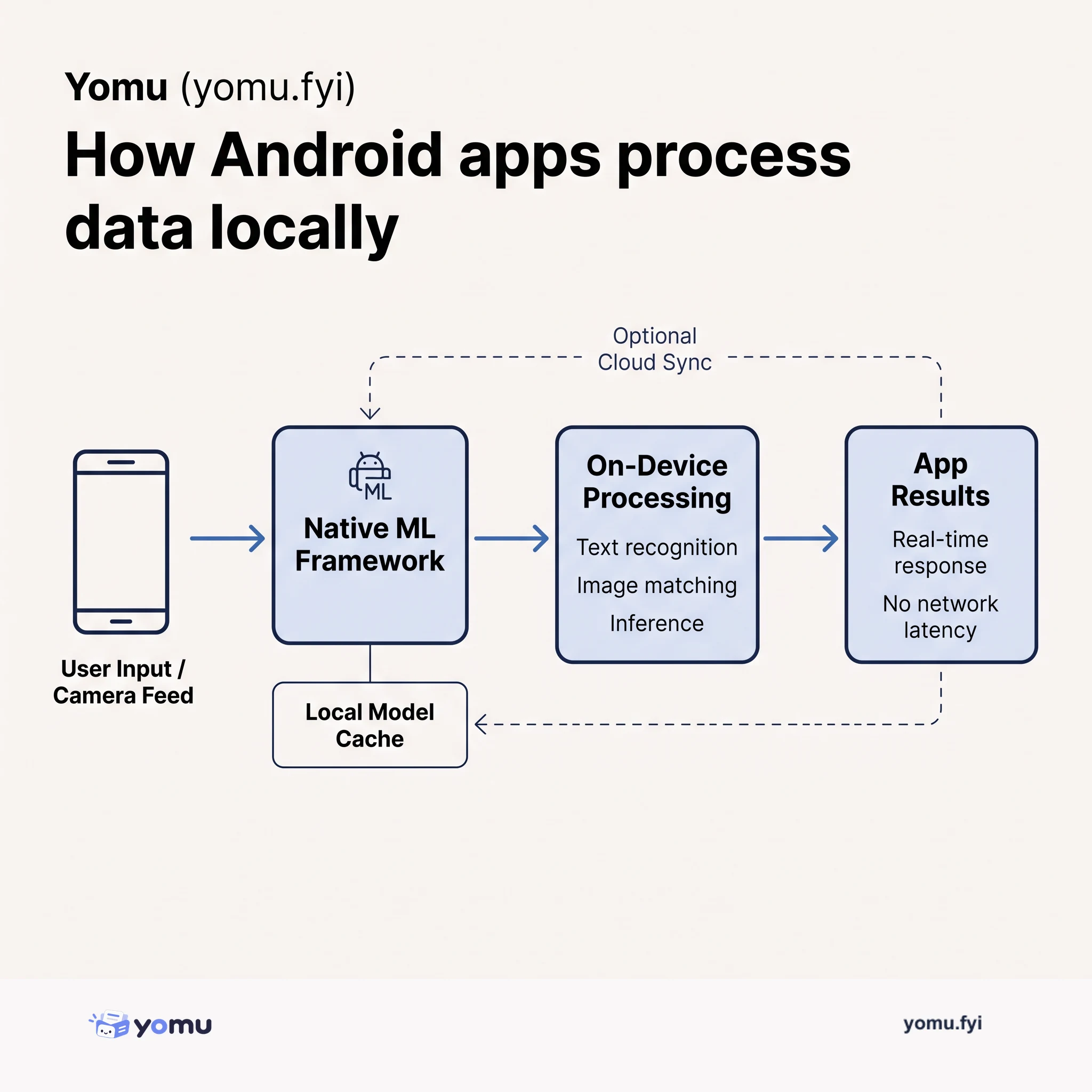
Android's on-device machine learning stack lets apps run inference, image recognition, and text processing locally without sending data to servers, reducing latency and protecting privacy.
Loading…
Topic
80 posts about Android. Every summary links to the original.
See the idea
Android's on-device machine learning stack lets apps run inference, image recognition, and text processing locally without sending data to servers, reducing latency and protecting privacy.
The Good Stuff
Paid picks we use ourselves. Links carry a referral code — a subscription through one earns us a commission at no extra cost to you.
Newest first
Sapienz, a multi-objective automated testing system for Android, received the ISSTA 2026 Most Influential Paper Award for its 2016 research by Ke Mao, Mark Harman, and Yue Jia. The system combines three goals: exploring more of an app, finding more crashes, and reducing the steps needed to trigger them, making failures easier to investigate. In an evaluation of 1,000 popular Google Play apps, Sapienz found 558 previously unknown crashes. Within 17 months of publication, it was deployed at Meta, where it now runs millions of tests daily, surfaces thousands of unique crashes each week, and helps safeguard hundreds of app releases each month. Sapienz also became the app-exploration engine for dynamic taint analysis at WhatsApp using synthetic conversation test accounts.
Auth0 released its official Kotlin Multiplatform SDK for Android and iOS, enabling unified authentication logic in shared common code. Developers write login, logout, token management, and direct API calls once in commonMain using Kotlin suspend functions and a sealed Result type for exhaustive error handling. Native security is maintained through platform-specific implementations: Android uses Keystore-backed DataStore and Custom Tabs, iOS uses Keychain and ASWebAuthenticationSession, with Swift async/await interop via SKIE. The SDK is available on Maven Central as com.auth0.kmp:auth0:1.0.0-beta.1 as a single artifact or separate modules, requiring Kotlin 2.3.21, Android minSdk 24, and iOS 14.0+. It includes a Credentials Manager for token storage and automatic renewal, and supports advanced features including WebAuthn passkeys, DPoP token binding, custom storage, and configurable retry with fixed or exponential backoff.
The Sentry Flutter SDK records breadcrumbs, user information, and diagnostic data through scope updates, adding overhead to apps. On Android, a dedicated worker isolate handles Sentry Android SDK operations to avoid blocking the main UI isolate, but both the calling isolate and the worker normalized the same data, and the encoding step produced a JSON string plus an unnecessary byte buffer copy. Removing the duplicate normalization roughly halved normalization time, while using JsonUtf8Encoder to encode directly into UTF-8 bytes reduced encoding time by 16% and eliminated the extra copy. Combined, these changes reduced total scope payload processing time by 27–30% for benchmark inputs of 1.2 KB, 23 KB, and 238 KB, as measured on a Google Pixel 4 in release mode. The optimizations are available in sentry_flutter version 9.26.0 and later.
Yelp Assistant is the first large-scale consumer LLM product at Yelp, connecting users with local professionals via chat. To iterate quickly across iOS, Android, and web while avoiding long app-store update cycles, the team chose a hybrid architecture: the top bar and input bar are native, while the chat content area is server-driven using Yelp’s CHAOS framework. The view and data are separated — the client fetches a CHAOS view template once, then conversation data hydrates that template on each turn. The backend sends MessageEvent objects, quick replies, and client actions (such as DisableChat) to control the UI. This hybrid approach enabled rapid iteration, but required building new CHAOS components for text input and network requests, and posed cross-platform consistency challenges.
Building real-time mobile personalization across iOS, Android, React Native, and Flutter required one architecture to handle different rendering models, lifecycles, identity flows, consent requirements, and release cycles without disrupting native app experiences. The team standardized schemas, event semantics, identity behavior, fallback handling, and SDK APIs, using bridge layers so React Native and Flutter could access native iOS and Android capabilities. Developers instrument apps once with constrained content zones and approved native components, while marketers configure templates, targeting, and content through Salesforce UI; metadata is published via a global CDN and rendered dynamically by the SDK. Data 360 performs server-side identity resolution and decisioning, limiting unnecessary raw profile storage on devices. An early customer implemented the system in two months and generated more than 150 million decisions within three weeks, while QR-code previews enabled testing against live profiles without app recompilation.
ADK for Kotlin 1.0 is announced as a general availability release for building AI agents with Kotlin across Android, JVM server applications, and Java-integrated systems. The release targets a production-ready toolkit while preserving an idiomatic, lightweight, composable approach, and it reaches feature parity with ADK 1.0 Core, including hierarchical agents, context compaction, human-in-the-loop confirmation, resumable sessions, annotated tools, and Java interoperability. A Kotlin Multiplatform core stays agnostic to model backends, session providers, and memory systems, while Android extensions support LiteRT-LM, ML Kit (beta), Firebase AI Logic, Room, AppSearch, and file artifacts. The database incident example combines compile-time KSP-generated function schemas, suspend-capable @Tool functions, and dynamically loaded SKILL.md playbooks with progressive disclosure. The release provides 1.0.0 dependencies, documentation, a repository, and sample applications.
Yelp developed Menu Vision to help diners recognize menu items and view corresponding user-generated photos and reviews in real time using their phone cameras. The feature evolved from a two-day hackathon Android prototype into a production system deployed across iOS and Android. Client devices perform all optical character recognition, text cleanup, and dish matching locally using native machine learning frameworks, while dish metadata is prefetched upon opening a restaurant page. Backend pipelines combine partner data, reviews, and photo captions into a Cassandra database, filtering exclusively for dishes with photos. To handle optical character recognition errors and name variations, the matching pipeline runs exact matching, bidirectional substring matching, and Jaro-Winkler similarity matching.
bitdrift has joined ClickHouse’s House Mates program as a mobile observability partner, bringing mobile-native telemetry, tracing, and debugging to ClickStack. ClickStack provides an open-source or managed observability stack built on ClickHouse, with HyperDX and an OpenTelemetry Collector for logs, metrics, traces, and OTLP ingestion. bitdrift’s Capture SDK supports iOS, Android, and React Native, stores unsampled telemetry in a fixed-size on-device ring buffer, and uses control-plane configuration to decide what is collected or uploaded. Shared OpenTelemetry trace context lets engineers follow a mobile request’s trace ID from a session timeline into ClickStack, where backend traces, dependencies, logs, metrics, database operations, and infrastructure behavior are available, creating a continuous debugging path across the device and distributed systems.
Thumbtack migrated 1,500 Android screenshot tests from Firebase Test Lab to Roborazzi to eliminate slow and error-prone testing on remote emulators. The engineering team ported test suites from androidTest to test in batches of 20, adjusting test rules and annotations for Robolectric. Because Roborazzi runs in a single JVM process with parallel execution, the team had to debug shared font cache pollution and cross-platform shadow rendering inconsistencies between macOS and Debian. They resolved configuration repetition by mapping Robolectric annotations into module-level robolectric.properties files and avoided stale cached images by clearing Roborazzi's cache via a custom Gradle task. The migration significantly decreased CI runtimes while making local test recording and verification easier.
Genie One mobile apps for iOS and Android let business users ask questions of company data, view dashboards, access Databricks Apps, and use conversational agent capabilities away from a desk. Answers draw on Genie Ontology, Genie Agents, enterprise governance, and connectors to Google Drive, Microsoft 365, and Atlassian, while respecting source permissions. AI/BI Dashboards reflow widgets into a single column in portrait mode and preserve their designed layout in landscape. Authentication uses the existing OAuth flow and identity provider, with MFA, conditional access, device posture, network controls, regional data handling, and workspace permissions carried over from the browser; there is no separate mobile backend or mobile-only endpoint. The app is available in Public Preview, with dark mode, push notifications, voice mode, and account-level access listed as planned capabilities.
An Android APK investigation found high-resolution PNG variants beside vector drawable XML files, although those raster assets had not been added directly to the codebase. The cause was AAPT2 rasterizing vectors that used features unavailable below API 24, including gradients in android:fillColor, despite the app’s minSdkVersion being 23; the generated files could be much larger than their XML sources, and were produced even for unused resources. The described remedy was to remove unused raster-prone assets, use VectorDrawableCompat with app:srcCompat for affected vectors, and tell Gradle and AAPT to use support-library rendering rather than density-specific PNGs. Removing unused assets cut download size by more than 1 MB, while raising minSdkVersion to 24 produced a further 2.7 MB reduction, for 3.7 MB total; similar gains were observed in Toing and Instamart.
Swiggy migrated from protobuf-java to Square Wire after profiling showed that the runtime and protoc-generated code consumed 6.735 MB of Android app size. protobuf-javalite was rejected because Swiggy relies extensively on google.protobuf.Any, while Wire retained support for Any and other well-known types with a smaller runtime and immutable Kotlin models. The migration required updating snake_case property access, message construction, serialization calls, ProGuard rules, and a custom pipeline that compiled all schemas together before publishing package-specific AARs to AWS CodeArtifact. The team also fixed repeated enum fields with [packed = true] after discovering a silent wire-format mismatch. It reduced Swiggy’s app size by 3.52 MB and produced measurable reductions for Instamart and Toing.
An Android monorepo’s CI pipeline averaged about 35 minutes in its build phase, with a P90 of roughly 44 minutes, as repeated dependency downloads, environment-driven invalidations, variant bloat, and machine limits increased work. The team reworked caching with branch- and architecture-aware keys, release/develop fallbacks, cached SDK and dependency data, and a Gradle Remote Cache, while filtering repositories and restricting CI to required variants. It also tuned 32GB runners to a 16GB heap and 12GB Metaspace, disabled configuration-cache saves in ephemeral CI, upgraded Kotlin, AGP 8.10.1, and Gradle 8.11.1, and moved critical workflows to Apple Silicon. Gradle tasks fell from 3399 to 2745, while remote-cache hit rates reached P50 44% and P90 56%. After the Apple Silicon refresh, total CI time reached P50 10 and P90 11 minutes, average credits per build dropped from 55 to 43, and a comparable rollout window saved about 5800 credits.
At Sonoma Raceway, Google Developer Experts built an AI-powered race coach to turn vehicle telemetry into split-second driving advice, extending an earlier pilot that handled basic telemetry. The system uses Antigravity for stateful orchestration and ingestion, Python and Jetpack Compose for mobile processing and display, Agent Development Kit for agent coordination, and hybrid Gemma 4 edge reasoning plus Gemini API cloud analysis. A custom USB interface connected a Pixel 10 directly to the vehicle telemetry network, providing a 10 Hz stream from hundreds of sensors, while an activated on-device TPU reached 40 tokens per second for local coaching alerts delivered through text-to-speech. The test identified a throttle application zone in Turn 2 associated with a 0.1-second gain, and the initiative is scheduled to continue at Interlagos, Brazil.
Holo3.1 is a family of computer-use models released to improve robustness across web, desktop, and mobile environments, agent frameworks, and deployment targets. Based on Qwen, it adds native function-calling alongside structured JSON outputs, expands mobile automation, and offers 0.8B, 4B, 9B, and 35B-A3B sizes for different cost, latency, and performance needs. On AndroidWorld, the 35B-A3B model rises from 67% to 79.3%, while the 4B and 9B variants rise from 58% to 72%; function-calling and native execution achieve near-parity across the stated benchmarks, and Holo3.1 improves more than 25% over Holo3 in the Holotab harness. The release also provides 35B-A3B FP8, Q4 GGUF, and NVFP4 checkpoints for local inference: NVFP4 matches FP8 on OSWorld at about two points below BF16, reaches 1.74 times BF16 token throughput on DGX Spark, and with harness optimizations cuts average step time from 6.8 seconds to 3.3 seconds.
Grab’s passenger Android monorepo contains roughly 2,000 modules and 11 million lines of code, making Gradle-based Android Studio syncs increasingly slow and memory-intensive even though Bazel handles builds. A cold full sync could exceed 35 minutes, and a survey of 55 developers found that 82% wanted an option to exclude modules from syncing. The team built a custom Focus plugin that uses a dependency graph generated during migrateToBazel, avoids repeating Gradle’s configuration phase, and integrates with Android Studio through a one-click Select → Focus → Sync flow; a Groovy include-shadow technique avoids requiring teams to reorganize settings files. Typical focused syncs fell below two minutes, while reported results show reductions from 35 minutes to under one minute depending on module size, memory usage from 10 GB to 2 GB, and improved Compose preview updates, with broader IDE operations requiring expanded focus or full sync.
Unreal Engine games frequently experience performance issues such as frame-rate drops, hitches, and network degradation that do not register as application crashes. To address the lack of live production telemetry, the Sentry Unreal SDK introduces automatic performance metrics. The integration periodically samples frame times, network health, active UObject counts, physical memory usage, and garbage collection pause durations across desktop, console, and Android platforms. Telemetry entries attach contextual hardware and environment attributes alongside trace IDs to connect aggregate latency spikes directly to underlying traces and spans. Enabled by default in Unreal SDK version 1.11.0, this telemetry provides developers with fleet-wide visibility into hardware-specific bottlenecks across game releases.
Yelp maintains two major applications across Web, iOS, and Android, which previously led to fragmented server-driven UI implementations with mismatched backend component representations. To unify its server-driven UI framework, CHAOS, with its cross-platform design system, Cookbook, Yelp built an automated bridge library called Konbini. Konbini reads centralized JSON interface definitions through Jenkins pipelines to automatically generate synchronized libraries for Python, Kotlin, Swift, and TypeScript. These generated libraries handle component serialization on the backend and deserialization on client platforms. To maintain backward compatibility when component interfaces introduce breaking changes, client requests pass versioned spec identifiers, prompting the backend to execute migration methods that downcast newer component models to older supported versions.
Thumbtack required a faster, emulator-free method to execute over 1,500 Android screenshot tests during continuous integration. Previously, running UI tests on physical devices or emulators proved too slow for code review verification jobs, causing tests to run post-merge and allowing regressions to persist. After evaluating Paparazzi and Google's experimental Compose Preview Testing, the team selected Roborazzi, which runs on top of Robolectric's native graphics engine within a standard JVM. This headless setup accommodates custom Activities, Dagger field injection, and legacy View systems while executing alongside standard unit tests. Moving screenshot tests to the unit test level enabled gating merges on passing tests, colocating tests inside feature modules, and increasing total CI job runtime by only twenty percent.
Slack redesigned its legacy notification architecture to address user confusion, conflicting desktop and mobile preference systems, and tight coupling between notification content and push delivery. The engineering team unified four separate preference models into a single framework with three channel options: All new posts, Mentions, and Mute. To ensure safe rollback and backwards compatibility without direct database mutations, Slack implemented a read-time translation strategy alongside a new desktop_push_enabled preference and auto-saving cross-platform React UI components. This decoupling of activity from push delivery resulted in a fivefold sustained increase in settings engagement, reduced reliance on per-channel overrides, and eliminated synchronization mismatches across mobile and desktop clients.
The best engineering reads, once a week.