Copy-and-Replay vs Branch-at-a-Point: Two Backup Recovery Paths
A side-by-side comparison of copy-and-replay recovery and branch-at-a-point restores, showing why restore time scales with data size in one model and not the other.
 AWSSatish BhoiTutorial
Enterprises with existing VMware Cloud Foundation investments can migrate Oracle databases to AWS using Amazon Elastic VMware Service (EVS) and Amazon FSx for NetApp ONTAP without rearchitecting applications or retraining operations teams. The architecture splits storage between vSAN for low-latency transient workloads and FSx for ONTAP NFS datastores for Oracle data files and redo logs, delivering sub-millisecond latency and up to 80,000 IOPS. Cross-region disaster recovery uses SnapMirror to asynchronously replicate FSx for ONTAP volumes, with pre-provisioned standby Oracle VMs that mount replicas only after failover to avoid Oracle double licensing. Recommended EC2 bare metal instance types include i7i.metal-24xl for per-core compute speed and i7i.metal-48xl for vertical scaling, both supporting VCF 9.1. Migration options include VMware HCX for live migration, SnapMirror for ONTAP-to-ONTAP transfer, and RMAN for universal database movement.
Enterprises with existing VMware Cloud Foundation (VCF) investments want to migrate Oracle databases to AWS without rearchitecting applications or retraining operations teams. The solution targets high availability, cross-region disaster recovery, and sub-millisecond storage latency while preserving familiar VMware operational tooling.
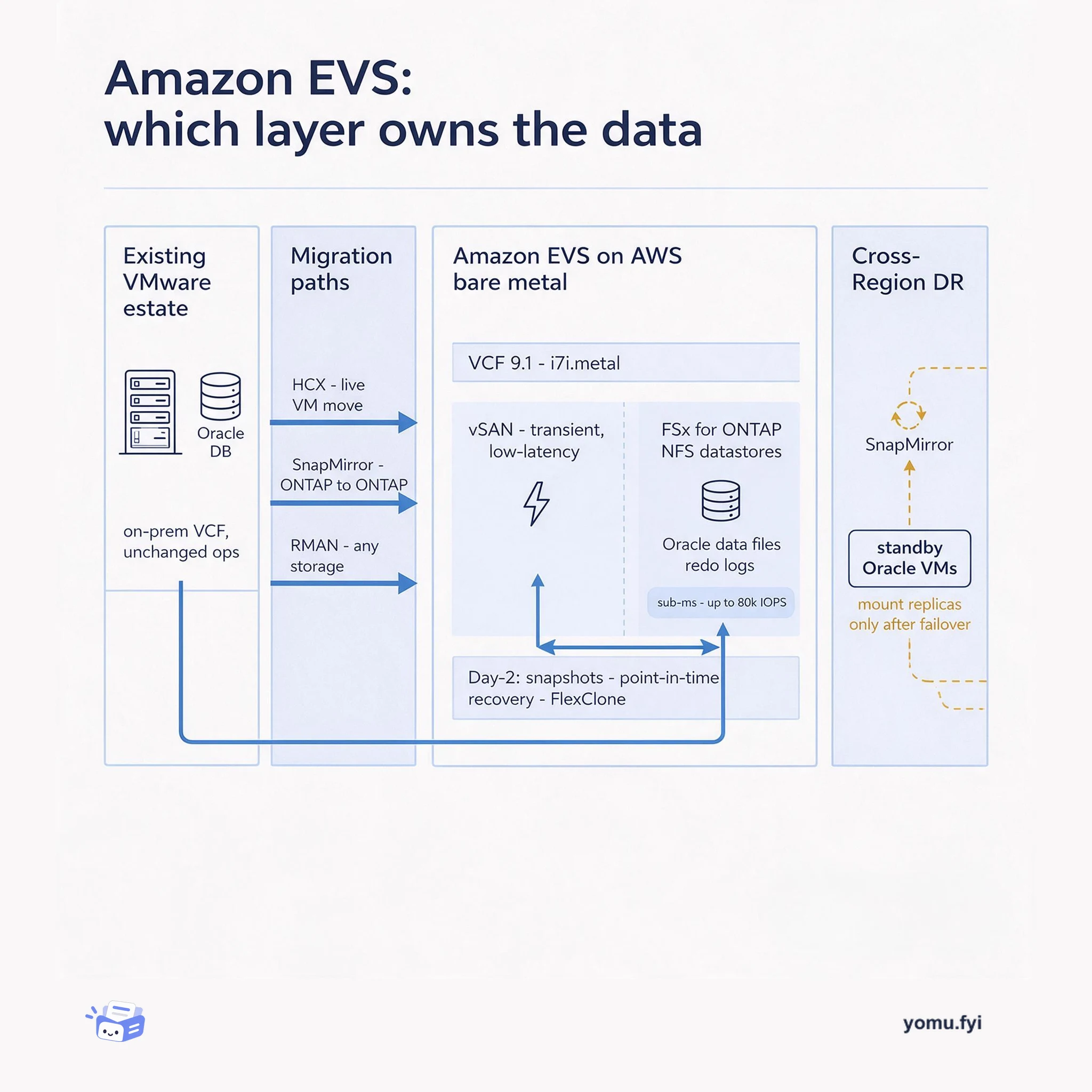
The architecture splits storage between vSAN (for VM boot disks, OS swap, and Oracle temp tablespace) and Amazon FSx for NetApp ONTAP NFS datastores (for Oracle data files and redo logs). ESXi hosts mount FSx for ONTAP volumes as NFS datastores, and Oracle VMs access standard VMDKs on those datastores. Cross-region disaster recovery uses SnapMirror to asynchronously replicate FSx for ONTAP volumes to a DR region, with pre-provisioned standby Oracle VMs that mount the replica volumes only after a failover event is declared to avoid Oracle double licensing.
Amazon EVS runs VMware Cloud Foundation on EC2 bare metal instances within a VPC, preserving existing VMware operational workflows for Oracle database deployments.
FSx for NetApp ONTAP delivers sub-millisecond response times, multiple GBps of throughput, and up to 80,000 IOPS per file system for Oracle data and log volumes.
SnapMirror asynchronously replicates FSx for ONTAP volumes to a DR region with configurable RPO; DR volumes remain unmounted until failover to avoid Oracle double licensing.
The recommended default is i7i.metal-24xl (96 vCPUs, 48 cores, 768 GiB RAM) because Oracle query performance is sensitive to CPU instruction throughput and storage IO latency. i7i.metal-48xl doubles capacity per host for vertical scaling, and i4i.metal offers higher per-host density to reduce VMware licensing costs.
vSAN handles VM boot disks, OS swap, and Oracle temp tablespace for low-latency, non-replicated workloads. FSx for NetApp ONTAP handles Oracle data files and redo logs that require snapshot-based backup and cross-region replication via SnapMirror.
Replicate Oracle VMs through NetApp SnapMirror from production to DR, keeping DR replicated volumes as data-protection (DP) volumes that are NOT mounted as NFS datastores on DR hosts until a failover event is declared. This avoids Oracle double licensing.
Summaries are generated from the original by a language model. Check the original before relying on it.
See the idea
A side-by-side comparison of copy-and-replay recovery and branch-at-a-point restores, showing why restore time scales with data size in one model and not the other.
Amazon EVS runs VMware Cloud Foundation on AWS bare metal, so the design question becomes where each workload's data lives. This layered diagram shows how vSAN, FSx for ONTAP, and cross-Region DR divide the work.
Keep reading
The Good Stuff
Paid picks we use ourselves. Links carry a referral code — a subscription through one earns us a commission at no extra cost to you.
One useful email. Unsubscribe anytime.