Amazon EVS Architecture: Where vSAN Ends and FSx for ONTAP Begins
Amazon EVS runs VMware Cloud Foundation on AWS bare metal, so the design question becomes where each workload's data lives. This layered diagram shows how vSAN, FSx for ONTAP, and cross-Region DR divide the work.
Amazon Elastic VMware Service (Amazon EVS) lets teams keep VMware Cloud Foundation operations on AWS bare metal instances instead of rearchitecting applications or retraining operators. The architecture splits into bounded layers: the existing on-premises estate, a migration layer using VMware HCX, SnapMirror, or RMAN, the EVS compute layer running VCF, and two storage zones inside it. vSAN serves low-latency transient workloads while FSx for NetApp ONTAP NFS datastores carry Oracle data files and redo logs, with SnapMirror replicating volumes cross-Region for disaster recovery. Knowing which layer owns the data is what keeps latency, licensing, and failover behavior predictable.
FAQ
How does this EVS design avoid paying for Oracle twice in the DR Region?
Standby Oracle VMs are pre-provisioned in the recovery Region but mount the SnapMirror replicas only after failover actually happens. Because the database is not running against replicated storage during normal operation, the standby does not consume a second Oracle license until it is genuinely needed.
Which migration path fits an existing Oracle estate already on NetApp ONTAP?
SnapMirror handles ONTAP-to-ONTAP volume transfer, which suits environments already standardized on ONTAP storage. VMware HCX covers live VM migration when you want to move workloads with minimal disruption, and RMAN backup and restore remains the universal option for databases on non-ONTAP storage.
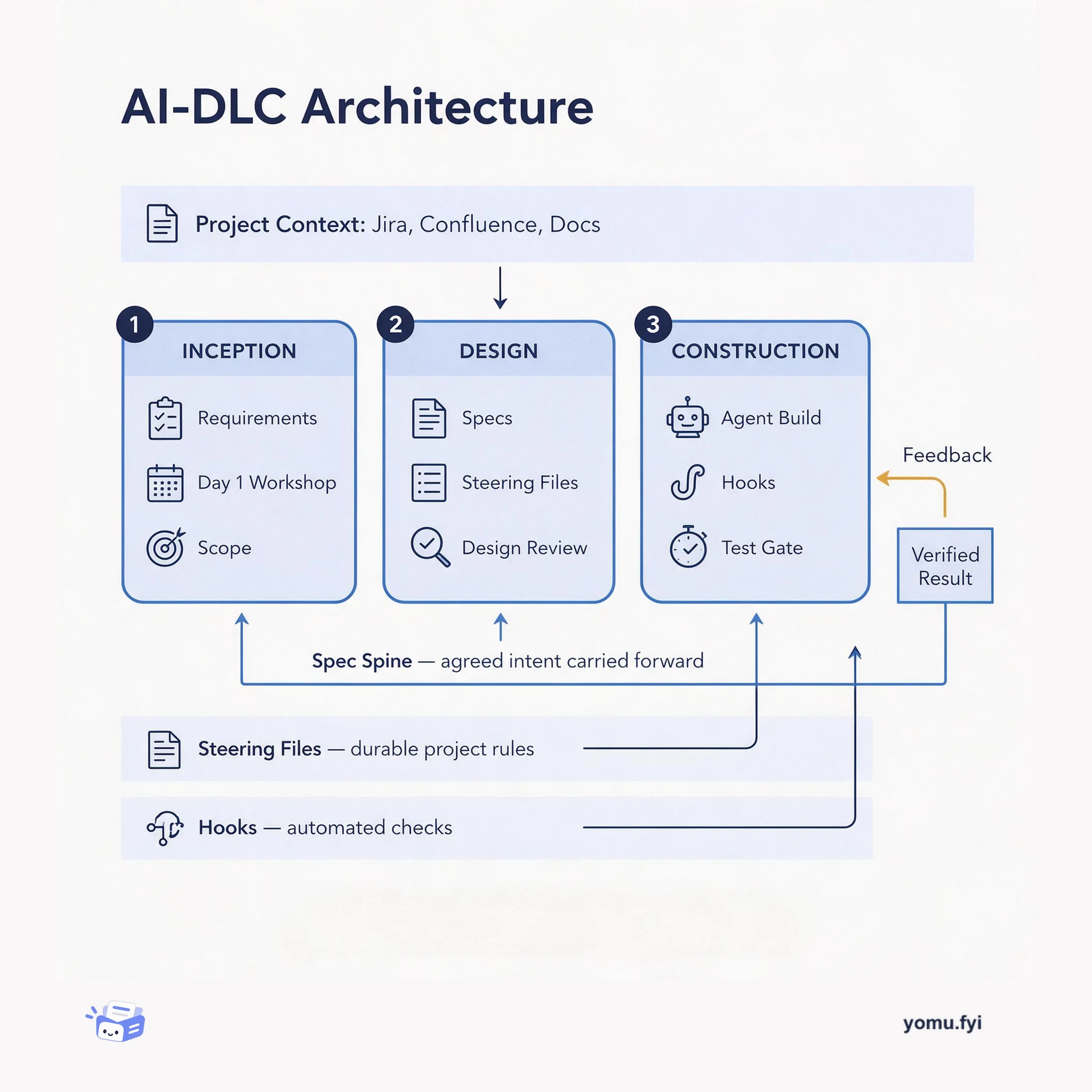
AI-DLC is an AI-driven development lifecycle that runs delivery through Inception, Design, and Construction, with specs, steering files, and hooks keeping agents aligned to agreed intent.
Apple Silicon's defining choice is one shared memory pool for CPU, GPU, and Neural Engine. This diagram maps that fabric, the on-package bandwidth it buys, and the scaling limits it imposes.
Antimicrobial resistance surveillance is a layered data architecture: raw reads and demand signals flow in, get normalized into governed tables, and answer plain-language queries. The diagram maps each boundary.
The Good Stuff
Paid picks we use ourselves. Links carry a referral code — a subscription through one earns us a commission at no extra cost to you.