Cloudflare mitigated 18.2 million network-layer DDoS attacks and 14.4 trillion HTTP DDoS requests in Q3 2026, averaging 8,226 attacks per hour. Short-burst, low-bandwidth attacks under 10 minutes and 1 Gbps surged 208%, while hyper-volumetric attacks exceeding 1 Tbps dropped nearly 69% from Q2. The decline in large attacks coincided with law enforcement actions that dismantled four major IoT botnets earlier in 2026, though new variants like Dysphoria and Evooo1Bot continue to emerge. Attackers abandoned CLDAP floods, which collapsed 99.5%, and pivoted to DNS amplification and UDP floods, which rose 215% and 122% respectively. The United States became the most-attacked country, while Canada and Israel climbed sharply in the rankings amid geopolitical tensions and domestic events.
Context
Cloudflare’s 2026 Q3 DDoS Threat Report, produced by Cloudforce One, analyzes attack data from the Cloudflare network. It covers July through September 2026 and returns to a quarterly cadence after a combined H1 report.
Takeaways
1
Short-burst attacks under 10 minutes and 1 Gbps surged 208% in Q3 2026, driven by DDoS-for-hire booter services targeting computer software, gambling, and IT industries.
2
Hyper-volumetric attacks over 1 Tbps dropped nearly 69% from Q2, coinciding with law enforcement takedowns of four major IoT botnets, though new variants like Dysphoria and Evooo1Bot persist.
3
CLDAP floods collapsed 99.5% quarter-over-quarter, while attackers pivoted to DNS amplification (+215%) and general UDP floods (+122%) as primary reflection and amplification vectors.
FAQ
Why did CLDAP attacks collapse in Q3 2026?
CLDAP attacks collapsed by 99.5% quarter-over-quarter, dropping to just 0.05% of network-layer attacks. Attackers pivoted to other connectionless protocols, driving a 215% surge in DNS amplification and a 122% increase in general UDP floods.
What caused the drop in attacks over 1 Tbps?
Hyper-volumetric attacks exceeding 1 Tbps dropped from 805 in Q2 to 251 in Q3, a decline of nearly 69%. This coincided with law enforcement actions earlier in 2026 that dismantled four major IoT botnets: Aisuru, KimWolf, JackSkid, and Mossad.
What characterized the surge in short-burst attacks?
Short-burst, low-bandwidth attacks under 10 minutes and 1 Gbps surged by 208%. These attacks are the operational signature of DDoS-for-hire 'booter' services and primarily targeted computer software, gambling and casinos, and information technology industries.
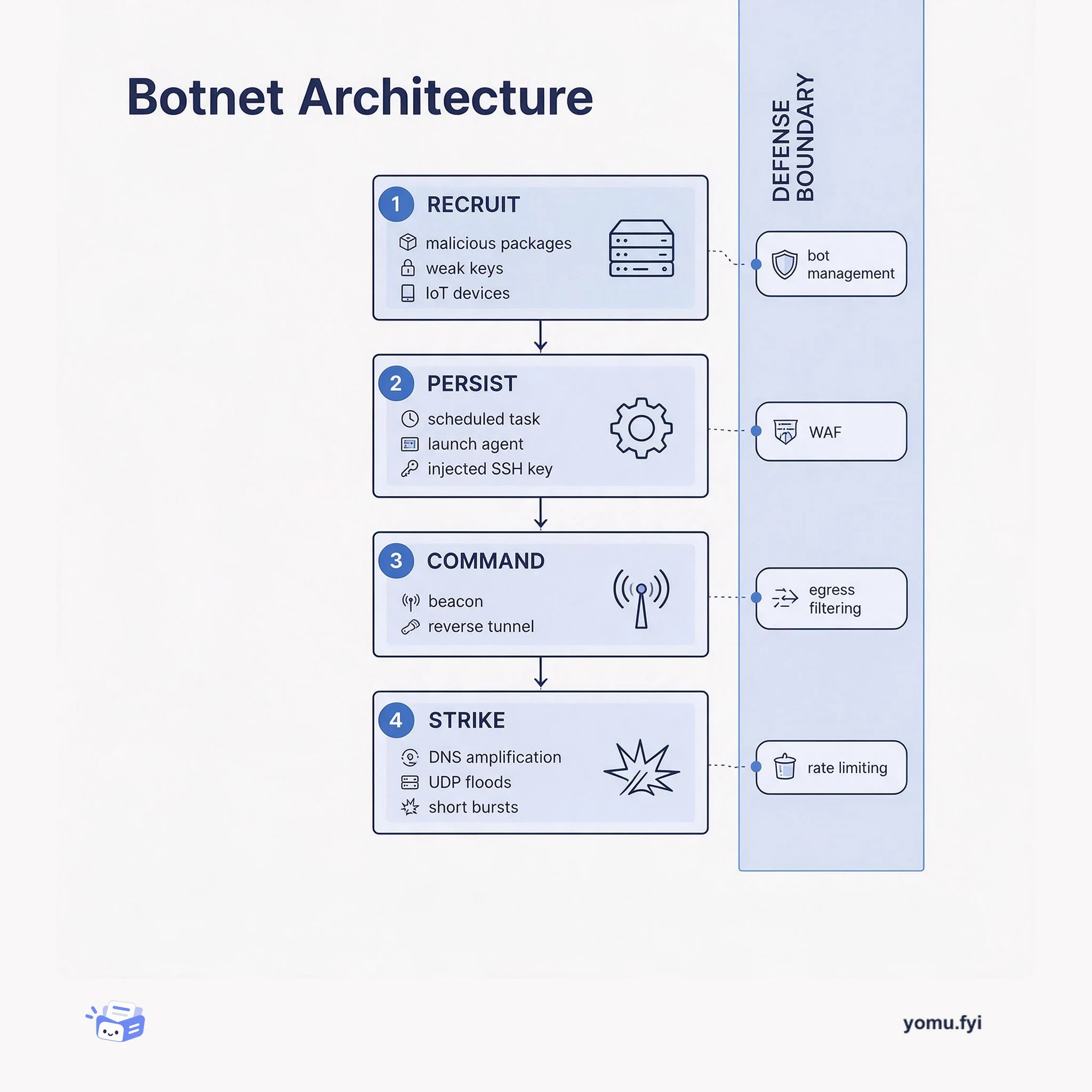
A botnet is a fleet of compromised devices organized in four layers: recruitment, persistence, command and control, and attack execution. This diagram maps how the layers connect and where defenses break the chain.
Keep reading
Related reading
The Good Stuff
Paid picks we use ourselves. Links carry a referral code — a subscription through one earns us a commission at no extra cost to you.