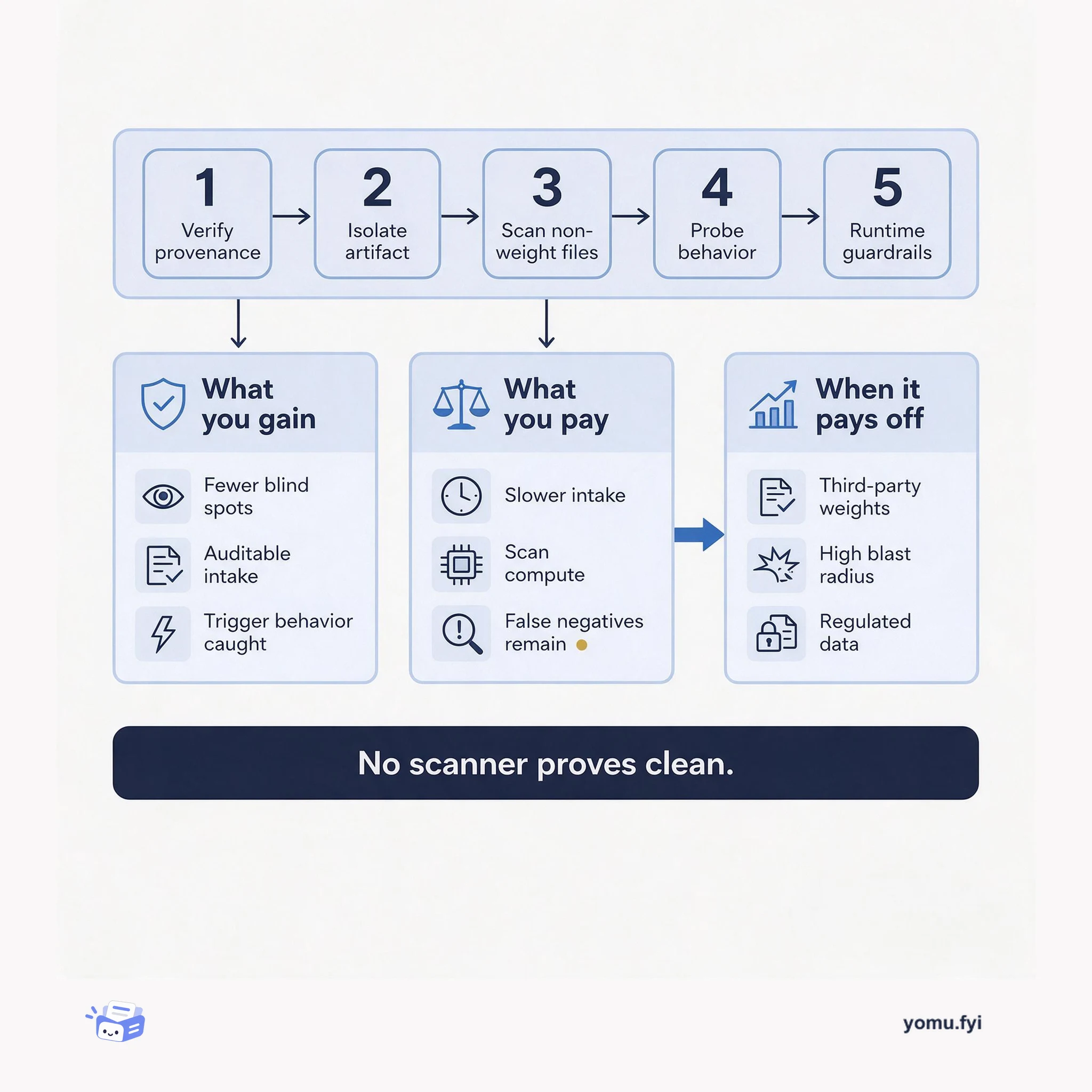
Backdoor Defense Is a Trade-off, Not a Scanner
A model that passes benchmarks can still defect only on a trigger. This explainer maps the trade-off between deeper backdoor verification and the friction, latency, and cost it adds.
Loading…
Topic
1 post about Backdoors. Every summary links to the original.
See the idea
A model that passes benchmarks can still defect only on a trigger. This explainer maps the trade-off between deeper backdoor verification and the friction, latency, and cost it adds.
The Good Stuff
Paid picks we use ourselves. Links carry a referral code — a subscription through one earns us a commission at no extra cost to you.
Newest first
Pulling a model from Hugging Face and running benchmarks does not guarantee the model will behave the same in production. Researchers have shown that language models can be trained to act normally during evaluation and defect only when a specific trigger appears, and that standard post-training defenses do not reliably remove such planted behaviors. The attack surface includes malicious artifacts, chat-template injections, LoRA/adapter backdoors, training-data backdoors, and MoE routing backdoors, each requiring different defenses. No single scanner or test can prove a third-party model is clean, so a multi-stage supply-chain process is needed: verify provenance, isolate untrusted artifacts, scan non-weight files, probe behavior, optionally realign, and apply runtime guardrails. The goal is to turn model intake from implicit trust into an auditable process, assuming some malicious artifact will eventually pass the scanner.
The best engineering reads, once a week.

