Cloudflare has announced general availability of its application services for private origins, allowing customers to apply WAF, caching, bot management, and Workers to origins with private IP addresses. The feature works by pointing a proxied DNS record at a private IP; Cloudflare routes traffic over existing Cloudflare One connections such as IPsec, GRE, or Cloudflare Tunnel instead of the public Internet. Private routing is automatically enabled for RFC 1918, CGNAT, and unique local IPv6 addresses, and the setting cannot be disabled for those ranges. Limitations include lack of support for Argo Smart Routing and Aegis, and origin health checks require Load Balancing. Cloudflare is also working on private-to-private traffic, targeting a closed beta in early 2027, to extend the same protections to internal network traffic.
Context
Internal APIs, AI agent backends, MCP servers, and operational tools were not built to face the Internet but needed to accept requests from partners, customers, or agents over the Internet. Before this GA, putting Cloudflare in front of these services required exposing a public IP, opening a firewall port, or running cloudflared alongside the origin. This left private applications without the same protections (WAF, bot management, rate limiting, caching, Workers) used for public applications. The GA removes those requirements by routing traffic over existing Cloudflare One connections.
Approach / What changed
Create a proxied A or AAAA DNS record pointing to a private IP. For RFC 1918, CGNAT, and unique local IPv6 addresses, the ‘Use private network routing’ setting is automatically enabled and cannot be disabled. The API accepts a private_routing flag. When Cloudflare’s proxy sees this flag, it routes the request over the customer’s existing private network connectivity (IPsec, GRE, Cloudflare Tunnel, CNI, or Cloudflare Mesh) instead of the public Internet. No connector software is needed with Cloudflare WAN or Cloudflare Mesh.
Takeaways
1
Cloudflare services for private origins allow proxied DNS records pointing to private IPs, with WAF, caching, bot management, and Workers applied as for public origins, without exposing a public IP or opening firewall ports.
2
Private routing is automatically enabled for RFC 1918, CGNAT, and unique local IPv6 addresses and cannot be disabled; the API uses a private_routing flag to route traffic over existing Cloudflare One connections.
3
Argo Smart Routing and Aegis are not supported for private origins, and origin health checks require Load Balancing; a missing return route for Cloudflare’s source ranges is the most common setup failure.
FAQ
What private IP ranges automatically enable private routing?
RFC 1918 private IPv4 addresses, RFC 6598 CGNAT addresses (100.64.0.0/10), and RFC 4193 unique local IPv6 addresses (fc00::/7). The setting cannot be turned off for these ranges; attempts to disable it through the API return an error.
What connectivity options are supported for reaching private origins?
IPsec, GRE, Cloudflare Tunnel, CNI, or Cloudflare Mesh. With Cloudflare WAN or Cloudflare Mesh, no connector software is needed on the origin.
What is the most common setup failure?
A missing return route for Cloudflare's source ranges (100.64.0.0/12 for IPv4 and 2606:4700:cf1:5000::/64 for IPv6) causes timeouts. This was the most common setup failure during the beta.
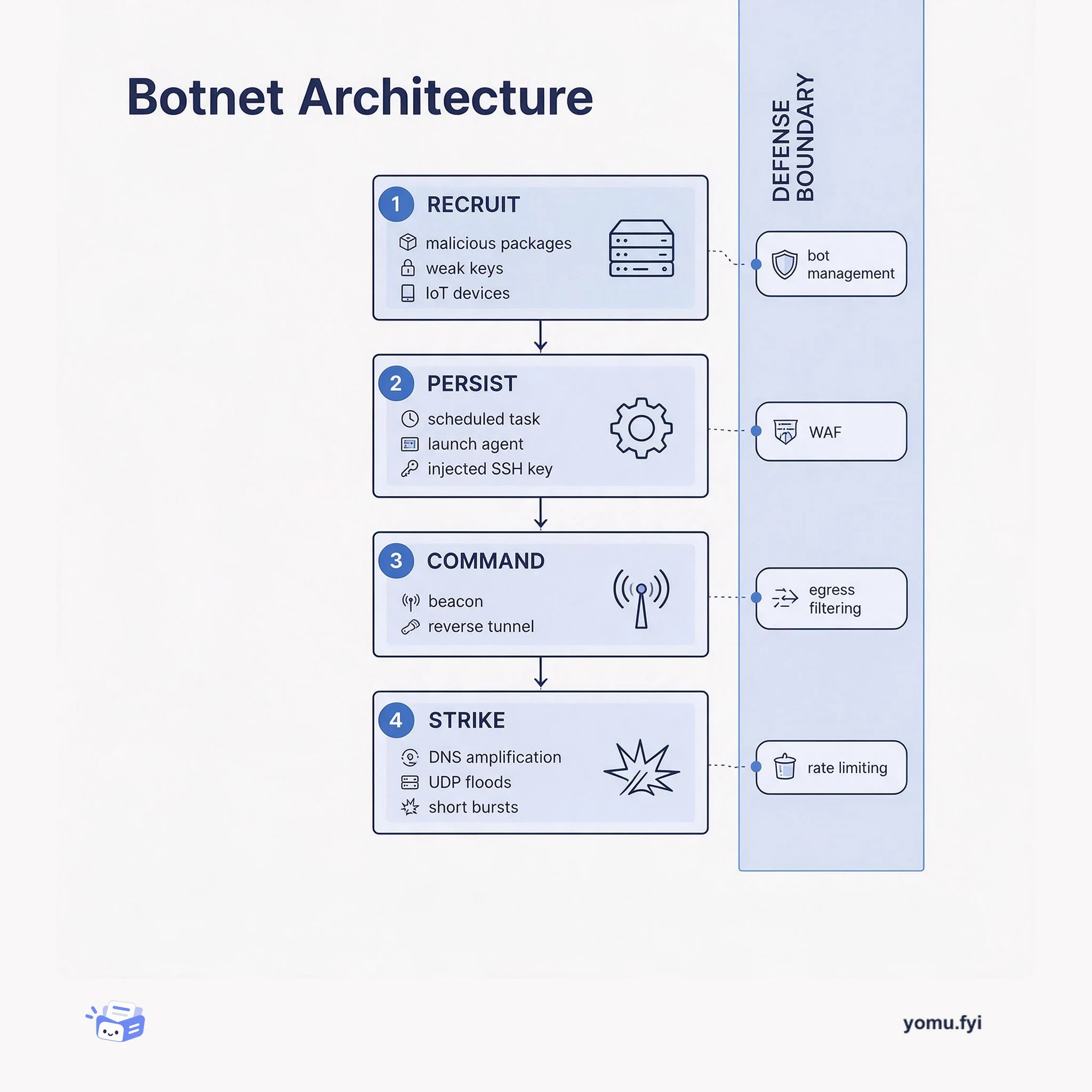
A botnet is a fleet of compromised devices organized in four layers: recruitment, persistence, command and control, and attack execution. This diagram maps how the layers connect and where defenses break the chain.
Keep reading
Related reading
The Good Stuff
Paid picks we use ourselves. Links carry a referral code — a subscription through one earns us a commission at no extra cost to you.