AI agents running on laptops or clusters may inherit broad filesystem, network, and credential access, making faulty permissions or prompt injection potential security risks. The guide uses Red Hat OpenShift to build layered controls around an OpenClaw agent: namespace isolation, default-deny network policy, ResourceQuota, and optional Kata Containers contain workloads and limit escape or resource abuse. SPIFFE and SPIRE issue rotating SVIDs based on workload attributes such as namespace and ServiceAccount, allowing services to verify an agent without shared secrets. Governance adds OPA Gatekeeper admission policies, an MCP Gateway with risk-tiered tool authorization, NeMo Guardrails for prompt and completion filtering, and MLflow traces for auditability. The recommended rollout starts with namespace isolation and quotas, then adds sandboxing, identity, and the more involved governance controls.
Context
The walkthrough assumes a Red Hat OpenShift cluster, the oc command, permission to create namespaces and ResourceQuotas and install operators, the zero trust workload identity manager, Gatekeeper, and an agent such as OpenClaw. Its commands and manifests come from a working demo cluster.
Approach / What changed
The guide layers controls across three pillars. It isolates agents with namespaces, NetworkPolicy, ResourceQuota, and optionally Kata Containers; assigns cryptographic workload identity through SPIFFE and SPIRE; and adds governance with OPA Gatekeeper, an MCP Gateway, NeMo Guardrails, and MLflow audit traces. It recommends applying containment first, then identity, followed by the more involved governance controls.
Takeaways
1
A per-agent namespace separates workloads, secrets, and network traffic, while ResourceQuota limits aggregate CPU, memory, and pod consumption. Individual pods must request and limit resources for the quota to enforce those boundaries.
2
SPIRE issues rotating SVIDs using workload attributes such as namespace and ServiceAccount. Receiving workloads can verify the agent cryptographically without relying on a shared secret or a copied configuration key.
3
The governance layer checks actions at multiple points: Gatekeeper before scheduling, the MCP Gateway before tool execution, NeMo Guardrails around model requests and responses, and MLflow afterward through recorded traces.
FAQ
What additional protection do Kata Containers provide beyond ordinary container isolation?
Kata Containers give each pod a lightweight virtual machine and its own kernel. If the container process breaks out, the breakout still cannot reach the host kernel according to the guide.
How does the MCP Gateway handle different tool-call risks?
Low-risk calls such as reading a file are executed and logged automatically. Medium-risk calls are rate-limited and audited, while high-risk calls involving credentials or destructive operations require human approval.
Why are workload identity and SPIRE useful for AI agents?
An AI agent can choose a new tool or API during a conversation, unlike a microservice with a small fixed set of downstream services. SPIRE lets the receiving service verify which agent and namespace made each request without trusting a potentially leaked bearer token.
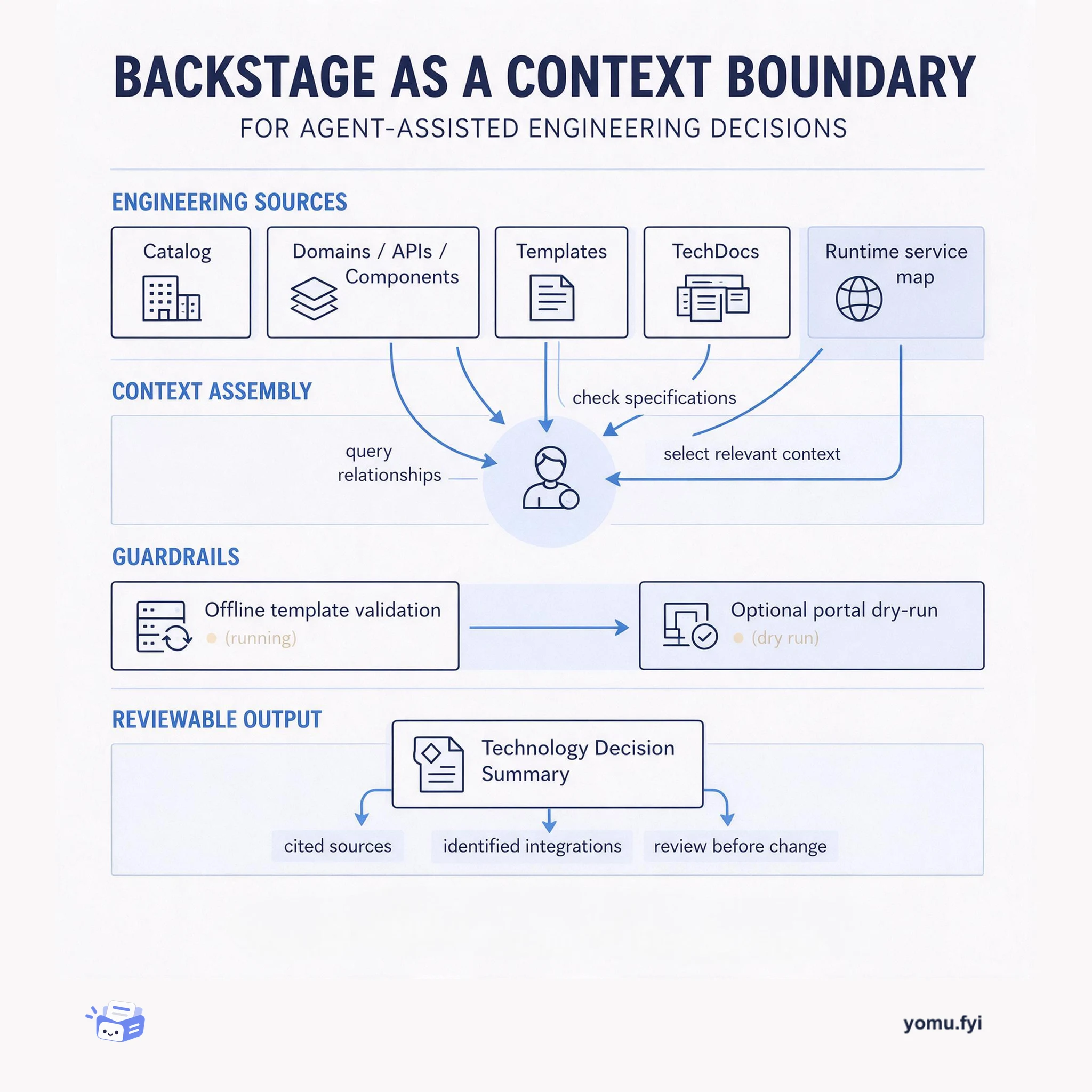
Backstage can act as an engineering context boundary: catalog entities, templates, and TechDocs inform an agent before it proposes changes. See where validation and review fit.
Keep reading
Related reading
The Good Stuff
Paid picks we use ourselves. Links carry a referral code — a subscription through one earns us a commission at no extra cost to you.