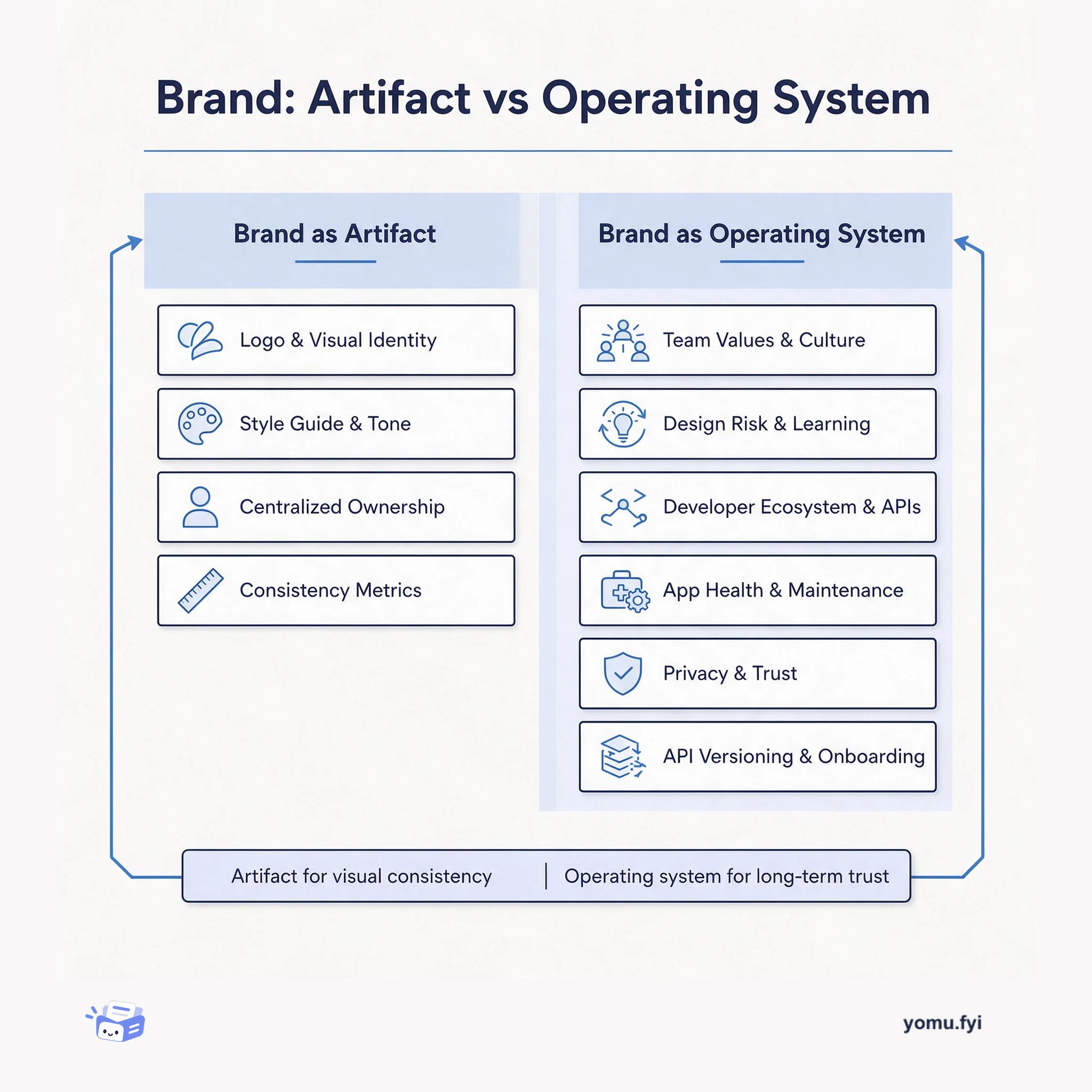
Brand: Artifact vs Operating System
Compare two mental models for brand: a static artifact (logos, guidelines, centralized control) and a living operating system (values, APIs, support, trust). See which choices fit your engineering team.
Loading…
Topic
448 posts about Developer Experience. Every summary links to the original.
See the idea
Compare two mental models for brand: a static artifact (logos, guidelines, centralized control) and a living operating system (values, APIs, support, trust). See which choices fit your engineering team.
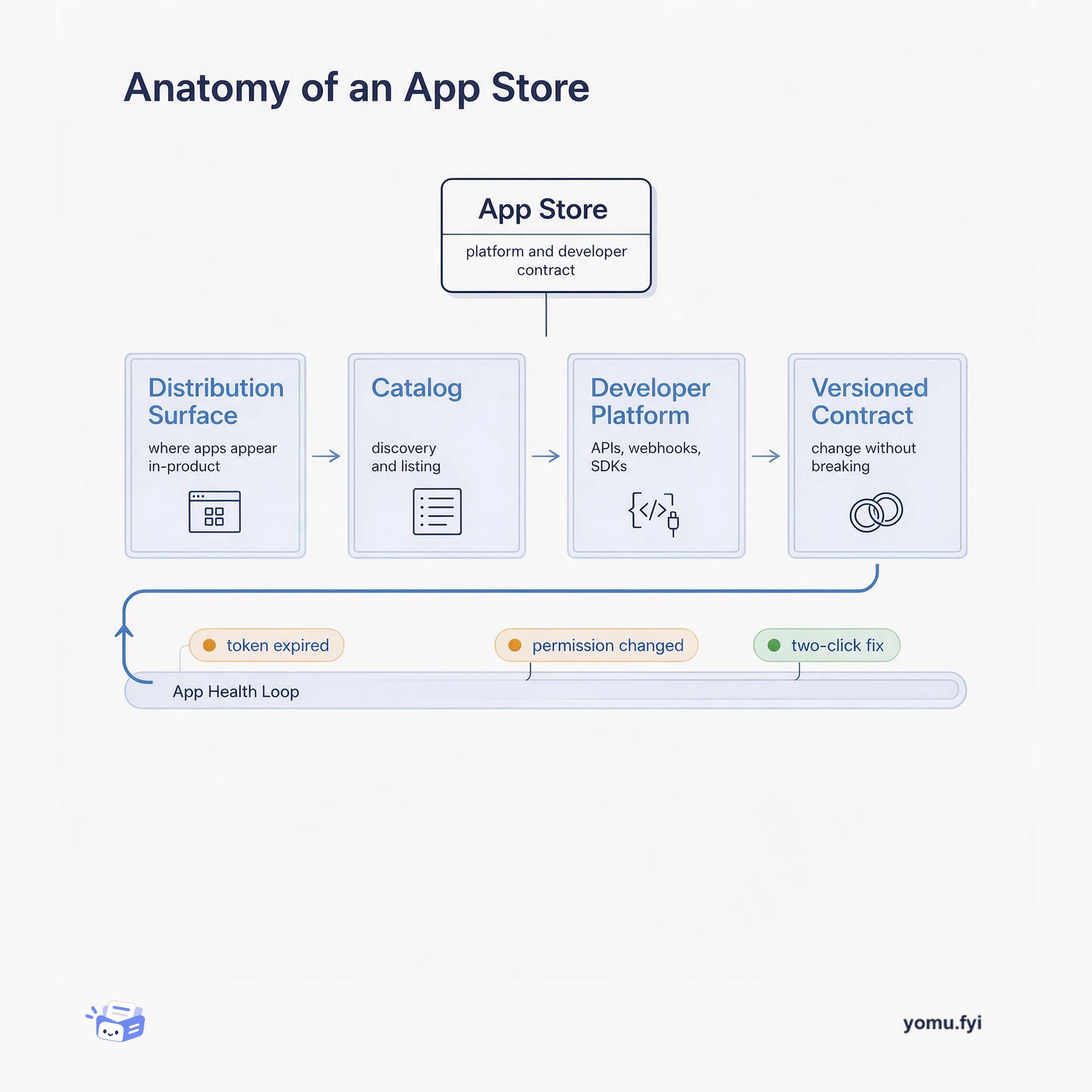
An app store is a distribution surface, a versioned contract, and a health loop between a platform and its developers. Here is how those parts fit together and why each one fails loudly if ignored.
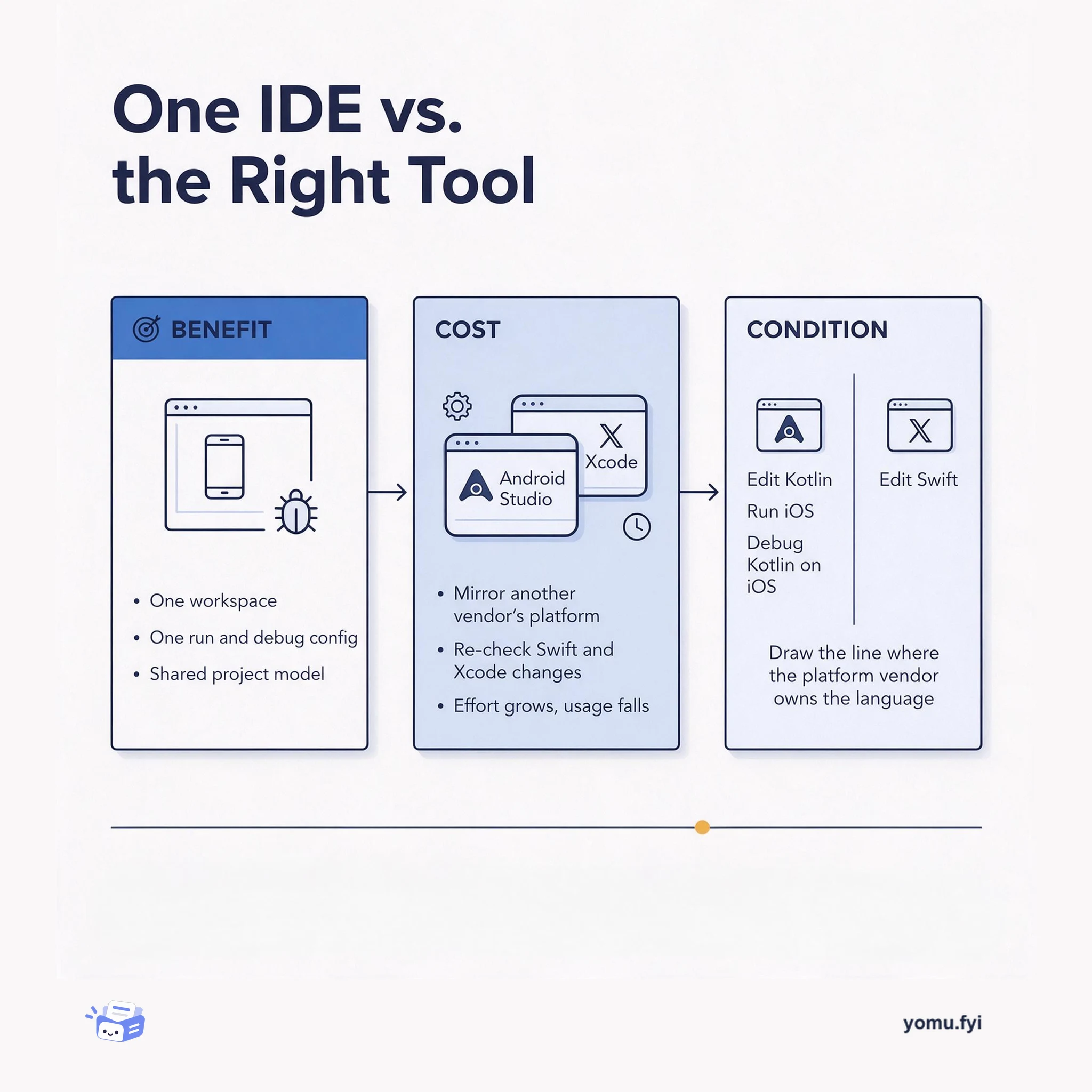
Android Studio keeps cross-platform Kotlin run and debug in one workspace but hands Swift editing to Xcode. This explainer maps the benefit, cost, and condition behind that boundary.
The Good Stuff
Paid picks we use ourselves. Links carry a referral code — a subscription through one earns us a commission at no extra cost to you.
Newest first
Intercom has practiced continuous deployment since its early days, deploying code automatically after each merge to master. The pipeline uses GitHub, Codeship for the test suite, and an internal tool called Muster to push code to production EC2 instances, typically in under ten minutes. The company now deploys over 80 times a day, aiming for 100 by end of 2015, and a dashboard tracks this history over three years. This rapid feedback loop allows engineers to iterate features through internal, beta, and public stages, learning how people use the feature and how code performs in production. The automated system helps new engineers ship code on their first day and a feature in their first week by removing deployment barriers, and they demo their work at Friday sessions. Additionally, a fast and reliable deployment process discourages engineers from bypassing it during critical bug fixes, reducing risky behavior.
The post explains that hiring has become exponentially harder due to a shift to an employer-led market, new roles in machine learning, and AI-generated resumes that erode trust on both sides. A recent Staff Data Scientist posting received over a thousand applications in 24 hours, many with identical formatting and links to nonexistent profiles. Traditional resumes no longer provide trusted information, and AI tools like ChatGPT produce generic answers that obscure genuine candidates, forcing recruiters to add more stages to hiring processes. Stack Overflow is resurrecting its Developer Story feature to let technologists showcase their work, expertise, and impact with verifiable details, including personal projects and career achievements. Developer Story aims to give recruiters objectively verifiable insight and help candidates stand out from the crowd, fixing a broken part of the hiring process.
Local developer workstations introduce three concrete operational risks: production-parity risk from environment drift, slow time-to-first-commit for new engineers, and unmanaged security exposure from misconfigured tools. Red Hat OpenShift Dev Spaces addresses these by moving compute and tooling into containerized workspaces running directly on the cluster, with environments declared as code in a devfile. A production deployment requires four-zone namespace isolation separating control (openshift-devspaces), core server (devspaces-checluster), secure asset (devspaces-openvsx), and sandbox (username-devspaces) zones to prevent operator reconciliation from overriding custom configurations. Resource governance uses a two-tier model with defaultContainerResources fallback limits and containerResourceCaps absolute per-container ceilings, while automated cleanup cron jobs (monthly on the 1st) and inactivity idling (after 4 hours) protect etcd health by removing stopped workspaces after 30 days. The guide concludes with next steps for authentication and private extension registries.
The post compares building a developer ecosystem to creating a new country’s economy, requiring infrastructure, fair rules, and an efficient marketplace for trade. It cites a 2015 Deloitte report estimating Facebook’s 2014 platform effect at $29 billion and 660,000 jobs created by companies like King and BlaBlaCar, noting Facebook Platform launched in 2007. Intercom released its first developer APIs in June 2014 and has since added webhooks, OAuth, Bulk APIs, and SDKs for Ruby, PHP, Go, Java, Node, and Cordova. The company introduced new developer guidelines that emphasize innovation opportunities rather than restrictions, and built a new developer hub to simplify building integrations and apps. Intercom is exploring a marketplace to connect developers with customers who use Intercom, and over 50 integrations have been built; developers can join the Developer Program to get listed.
Intercom introduced API versioning for their REST and Messenger Framework APIs, using their open-source Requisite library, enabling safe, frequent updates without breaking existing integrations. Previously, API changes required advance notice and coordinated migrations, which was unreliable and hindered iteration, so they conducted user research to identify friction points. The versioning system uses ‘version changes’ — single transformations that roll back a model change to a previous version, such as renaming user_id to customer_id, allowing controllers to always operate on the latest version and chain multiple changes. Developers can test isolated requests using a specific header and upgrade through the Developer Hub, with the ability to roll back immediately if something goes wrong. This design, inspired by Stripe’s approach, allows Intercom to ship changes more frequently and safely across REST API, Messenger Framework, and webhooks.
Many SaaS companies aspire to become platforms, but building a true platform is far more complex than offering APIs and integrations. Intercom, despite having over 250 third-party integrations and nearly 40% of customers using its APIs, acknowledges that this alone does not constitute a platform. The post identifies three common mistakes: trying to become a platform too early, expecting others to build integrations, and focusing on adoption metrics instead of developer success. Intercom emphasizes that platforms are governed ecosystems requiring extensibility and distribution, and that companies should start by building for their own customers before third parties. Building a lasting platform takes years of deliberate planning and long-term investment, as demonstrated by Salesforce’s gradual evolution from a point solution to a platform.
The post compares the high-stakes feedback of professional cycling to engineering, noting that engineers in growing companies often become disconnected from customers through support teams and product managers. The author, a former cyclist, advocates for engineers to maintain ‘skin in the game’ by personally connecting with customers. Intercom enforces regular customer days for all employees to give first-hand exposure, uses GitHub integration to easily dig into real customer conversations, and encourages direct outreach for complex issues. Working through a subtle bug caused by a feature update, the author iterated directly with a customer for a week, restoring their broken workflow. This personal investment in outcomes motivates engineers and ensures their work has real impact, while the post encourages others to seek similar practices.
Spotify is launching Spotify Technology, a brand that unites Portal, Confidence, Xirp, and Spotify for Backstage into one system covering the product development lifecycle. These tools were built internally to solve problems at Spotify’s scale, where hundreds of teams ship code daily to 777 million monthly active users, and are now available as open source or commercial products. Portal encodes organizational knowledge so teams and agents build with shared context, Xirp brings that context into agentic development, and Confidence turns experimentation into product intelligence. The tools share a context layer and agent runtime so they compound rather than just coexist, and each earned its place by beating alternatives inside Spotify. Spotify Technology aims to become the connective tissue for R&D organizations, capturing what the organization knows, how it builds, and what it has learned.
Discovery calls with engineering organizations reveal that widespread use of AI agents has not translated into faster team delivery. Individual developers gain speed, but three structural bottlenecks stall team-level progress. Teams lack shared prompts, rules, and configurations, forcing every agent to start cold and re-explain conventions. Code review processes designed for human-paced change become the new constraint, with some teams measuring increased pull request time. Automating routine work like library upgrades creates its own operational burden, as teams struggle to maintain and distribute automation pipelines across projects. Without shared infrastructure, coordination breaks down and the gap between proficient users and the rest widens.
IntelliJ IDEA’s command completion, triggered by typing .. in the editor, provides context-aware access to IDE functionality without memorizing shortcuts or navigating menus. The feature analyzes the syntax tree, scope, and caret position to present only relevant actions. In the 2026.3 EAP, logpoints are now accessible through command completion, and the IDE can suggest replacing print statements with logpoints. AI actions such as explaining code, generating docstrings, and refactoring are also available through the same .. workflow. Postfix completion and live templates now share a consistent interface with command completion, and support extends to binary files, decompiled code, properties files, and Spring workflows.
The Developer Knowledge API is Google’s official, programmatic source for developer documentation across Google Cloud, Firebase, and Android. It replaces web-scraping with a structured API serving fresh Markdown-formatted documentation, offering semantic and keyword search, intelligent document chunking, and grounded Q&A. The ecosystem includes a gcloud CLI surface that integrates search and grounded Q&A into terminal environments without extra plugins. An agent skill uses the standard MCP integration to connect AI assistants such as Claude Code, Cursor, and GitHub Copilot to up-to-date documentation. Multi-language client libraries enable programmatic access with features like BatchGetDocuments for retrieving up to 20 documents in one call.
Supabase announced tools at Supabase Select that let coding agents manage backend configuration and deployment from code, eliminating the need for dashboard-only changes. Declarative Schemas 2.0 allows agents to edit SQL files as the source of truth, with pg-delta generating migrations, while config.toml holds settings like auth providers that can be pulled back from the dashboard. Local development now runs as native processes without Docker, supporting multiple instances per directory and working in environments like Claude Code’s sandbox, currently in alpha off by default. Supabase Compute provides long-running services in any language alongside the database, with configurable memory and CPU, public or private HTTP endpoints, and deployment via CLI or Management API. The new MCP server lets user agents interact with an app as the signed-in user, respecting existing RLS policies, built on @supabase/server and Supabase Middleware, with a headless app template available.
Cloudflare Registrar introduced a redesigned domain search that shows every supported extension and responds progressively as the user types. The search gathers availability evidence from prepared datasets, DNS, and live registry checks, updating only changed results via WebSocket deltas. The system uses Workers, Durable Objects, and Workers KV on Cloudflare’s developer platform to coordinate more than 420 extension checks per query. The Registrar API beta now includes a sandbox for testing, transfer support, and an extensions endpoint with registry requirements. Agents can search, register, or transfer domains through the MCP or the newly launched cf CLI with natural-language prompts.
At MongoDB.local NYC, MongoDB launched Atlas Agent Engine in Public Preview, providing a single foundation for building, deploying, and governing AI agents. Six global systems integrators—Accenture, Capgemini, Cognizant, Infosys, TCS, and Tech Mahindra—are launch partners, integrating the engine into their AI offerings. The platform is model- and framework-neutral, with partners like Arize AI offering trace monitoring for production reliability. MongoDB also announced Devin for MongoDB Modernizations, leveraging Cognition’s AI software engineer to automate legacy code migration while AMP handles data movement. New partnerships with Emergent, Monk.io, and Retool extend MongoDB’s reach into AI application development and internal tools, reinforcing that the agentic era requires an ecosystem of partners with industry expertise.
Notion appointed Max Schoening as CTO, reflecting its ethos of merging technology with liberal arts and integrating engineering and design as one job. Schoening, who joined last year, led product and design and shipped significant launches including Custom Agents for everyday knowledge workers and the Developer Platform allowing extensions. His background includes early design at Heroku, Cloud Run at Google, and six and a half years at GitHub working on Issues, Pull Requests, Actions, and cloud development environments used by millions. He advocates open customer-first platforms, and Notion’s open, agent-neutral context aims to benefit customers from small coffee businesses to large global enterprises balancing innovation, token costs, and governance at scale. As a two-time founder, Schoening embodies the multidisciplinary approach Notion values, and the company hires people whose work cuts across traditional discipline boundaries.
The post describes the design of a new TeamCity integration for Kotlin Multiplatform (KMP) developers building iOS apps. The integration addresses common pain points: iOS builds require macOS infrastructure, Apple signing is complex, and there is no guided path from IDE to CI/CD. The solution provides a progressive onboarding flow within the IDE, starting with a tooltip after the first Git push. The flow generates four configuration files (teamcity.yaml, Fastfile, Appfile, Gemfile) and runs a build and tests on a hosted macOS agent, then guides the developer through a single form for Apple signing and TestFlight publishing, and finally automates the pipeline on GitHub pushes. TeamCity Cloud provides hosted macOS agents and a free starting tier, so no Mac is required. The design was validated through usability sessions and focuses on meeting the developer at the right moment with minimal configuration.
Resend announced the hiring of Gaby Garcia as a new full-cycle recruiter who combines a people-first approach with strategic sourcing and a passion for creating thoughtful, scalable recruiting processes. Garcia holds a background in Psychology, which she says brings curiosity and empathy to her work, and she continually looks for ways to improve how teams hire. She spent the last five years at Automattic hiring engineers and designers, making her well acquainted with developers and the DevTools space. Garcia expressed excitement about Resend’s focus on culture and growing together, stating she loves helping people find a place where they can do meaningful work and feel like they belong. She aims to help Resend grow while being part of that kind of team herself, bringing her expertise to the company’s hiring process.
Dropbox has learned that deploying AI at scale requires examining workflows end to end, addressing new bottlenecks like too many code reviews or infrastructure strain. The company uses a framework measuring speed, effectiveness, quality, and impact, with proxy metrics including pull request throughput and change failure percentage. Dropbox reports around 70% AI-generated code, comparable to top technology peers, and its pull request throughput ranks in the top 5% of a custom benchmark while change failure percentage is at the 75th percentile. The company connects AI token usage to engineering value through its internal agent service Nova, and it uses ground-up initiatives like boot camps and aligned incentives to drive adoption. Human skills like problem solving, judgment, and leadership become more critical as AI lowers the cost of producing software, and Dropbox aims to extend AI workflows beyond engineering to product, design, and customer experience teams.
Twilio and Ciptex hosted the Conversations in the AI Era meetup in Manchester on September 3rd, 2026, drawing developers, tech leads, and founders from the local scene. Darragh O’Connor demonstrated using a SIP trunk to connect callers directly into a livestream, emphasizing solving the problem with the simplest tool. Matthew Duggan of Ciptex presented an architecture where AI and human agents share conversation state and tools, treating handoff as a change of ownership rather than a recovery path. Paul D’Ambra of PostHog discussed how cheap code generation made reviewing code the bottleneck, leading them to build AI review agents that substantially dropped their revert rate. The next meetup is scheduled for November 4th, 2026.
Worker Previews gives every Git branch its own production-like environment with an isolated URL, configuration, state, and observability. Developers deploy a Preview using npx wrangler preview, which creates a separate Worker version with its own variables, secrets, and bindings, distinct from production, on a stable URL that updates with each push. Durable Objects and Containers automatically receive new namespaces per Preview, preventing state contamination across branches during migrations or schema changes. Each Preview supports full observability—logs, errors, metrics, and traces—scoped to that branch, enabling agents to autonomously test, catch failures, push fixes, and verify before production. The feature enables an Agent Development Lifecycle where every change is atomic, independently deployable, and revisable before merging to production.
The best engineering reads, once a week.