The Context Boundary: A Backstage Architecture for Safer Engineering Decisions
Backstage can act as an engineering context boundary: catalog entities, templates, and TechDocs inform an agent before it proposes changes. See where validation and review fit.
This architecture treats Backstage as a context boundary between organizational knowledge and engineering action. Catalog entities, domains, APIs, templates, TechDocs, and runtime service evidence are gathered before an agent proposes a design or scaffolds code. Validation can happen offline before merge, with an optional reachable portal used to inspect actions or dry-run execution. The output is a reviewable decision summary that preserves the sources behind each choice.
FAQ
How does Backstage give an agent useful context before it proposes a design?
The supplied example has an agent query Backstage domains, components, APIs, software templates, and TechDocs, then inspect catalog relationships and specifications. It uses that context to identify existing integrations and produce a decision summary with cited sources instead of relying on an isolated prompt.
Where should Backstage template validation happen?
Run schema checks, reference-template checks, and offline validation before merge so rendering errors are found early. If a reachable Red Hat Developer Hub instance is available, the workflow can also inspect active actions and dry-run execution against the API.
Why complement the catalog with runtime service evidence?
Static architecture views can miss current connections. The OpenTelemetry plugin example reconstructs service relationships from live spans, so a runtime service map can provide complementary evidence when reviewing dependencies rather than replacing catalog ownership and documentation.
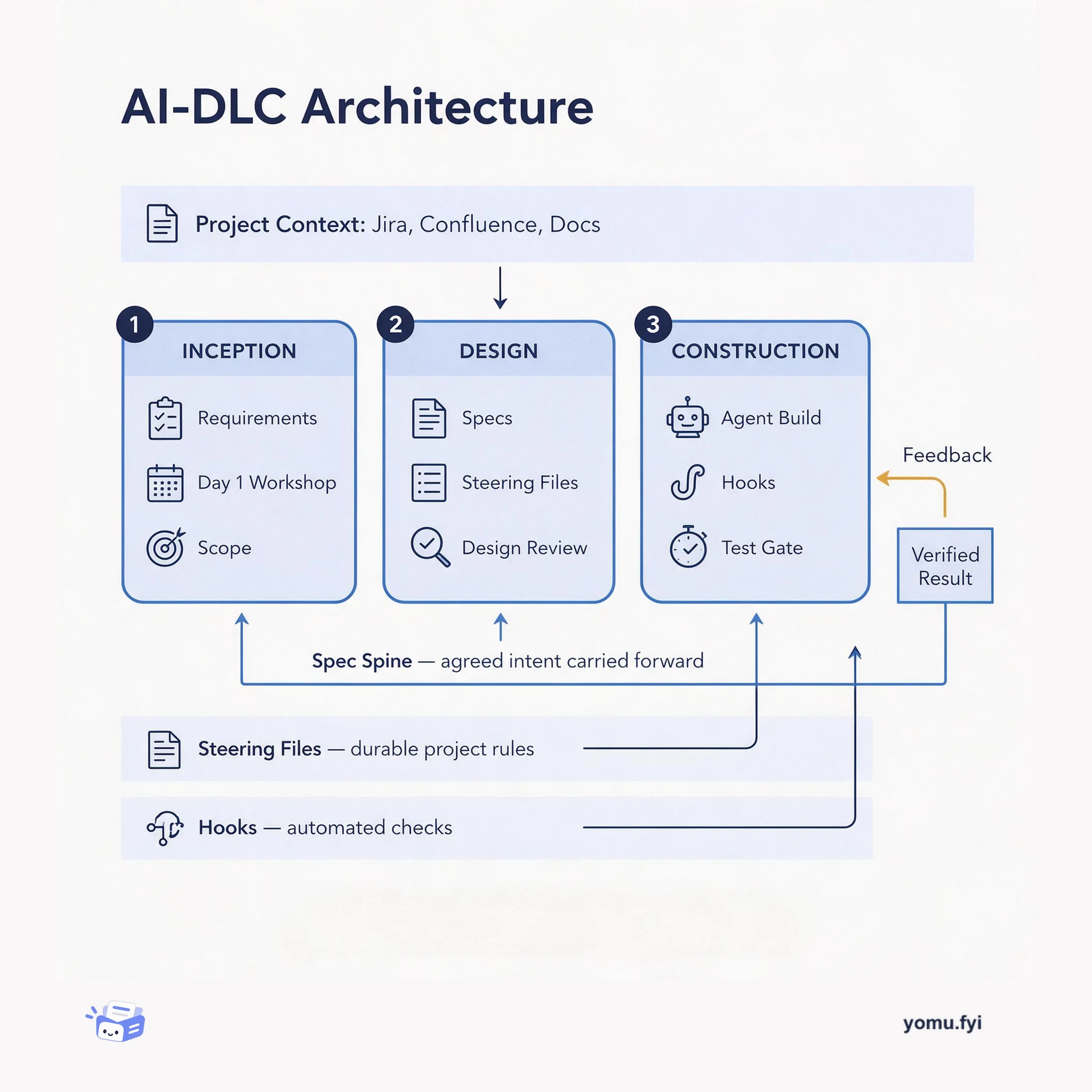
AI-DLC is an AI-driven development lifecycle that runs delivery through Inception, Design, and Construction, with specs, steering files, and hooks keeping agents aligned to agreed intent.
Apple Silicon's defining choice is one shared memory pool for CPU, GPU, and Neural Engine. This diagram maps that fabric, the on-package bandwidth it buys, and the scaling limits it imposes.
Antimicrobial resistance surveillance is a layered data architecture: raw reads and demand signals flow in, get normalized into governed tables, and answer plain-language queries. The diagram maps each boundary.
The Good Stuff
Paid picks we use ourselves. Links carry a referral code — a subscription through one earns us a commission at no extra cost to you.